






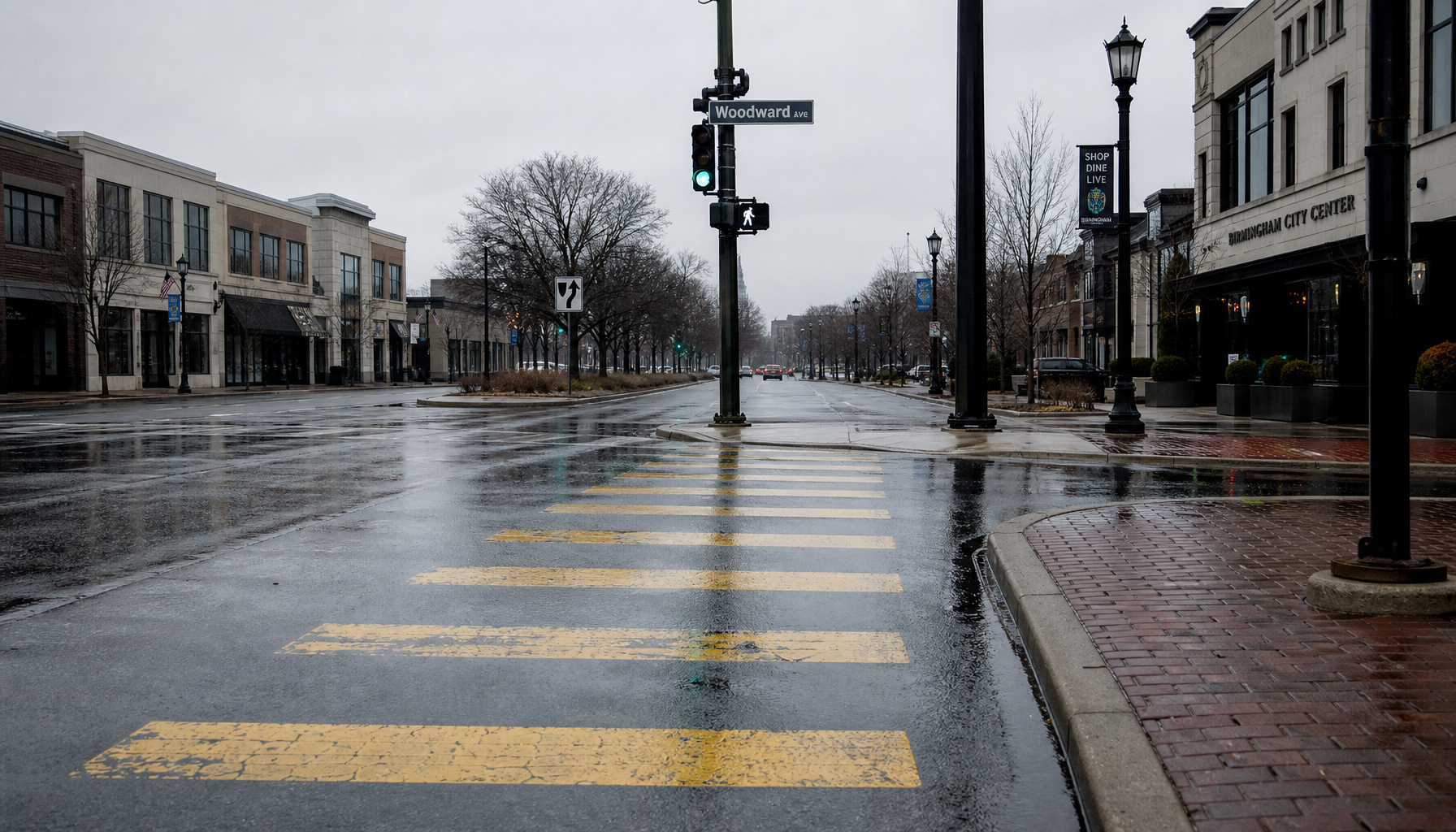
If you were hit by a car in Birmingham, Michigan, you have the right to file a claim for medical bills, lost wages, and — if your injuries are serious enough — pain and suffering. Michigan’s no-fault insurance system covers pedestrians, not just drivers. You don’t need to prove the other driver was at fault to start receiving benefits. But there are deadlines, and the insurance company is already working against you.
Old Woodward Avenue between Maple Road and Brown Street sees some of the heaviest foot traffic in Oakland County. Restaurants, boutiques, the Baldwin Public Library — people are walking those blocks all day and into the evening. And where foot traffic is heavy and parking is tight, drivers are distracted. The Oakland County Sheriff’s Office and Birmingham Police Department both have records of pedestrian crashes in this corridor.
Michigan’s No-Fault System Covers Pedestrians Too
Most people think no-fault insurance is only for people inside vehicles. It isn’t. Under MCL 500.3107, Personal Injury Protection (PIP) benefits are available to pedestrians struck by a motor vehicle — covering reasonable and necessary medical expenses, 85% of lost wages up to the statutory cap, and replacement services for things you can’t do at home while you’re hurt.
You claim PIP through your own auto insurance policy first. If you don’t own a car or have a policy, you move down a priority chain: a resident relative’s policy, then the at-fault driver’s insurer, then the Michigan Assigned Claims Plan.
The immediate steps matter a great deal here. If you haven’t already, read through what to do after a pedestrian accident in Michigan — the sequence you follow in the first 24 to 72 hours can directly affect what you recover.
When Can You Sue the Driver Who Hit You?
PIP pays your bills. It doesn’t compensate you for pain, emotional distress, or the ways your injury changed your daily life. For that, you need to bring a third-party claim against the driver — and Michigan law sets a threshold.
Under MCL 500.3135, you can pursue non-economic damages only if you suffered death, serious impairment of a body function, or permanent serious disfigurement. “Serious impairment” has been litigated extensively in Michigan courts. A fracture, a torn ligament, a herniated disc that limits what you can do — these often qualify. A bruise that healed in a week typically doesn’t.
This is where having an attorney early makes a real difference. The threshold question isn’t always obvious, and insurance adjusters know how to minimize it.
What Counts as a Serious Impairment?
Michigan courts look at whether the injury affects an important body function and whether that effect is objectively manifested — meaning a doctor can document it. Common injuries that meet the threshold after Birmingham pedestrian accidents include:
- Fractures to the leg, hip, pelvis, or arm
- Traumatic brain injuries, including concussion with lasting symptoms
- Spinal injuries — herniated or bulging discs that limit mobility
- Torn ligaments in the knee or shoulder requiring surgery
- Internal organ damage
If you have neck or spine pain after being hit, neck injuries caused by auto accidents explains how Michigan courts treat those claims and why documentation in the first days is so important.
Who Is Legally at Fault in a Birmingham Pedestrian Crash?
Fault in a pedestrian accident is almost never as simple as “the car hit the person.” Michigan uses a modified comparative fault system. If you’re found to be more than 50% at fault for your own injuries, you can’t recover non-economic damages. If you’re partially at fault but under 50%, your damages are reduced proportionally.
Drivers in Birmingham have duties that are easy to document — traffic signal violations, failure to yield at a crosswalk, speeding on Woodward or Maple. But insurance adjusters will look for anything to shift blame: did you cross mid-block? Were you looking at your phone? Were you wearing dark clothing at night?
A deeper look at how fault is assigned in crosswalk situations — and what Michigan law actually says — is covered in who’s at fault when a pedestrian is hit in a crosswalk.
Common Causes of Birmingham Pedestrian Accidents
Birmingham’s walkable downtown is one of its defining features. It’s also the reason pedestrian crash risk is elevated. According to NHTSA crash data, pedestrians account for roughly 17% of all traffic fatalities nationally — and urban commercial corridors like Old Woodward are disproportionately represented.
The causes we see most often in Birmingham-area pedestrian crashes:
- Drivers turning left across pedestrian traffic on Woodward or Maple
- Distracted driving in the restaurant and retail parking areas near Bates and Brown
- Vehicles exiting parking garages without yielding to pedestrians on the sidewalk
- Speeding on residential streets feeding into the downtown grid
- Poor nighttime visibility near outdoor dining areas
Left-turn crashes in Michigan have their own complications — read about how Michigan left-turn accidents are handled when fault is disputed.
The Statute of Limitations — Don’t Miss It
Under MCL 600.5805(2), you have three years from the date of the accident to file a personal injury lawsuit. Three years sounds like a lot of time. It isn’t, once you factor in the investigation, medical records collection, expert review, and negotiation before any lawsuit is filed.
There’s also a separate deadline for PIP claims: you must file written notice with the insurer within one year of the accident, and benefits can only be recovered for losses incurred within one year before you file. Missing this deadline doesn’t just reduce your claim — it can eliminate it.
For a full breakdown of how these timelines interact, how long you have to file a pedestrian accident lawsuit is worth reading before you assume you have time to wait.
What a Birmingham Pedestrian Accident Claim Actually Involves
When someone is hit by a car in Birmingham, two separate legal tracks open up at the same time. Understanding both helps you make decisions without being blindsided.
Track 1: Your PIP Claim
This is a claim against your own insurer (or the at-fault driver’s insurer if you have no policy). It covers:
- All reasonable and necessary medical expenses with no dollar cap under most plans
- 85% of lost income, up to the monthly cap set by statute
- Replacement services — housekeeping, childcare, errands — up to $20 per day
- Attendant care if your injuries require it
Your insurer has 30 days to pay each submitted bill or explain why it won’t. Denials happen constantly, and an attorney can challenge them.
Track 2: Your Third-Party Claim Against the Driver
This is where non-economic damages live — pain, suffering, loss of enjoyment of life. You file against the at-fault driver’s liability insurer. To recover, you must meet the serious impairment threshold described above.
If the driver had no insurance or inadequate coverage, your own uninsured/underinsured motorist (UM/UIM) coverage becomes relevant. Michigan doesn’t require UM/UIM, so not every policy has it — but many do.
What Your Case May Be Worth
There’s no formula that produces a number before the medical picture is clear. What we can tell you is that the value of a pedestrian accident claim in Michigan turns on a few key factors:
- The total cost of past and future medical treatment
- Whether you’ve lost income and for how long
- Whether your injuries meet the threshold for non-economic damages
- The at-fault driver’s insurance limits
- Whether there’s UM/UIM coverage available
- How clearly fault can be established
For a more detailed breakdown of how Michigan injury claims are valued, how much your personal injury case is worth in Michigan explains the factors attorneys and adjusters actually use.
If you’re handling a claim for someone who didn’t survive the crash, the legal framework shifts to wrongful death — a separate claim with its own rules and damages categories.
Steps to Take Right Now If You Were Hit in Birmingham
If you’re reading this in the hours or days after the accident, here’s what to prioritize:
- Get medical care and keep all records — every bill, every diagnosis, every prescription
- Report the accident to Birmingham Police if it wasn’t already reported at the scene
- Write down everything you remember: time, location, what the driver did, what you were doing
- Photograph your injuries, your clothing, the scene if possible
- Do not give a recorded statement to any insurance company before you speak with an attorney
- Notify your auto insurer in writing within one year — sooner is always better
- Contact a pedestrian accident attorney to understand your specific options
You can also read steps to take after an injury for a fuller checklist that applies across injury types.
Frequently Asked Questions
I don’t own a car. Can I still get PIP benefits after being hit in Birmingham?
Yes. If you don’t own a vehicle or have your own auto policy, Michigan law creates a priority order. You check first whether a resident relative has an auto policy — if so, their PIP coverage applies. If not, the at-fault driver’s insurer is next. If the driver had no insurance, the Michigan Assigned Claims Plan is the fallback. An attorney can help identify which insurer to file against.
The driver’s insurance company already called me. Should I talk to them?
No — not before you speak with a lawyer. The at-fault driver’s insurer is not on your side. Recorded statements are used to minimize claims, and adjusters are trained to ask questions that can undercut your case later. You’re not legally required to give one.
What if I was crossing mid-block and not in a crosswalk?
You can still recover. Michigan’s comparative fault rules reduce your damages in proportion to your share of fault, but they don’t eliminate your claim unless you’re found more than 50% responsible. A mid-block crossing doesn’t automatically make you majority at fault — driver speed, attention, and other factors matter too.
My injury doesn’t seem that serious yet. Should I still see a doctor?
Yes, immediately. Some injuries — traumatic brain injuries, internal bleeding, spinal disc damage — don’t produce their worst symptoms right away. A gap in medical treatment also gives insurers an argument that the injury wasn’t serious or wasn’t caused by the accident. Get evaluated, and let the medical record tell the story.
How long will my pedestrian accident case take in Michigan?
It depends. A straightforward PIP claim where liability is clear and injuries resolve within a few months might settle in six to twelve months. Cases involving serious injuries, disputed fault, or uncooperative insurers can take two to three years, including potential litigation. The three-year statute of limitations under MCL 600.5805(2) is the outer boundary — not the target.
Does it matter that Birmingham is a smaller city than Detroit? Will my case be handled in a different court?
Birmingham pedestrian accident cases are typically filed in Oakland County Circuit Court for serious injury claims. District court handles smaller civil matters. The courthouse, the judges, and local court rules all matter — local experience with Oakland County’s courts is something to ask any attorney about before you hire them.
If you were hit by a car in Birmingham or anywhere in Oakland County, talk to us before you sign anything or give a recorded statement. Khamo Law, PLLC offers a free consultation — call 248-466-0606 or message us through the contact form. We serve Birmingham, Troy, Southfield, Sterling Heights, Warren, and the surrounding communities. Our team includes Arabic- and Chaldean-speaking attorneys who can handle your case in your language.