










Losing a family member because of someone else’s negligence can leave a family facing emotional loss, financial uncertainty, and difficult legal questions at the same time.
A Michigan wrongful death lawyer at Khamo Law can help families understand what claims may be available, identify the parties responsible for the death, preserve important evidence, and pursue compensation allowed under Michigan law.
Wrongful death claims may arise from fatal car crashes, truck accidents, motorcycle collisions, pedestrian and bicycle accidents, dangerous property conditions, and other incidents caused by negligence or wrongful conduct.
If your family has lost a loved one because of someone else’s actions, call Khamo Law at (248) 466-0606 or contact us online for a free consultation.
For families seeking local information, Khamo Law also provides dedicated wrongful death resources for Troy, Sterling Heights, Warren, Detroit, Clinton Township, and Southfield.
What Is a Wrongful Death Claim in Michigan?
Michigan’s Wrongful Death Act allows a legal claim when a person’s death results from a wrongful act, neglect, or fault that would have entitled the injured person to pursue damages if death had not occurred. Michigan law provides that the action is brought by the personal representative of the deceased person’s estate.
A wrongful death case is a civil claim. Its purpose is to address the losses resulting from the death and hold legally responsible parties accountable.
Whether a wrongful death claim exists depends on what caused the death, the conduct of the responsible party, available evidence, and other circumstances surrounding the incident.
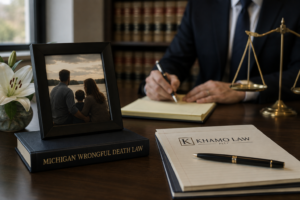
Khamo Law helps Michigan families understand their legal options after losing a loved one because of another party’s negligence.
Who Can File a Wrongful Death Lawsuit in Michigan?
Michigan wrongful death lawsuits are generally brought in the name of the personal representative of the deceased person’s estate rather than being filed independently by individual family members.
The personal representative is responsible for pursuing the claim on behalf of the estate and the people who may be entitled to receive damages under the Wrongful Death Act.
Because probate and wrongful-death issues can overlap, determining who has authority to act for the estate can be an important early step in the case.
Who May Receive Compensation After a Wrongful Death?
Michigan’s wrongful-death law provides a process for identifying people who may be entitled to damages resulting from the death.
The specific people entitled to participate can depend on the deceased person’s family relationships and the circumstances of the estate.
This is one reason wrongful-death cases involve more than proving negligence. The case must also properly address the estate, potential beneficiaries, damages, and the distribution process required by Michigan law.
Fatal Car Accidents in Michigan
Motor vehicle collisions are a common source of wrongful-death claims.
A fatal crash may result from:
- Distracted driving
- Drunk or drugged driving
- Excessive speed
- Failure to yield
- Running a red light or stop sign
- Reckless driving
- Unsafe lane changes
- Following too closely
- Other negligent driving
Our Michigan car accident attorneys can investigate the collision, insurance coverage, evidence of fault, and potential wrongful-death claims.
Fatal Truck Accidents
Commercial truck crashes can involve particularly serious injuries because of the size and weight of tractor-trailers and other large commercial vehicles.
Potentially responsible parties may include:
- The truck driver
- A trucking company
- A vehicle owner
- A maintenance contractor
- A freight or loading company
- Another negligent motorist
Truck cases may involve driver records, electronic logging data, inspection records, vehicle maintenance information, company policies, and other evidence that should be preserved as early as possible.
Learn more from our Michigan truck accident attorneys.
Fatal Motorcycle, Pedestrian, and Bicycle Accidents
People outside enclosed passenger vehicles have very little protection when struck by a motor vehicle.
Wrongful-death claims can result from fatal:
- Motorcycle accidents
- Pedestrian collisions
- Bicycle crashes
- Crosswalk accidents
- Intersection collisions
- Hit-and-run crashes
Families dealing with a fatal pedestrian collision can learn more from our Michigan pedestrian accident attorneys.
For bicycle crashes, see our Michigan bicycle accident lawyer page.
Fatal Slip and Fall and Premises Liability Incidents
Property owners and other parties responsible for property may be liable when a dangerous condition causes a fatal injury and Michigan law imposes responsibility for that condition.
Depending on the facts, cases may involve:
- Dangerous stairs
- Unsafe walkways
- Falls from heights
- Defective railings
- Hazardous flooring
- Poorly maintained property
- Other dangerous premises conditions
Premises-liability law is highly dependent on the specific condition, the property, and the defendant’s conduct.
See our Michigan slip and fall lawyer page and our guide to premises liability laws in Michigan for more information.
How Do You Prove a Michigan Wrongful Death Case?
A wrongful death claim generally requires establishing the legal responsibility of the person or organization whose conduct caused the death.
In a negligence case, that may involve showing that:
- The defendant owed a legal duty.
- The defendant failed to act as required under the circumstances.
- That failure caused the fatal injury.
- The death resulted in legally compensable losses.
The precise legal requirements depend on the type of accident and claim.
A motor vehicle case, for example, may involve different legal and insurance issues than a dangerous-property claim.
Evidence Used in a Wrongful Death Claim
Strong evidence can be critical in determining how the incident happened and who was responsible.
Depending on the case, evidence may include:
- Police reports
- Accident reports
- Photographs
- Surveillance footage
- Dash-camera video
- Witness statements
- Vehicle data
- Cellphone records
- Medical records
- Autopsy or medical examiner records
- Employment and income records
- Insurance policies
- Business records
- Maintenance records
- Expert analysis
Some evidence can disappear or be overwritten quickly.
A lawyer may take steps to preserve evidence and obtain records before they are lost.
What Damages May Be Available in a Michigan Wrongful Death Case?
Michigan’s Wrongful Death Act permits recovery of damages considered fair and equitable under the circumstances and specifically addresses categories including reasonable medical, hospital, funeral and burial expenses, conscious pain and suffering experienced before death, loss of financial support, and loss of society and companionship.
Potential damages therefore may include:
- Medical expenses resulting from the fatal injury
- Funeral expenses
- Burial expenses
- Conscious pain and suffering before death
- Loss of financial support
- Loss of society and companionship
- Other damages permitted under Michigan law
The damages available in any particular case depend on the evidence and circumstances.
Loss of Financial Support
A person’s death can create significant financial consequences for a spouse, children, or other dependents.
Evaluating loss of financial support may involve examining:
- Earnings before death
- Employment history
- Expected future earnings
- Benefits
- Age and work history
- Financial contributions to the household
- Other economic circumstances
In appropriate cases, financial or vocational professionals may assist in evaluating future losses.
Loss of Society and Companionship
Michigan wrongful-death law expressly recognizes loss of society and companionship as a potentially compensable loss.
This category addresses the personal relationship lost because of the death.
Evidence may include testimony and information regarding the relationship between the deceased person and surviving family members.
Unlike a medical bill or lost paycheck, this type of loss cannot be reduced to a simple mathematical formula.
Conscious Pain and Suffering Before Death
When a person survives for some period after sustaining a fatal injury, evidence may establish that the person experienced conscious pain and suffering before death.
Michigan’s wrongful-death framework permits compensation for conscious pain and suffering when supported by the facts.
Relevant evidence may include:
- Medical records
- Emergency treatment records
- Witness observations
- Statements made by the injured person
- Medical testimony
- The nature and duration of the injuries
These issues are highly fact-specific.
What If the Death Resulted From a Serious Brain or Spinal Injury?
Some fatal accidents initially result in catastrophic neurological injuries before the injured person dies.
These cases may require detailed review of hospitalization, neurological treatment, rehabilitation, life support, and the person’s condition between the accident and death.
For more information about these injuries, see our Michigan traumatic brain injury lawyer and Michigan spinal cord injury lawyer pages.
What If More Than One Party Caused the Death?
Some fatal accidents involve multiple responsible parties.
For example, a collision could involve:
- Two negligent drivers
- A commercial driver and trucking company
- A vehicle owner and driver
- A business and contractor
- Multiple companies involved in the same incident
Identifying every potentially liable party can be important because different defendants may have different insurance policies, legal responsibilities, and available evidence.
What If the Person Who Died Was Partially at Fault?
Michigan comparative-fault rules can affect certain damages when the deceased person shared responsibility for the incident.
The effect of comparative fault varies depending on the type of case and damages involved.
A lawyer evaluating the claim should examine the available evidence instead of accepting an insurance company’s initial allocation of fault.
How Long Do You Have to File a Wrongful Death Lawsuit in Michigan?
Michigan generally uses a three-year limitations period for actions seeking damages for the death of a person, although the applicable deadline can depend on the underlying legal claim and other circumstances.
That does not mean every wrongful-death matter should be treated as having one universal three-year deadline.
Claims involving governmental entities, insurance benefits, particular defendants, or other special circumstances can involve separate notice requirements or time limits.
Families should determine the applicable deadline based on the specific facts rather than waiting until the general limitations period is close to expiring.
Why Acting Quickly Can Matter
Even when the formal filing deadline has not approached, waiting can make a wrongful-death case harder to investigate.
Over time:
- Surveillance footage may be deleted
- Vehicles may be repaired or destroyed
- Witness memories may fade
- Electronic information may disappear
- Businesses may dispose of records
- Accident scenes may change
Early investigation gives attorneys a better opportunity to identify and preserve evidence.
How Khamo Law Investigates a Wrongful Death Case
Wrongful-death cases require careful attention to both liability and the extent of the family’s losses.
Depending on the case, Khamo Law may:
- Investigate how the fatal incident occurred
- Obtain police and accident reports
- Identify witnesses
- Preserve photographs and video
- Review medical records
- Identify potentially responsible parties
- Review available insurance policies
- Gather employment and financial information
- Work with qualified experts when appropriate
- Communicate with insurance companies
- Prepare the case for litigation when necessary
The goal is to understand both why the death occurred and the full consequences of that loss.
Why Choose Khamo Law for a Michigan Wrongful Death Case?
Wrongful-death cases can be legally complex and emotionally difficult for families.
For families seeking local information, Khamo Law also provides dedicated wrongful death resources for Troy, Sterling Heights, Warren, Detroit, Clinton Township, and Southfield.
Our firm handles these cases on a contingency-fee basis, meaning attorney fees are tied to the recovery obtained rather than charged upfront.
We can handle communications with insurance companies and opposing parties while the family focuses on personal and family matters following the loss.
Frequently Asked Questions About Michigan Wrongful Death Claims
Who actually files a wrongful death lawsuit in Michigan?
The action is generally brought by the personal representative of the deceased person’s estate.
Does a spouse automatically file the lawsuit?
Not necessarily. A surviving spouse may have an interest in the wrongful-death recovery, but Michigan law provides for the action to be brought by the estate’s personal representative.
Can children recover damages after a parent’s wrongful death?
Depending on the circumstances, surviving family members may be entitled to damages recognized under Michigan’s Wrongful Death Act, including qualifying losses such as society, companionship, and financial support.
Can parents bring a claim after losing a child?
Michigan wrongful-death law provides a process through the estate for claims arising from a wrongful death. The particular people entitled to damages and the available damages depend on the family relationships and circumstances.
Can a wrongful death case settle without going to trial?
Yes. Many civil cases resolve through negotiated settlements. If a fair resolution cannot be reached, litigation may be necessary.
What happens if criminal charges are also filed?
A criminal prosecution and a civil wrongful-death claim are separate proceedings. Criminal charges do not automatically compensate the family for all civil losses, and the outcome of one proceeding does not necessarily determine every issue in the other.
How much is a Michigan wrongful death case worth?
There is no standard amount. Relevant factors can include the circumstances of the death, medical expenses, conscious pain and suffering, lost financial support, family relationships, insurance coverage, liability, and other evidence.
How much does a Michigan wrongful death lawyer cost?
Khamo Law handles personal injury and wrongful-death cases on a contingency-fee basis, so attorney fees are generally tied to the recovery obtained rather than paid upfront.
Michigan Wrongful Death Lawyers Serving Families Statewide
Khamo Law represents families in wrongful-death cases throughout Michigan.
Our related statewide practice areas include Michigan car accidents, Michigan truck accidents, Michigan pedestrian accidents, Michigan bicycle accidents, Michigan slip and fall accidents, traumatic brain injuries, and spinal cord injuries.
Khamo Law also provides local wrongful-death resources for Troy, Sterling Heights, Warren, Detroit, and Clinton Township.
Contact a Michigan Wrongful Death Lawyer
If your family lost a loved one because of another person’s negligence or wrongful conduct, Khamo Law can review the circumstances and explain the legal options that may be available.
Call (248) 466-0606 or contact Khamo Law online for a free consultation.
Legally reviewed by Attorney Koro E. Khamo
Attorney at Khamo Law, PLLC