


If you slipped and fell on someone else’s property in Birmingham, Michigan, the owner may owe you compensation — but only if they knew about the hazard (or should have known) and failed to fix it. Michigan gives you three years to file a lawsuit under MCL 600.5805(2), and a recent shift in state law has made it significantly easier to recover damages even when a hazard was visible. Here’s what you need to know before you talk to an insurance adjuster.
Birmingham’s Woodward Corridor and Why Slip and Fall Claims Are Common Here
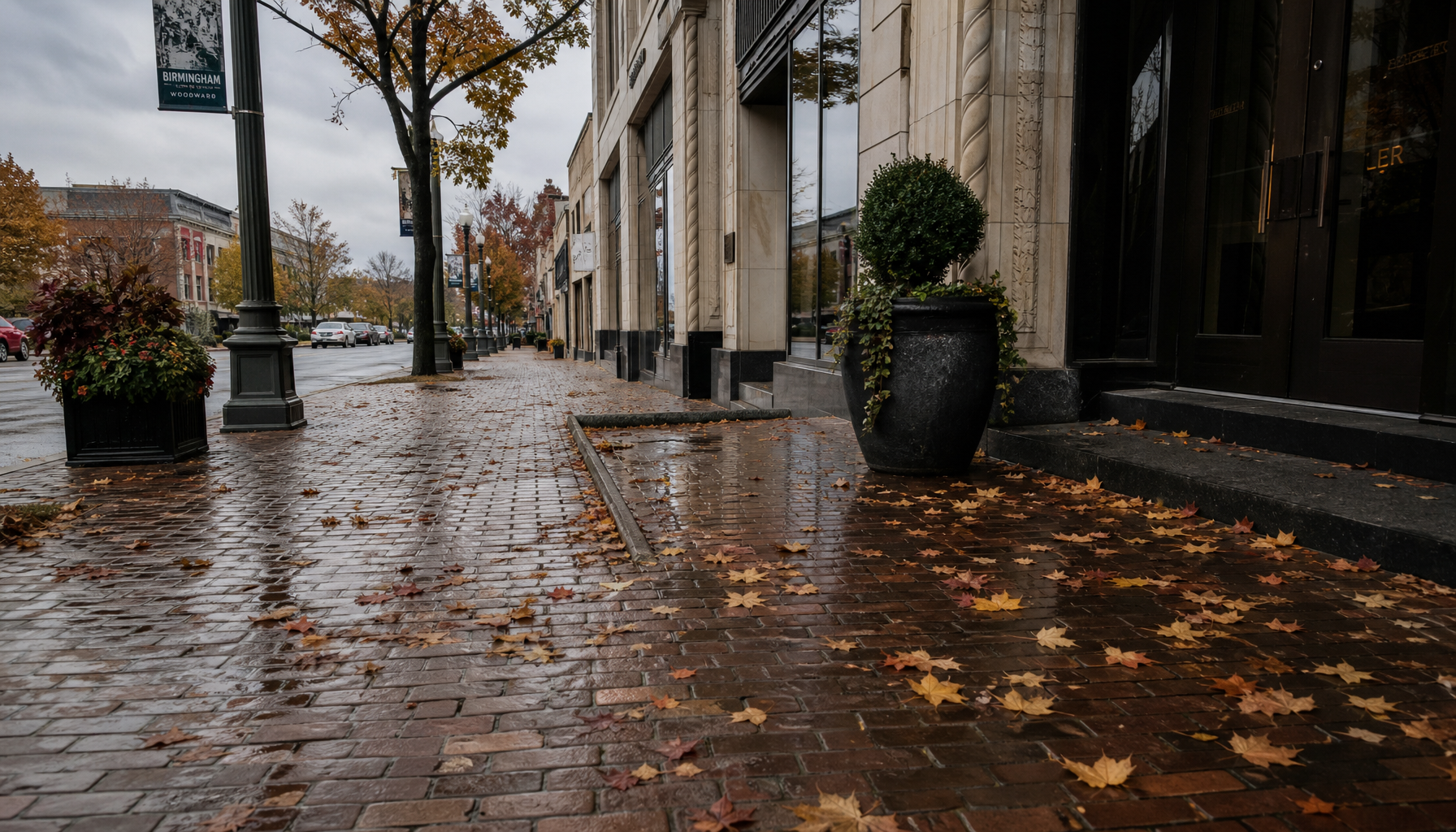
Birmingham’s retail and dining strip along Woodward Avenue — from Maple Road south toward the railroad tracks — packs hundreds of storefronts, restaurants, and boutiques into a walkable area that draws foot traffic year-round. That density is exactly what makes the area a genuine premises liability hotspot. Wet tile in a restaurant entryway, an icy sidewalk in front of a boutique, a broken step outside a bar on Old Woodward Avenue — these are not hypothetical scenarios. They happen, and when they do, the injuries can be serious.
According to the CDC’s injury data, falls are the leading cause of nonfatal emergency room visits in the United States. In Michigan alone, tens of thousands of people are treated in emergency rooms each year for fall-related injuries. The Woodward corridor’s combination of historic architecture, uneven pavement, high winter foot traffic, and active restaurant and bar scene creates real risk for pedestrians, diners, and shoppers alike.
What Michigan Law Requires of Property Owners
Property owners in Michigan have a legal duty to keep their premises reasonably safe for visitors. That duty comes from both common law and, for residential rental properties, from MCL 554.139, which requires landlords to maintain rental units and common areas in a condition fit for use.
For commercial properties — the restaurants, shops, and event spaces along Woodward — the duty is grounded in premises liability law and the owner’s obligation to inspect for and correct known hazards. This applies to:
- Wet or slippery floors without adequate warning signs
- Cracked or uneven sidewalks and parking lot surfaces
- Broken steps, loose railings, or defective entryways
- Poor lighting that makes hazards hard to see
- Ice and snow accumulation that isn’t addressed within a reasonable time
The owner doesn’t have to personally know about a hazard — they just have to have had enough time that they reasonably should have known about it and fixed it. That’s a fact-intensive question, and it’s one of the reasons documentation right after a fall matters so much.
The Open and Obvious Doctrine — and Why It No Longer Protects Every Property Owner
For years, property owners in Michigan could escape liability by arguing that a hazard was “open and obvious” — meaning a reasonable person would have seen it and avoided it. Courts used this doctrine aggressively to dismiss slip and fall cases before they ever reached a jury.
That changed in 2023. The Michigan Supreme Court’s decision in Kandil-Elsayed v. F & E Oil, Inc. and its companion case significantly curtailed the open and obvious doctrine. The Court held that an open and obvious condition is no longer an automatic bar to recovery. Instead, it goes to the question of whether the property owner acted reasonably and whether the injured person was comparatively at fault.
In plain terms: the fact that you could see ice on a sidewalk doesn’t automatically mean the property owner is off the hook. The jury now weighs both sides. This is a major shift that opens the door for many Birmingham slip and fall victims who would have been turned away before 2023. Our post on how this doctrine was essentially overturned explains the ruling in more detail.
What “Comparative Fault” Means for Your Case
Michigan follows a modified comparative fault rule. If you’re found partially responsible for your fall — say, you were looking at your phone, or you ignored a wet floor sign — your compensation is reduced by your percentage of fault. You can still recover as long as you’re not more than 50% at fault. If a jury finds you 30% responsible for a fall that caused $100,000 in damages, you’d recover $70,000.
This is why how you describe the incident — to the store manager, to a claims adjuster, to anyone — matters. Say only what you know for certain.
Steps to Take Right After a Slip and Fall in Birmingham
The evidence that wins or loses these cases is usually gathered in the first 24 to 72 hours. Here’s what to do:
- Get medical care first. If you’re seriously hurt, call 911. Even if you feel okay, see a doctor the same day — some injuries, especially to the spine and head, don’t fully announce themselves for hours or days.
- Report the incident to the property owner or manager before you leave. Ask for a copy of any incident report they fill out.
- Photograph everything — the exact spot where you fell, any liquid, debris, uneven surface, or missing signage. Get wide shots and close-ups.
- Get names and contact information from anyone who saw what happened.
- Preserve your clothing and shoes. Don’t wash them. They can be relevant to whether the footwear was appropriate and to proving the fall happened.
- Write down exactly what happened while it’s fresh — what surface you were on, what caused the fall, what you were doing, what the lighting was like.
- Don’t post about it on social media. Insurance adjusters monitor this.
- Call an attorney before you speak to any insurance company. Adjusters are trained to get recorded statements that limit your claim.
For a fuller breakdown of what to do in the immediate aftermath, see our guide on steps to take after a premises liability accident in Michigan.
Common Birmingham Slip and Fall Locations and Scenarios
Restaurants and Bars
Restaurant floors — especially near bar areas, entrances, and restrooms — are among the most frequent sites for slip and fall injuries. Spilled drinks, mopped floors without signage, and snow tracked in from outside all create real hazards. Under Michigan law, a restaurant owner who knew the floor near the entrance gets wet every time it snows, and did nothing about it, has a real exposure.
Retail Shops on Woodward
Birmingham’s boutiques often have narrow aisles, older flooring, and steps between floor levels. Boxes left in walkways, rugs that curl at the edges, and uneven thresholds between rooms are all legitimate hazard claims when they cause an injury.
Parking Structures and Surface Lots
Birmingham has several multi-story parking structures serving the downtown area. Expansion joint gaps, drainage failures that create standing water and ice, and inadequate lighting in stairwells all create the kind of hazardous conditions that trigger property owner liability.
Sidewalks
This is a trickier area. In Michigan, municipalities generally own sidewalks, which changes the rules and the deadlines significantly. You may have as little as 60 days to file a notice of claim against a municipality. If you fell on a public sidewalk, talk to an attorney quickly — the timeline is shorter than most people realize.
How Much Is a Birmingham Slip and Fall Case Worth?
There’s no formula that spits out a number. The value of your case depends on the severity of your injuries, how much medical care you’ve needed, whether you’ve missed work, and how clearly the property owner’s negligence caused the fall. A sprained wrist and a fractured hip are entirely different cases.
Damages in a Michigan slip and fall claim typically include:
- Medical expenses, past and future
- Lost wages and lost earning capacity
- Pain and suffering (non-economic damages)
- Any permanent impairment or disability
For a deeper look at what goes into valuing a premises liability case, see how premises liability settlement amounts are determined.
Michigan’s Three-Year Deadline — Don’t Wait
Under MCL 600.5805(2), you have three years from the date of your injury to file a personal injury lawsuit in Michigan. Three years sounds like a lot of time. It isn’t. Evidence disappears. Witnesses move. Security camera footage gets overwritten in 30 days or less. The property owner’s insurer has already started building their file.
The sooner you talk to an attorney, the more options you have.
Why Property Owners in Birmingham Fight These Claims
Birmingham is an affluent community with high commercial real estate values and sophisticated property owners who carry commercial general liability insurance. That insurance comes with adjusters and defense attorneys whose job is to minimize what they pay you. They will argue the hazard was open and obvious (less effective now, but still raised), that you weren’t watching where you were going, or that your injuries weren’t caused by the fall. These aren’t just negotiating tactics — they’re arguments that can significantly reduce what you recover if you’re not prepared for them.
An attorney who knows Michigan premises liability law and has handled Birmingham-area claims understands exactly where those arguments fall apart — and how to document your case in a way that makes them harder to make.
Frequently Asked Questions
Can I still sue if the hazard was something I could see?
Yes. Since the Michigan Supreme Court’s 2023 ruling in Kandil-Elsayed, the open and obvious doctrine no longer automatically bars your claim. Whether the hazard was visible is now one factor the jury weighs — not a reason to throw your case out. You may still recover even if the ice or the wet floor was plainly visible, as long as the property owner’s failure to address it was unreasonable.
What if I slipped in a Birmingham parking structure?
Parking structures are typically owned by either a private entity or the City of Birmingham. If it’s a private structure, standard premises liability rules apply. If it’s city-owned, you’ll need to file a notice of claim against the municipality within 60 days of the injury. Missing that deadline can end your case entirely, so don’t wait to find out which type of ownership applies.
What if the property owner says I was trespassing?
Michigan law gives different levels of protection depending on why you were on the property. Invitees — customers in a store, for example — get the highest protection. Licensees get a lower level. Trespassers get the least, but even trespassers have some protection against intentional or reckless harm. If you were a customer or a guest, trespassing almost certainly doesn’t apply.
How long does a slip and fall case take in Michigan?
It depends heavily on the severity of the injuries and whether the case settles or goes to trial. Some cases resolve in a few months through insurance negotiation. Others take two or three years if the parties litigate. Cases that involve serious injuries — fractures, spinal damage, surgery — often take longer because it takes time to understand the full extent of the medical impact before settling.
Does it matter that I didn’t go to the hospital right away?
It matters, but it doesn’t end your case. Insurance companies will use any gap in medical care to argue your injuries weren’t serious or weren’t caused by the fall. The longer the gap, the harder the argument becomes to counter. If you delayed, document your reasons — you were uninsured, you thought it would get better, someone told you to wait and see. Your attorney can work with a delayed-care situation, but it’s genuinely better to get checked out immediately.
Do I have to pay upfront for a slip and fall attorney?
Khamo Law, PLLC handles slip and fall cases on a contingency fee basis. You don’t pay attorney fees unless we recover money for you. There’s no cost to talk to us — the consultation is free.
If you were hurt on someone else’s property in Birmingham or anywhere in the Oakland County area, talk to us before you sign anything or give a recorded statement. Khamo Law, PLLC offers a free consultation — call 248-466-0606 or reach us through the contact form on our site. We serve Birmingham, Troy, Southfield, Sterling Heights, and communities throughout metro Detroit. Our team includes Arabic-speaking and Chaldean-speaking attorneys who handle premises liability claims every day.