










Motorcycle accidents can cause severe injuries in seconds. Riders have little physical protection when they are struck by a passenger vehicle, commercial truck, or another motorist, and even a collision that causes relatively little damage to a car can leave a motorcyclist facing surgery, rehabilitation, missed work, and long-term physical limitations.
A Clinton Township motorcycle accident lawyer at Khamo Law can investigate how the collision occurred, preserve physical and video evidence, identify applicable insurance coverage, address allegations against the rider, document medical and financial losses, and pursue claims against legally responsible parties when supported by Michigan law and the evidence. A Clinton Township motorcycle accident attorney can also help address motorcycle-specific No-Fault issues, disputed fault, and serious rider injuries.
Khamo Law represents injured motorcyclists throughout Clinton Township, Macomb County, and Metro Detroit.
Call 248-466-0606 or contact Khamo Law online for a free consultation.
For broader statewide motorcycle law and insurance information, visit our Michigan motorcycle accident lawyer resource. For broader representation involving serious injuries caused by negligence in the area, visit our Clinton Township Personal Injury Attorney page.
Legally reviewed by Attorney Koro E. Khamo
Attorney at Khamo Law, PLLC
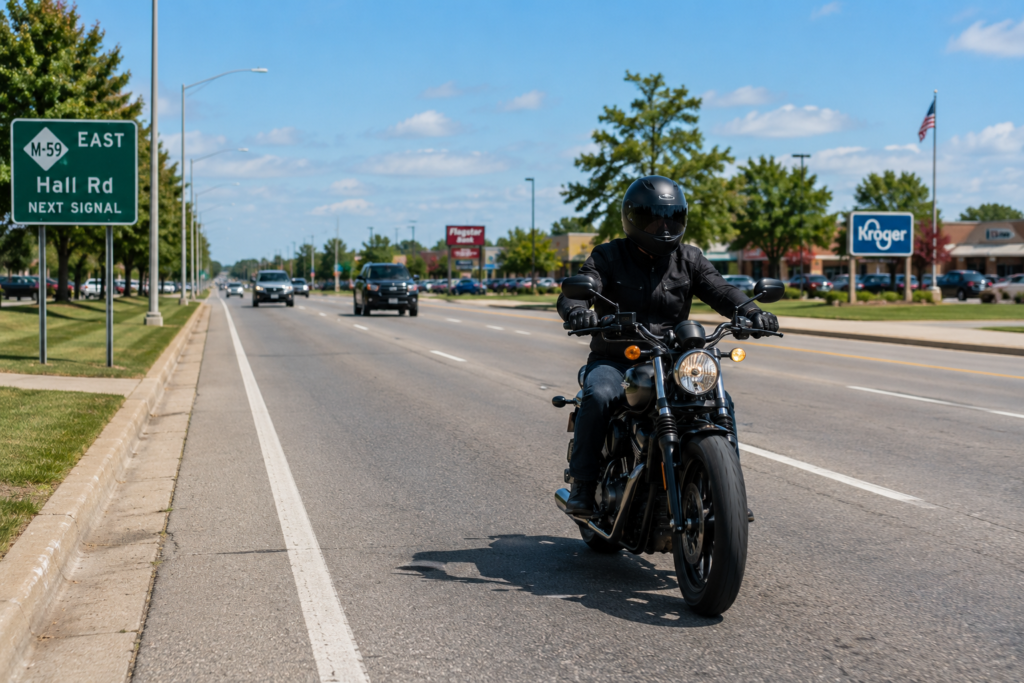
Motorcyclists in Clinton Township travel busy corridors such as Hall Road, where crash investigations may involve visibility, unsafe turns, lane changes, and serious rider injuries.
Motorcycle Accidents in Clinton Township
Clinton Township includes heavily traveled state routes, county roads, commercial corridors, residential streets, and busy intersections.
Motorcyclists regularly travel on routes such as:
- Hall Road / M-59
- Gratiot Avenue / M-3
- Groesbeck Highway / M-97
- Metro Parkway / 16 Mile Road
- Garfield Road
- Hayes Road
- Harper Avenue
- 15 Mile Road
- 17 Mile Road
- 18 Mile Road
The type of roadway can affect the evidence available after a crash.
A high-speed collision on M-59 may present different visibility, braking, and electronic-evidence issues than a left-turn crash at a signalized intersection or driveway entrance.
Clinton Township also does not control every roadway within the township. State routes such as Hall Road, Gratiot Avenue, and Groesbeck Highway fall under state jurisdiction, while other roads may fall under the Macomb County Department of Roads.
That distinction can matter if roadway design, traffic-control devices, construction, or maintenance becomes relevant to the investigation.
How Can a Clinton Township Motorcycle Accident Lawyer Help?
Motorcycle claims can involve more complicated liability and insurance issues than an ordinary passenger-vehicle collision.
Khamo Law can help by:
- Obtaining police and crash reports
- Investigating the crash scene
- Identifying the other vehicles involved
- Interviewing witnesses
- Seeking surveillance and dashcam footage
- Documenting motorcycle and vehicle damage
- Preserving the motorcycle and riding gear
- Evaluating applicable insurance coverage
- Investigating uninsured or underinsured motorist coverage
- Reviewing motorcycle-specific PIP issues
- Addressing comparative-fault allegations
- Gathering medical records
- Documenting lost income
- Evaluating future medical and rehabilitation needs
- Working with qualified reconstruction professionals when appropriate
- Negotiating with insurers
- Filing a lawsuit when necessary
Motorcycle cases should be evaluated from the evidence rather than stereotypes about riders.
Common Causes of Clinton Township Motorcycle Accidents
Motorcycle crashes may result from:
- Failure to yield
- Unsafe left turns
- Distracted driving
- Speeding
- Unsafe lane changes
- Following too closely
- Running red lights
- Running stop signs
- Impaired driving
- Failure to check blind spots
- Driving too fast for weather or traffic conditions
- Opening a vehicle door into a rider’s path
More than one factor may contribute to the same crash.
Left-Turn Motorcycle Accidents
A common serious motorcycle crash occurs when another vehicle turns left across the path of an approaching rider.
Potential causes include:
- Failure to see the motorcycle
- Misjudging the motorcycle’s speed
- Turning without enough clearance
- Distracted driving
- Failure to yield
Potential evidence may include:
- Surveillance video
- Dashcam footage
- Witness statements
- Traffic-signal information
- Vehicle damage
- Motorcycle damage
- Crash-scene photographs
A driver’s statement that they “didn’t see” the motorcycle does not automatically resolve fault.
Blind-Spot and Lane-Change Accidents
Motorcycles have a smaller visual profile than passenger vehicles.
A driver who fails to check mirrors and blind spots may move directly into a rider’s lane.
These crashes may involve:
- Unsafe merging
- Abrupt lane changes
- Failure to signal
- Drifting into another lane
- Misjudging the rider’s position
The resulting collision can force a motorcyclist into another vehicle, a median, a barrier, or the roadway.
Rear-End Motorcycle Accidents
Rear-end crashes can be especially dangerous for motorcyclists because riders are not protected by a passenger compartment, crumple zone, or head restraint.
Potential causes include:
- Following too closely
- Distracted driving
- Speeding
- Failure to notice stopped traffic
- Driving too fast for conditions
For broader rear-impact information, visit our Michigan rear-end collision lawyer resource.
Hit-and-Run Motorcycle Accidents
When a driver strikes a rider and leaves the scene, identifying the vehicle can become an important part of the investigation.
Potential evidence may include:
- Witness descriptions
- Nearby surveillance footage
- Dashcam video
- Vehicle debris
- Partial plate information
- Police investigation
Applicable insurance coverage should also be evaluated if the responsible driver cannot be identified.
For more information, visit our Michigan hit-and-run accident lawyer page.
Distracted Driving Motorcycle Crashes
Drivers distracted by cellphones, navigation systems, passengers, or other activity may fail to detect a motorcycle.
Potential evidence may include:
- Witness statements
- Dashcam footage
- Surveillance video
- Cellphone information when legally obtainable
- Driver statements
- Other electronic records
The fact that a motorcycle is smaller than a passenger vehicle does not excuse another driver from safely observing traffic.
Drunk or Drug-Impaired Motorcycle Accidents
Alcohol or drug impairment can affect reaction time, judgment, coordination, and the ability to safely perceive surrounding traffic.
When an impaired driver causes a motorcycle collision, there may be:
- A criminal prosecution brought by the government
- A separate civil injury claim pursued by the motorcyclist
Potential evidence may include police records, toxicology information, witnesses, and video.
Common Motorcycle Accident Injuries
Motorcyclists may suffer severe injuries even when protective equipment is being used.
Potential injuries include:
- Traumatic brain injuries
- Concussions
- Spinal cord injuries
- Neck and back injuries
- Herniated discs
- Broken bones
- Shoulder injuries
- Knee injuries
- Leg and foot injuries
- Nerve damage
- Internal injuries
- Road rash
- Burns
- Crush injuries
- Amputations
- Scarring
- Permanent impairment
Serious motorcycle injuries may require hospitalization, surgery, rehabilitation, assistive equipment, and long-term medical care.
For traumatic brain injuries, visit our Clinton Township brain injury attorney page.
For spinal injuries, visit our Clinton Township spinal cord injury attorney page.
Michigan Motorcycle Helmet Law
Michigan does not require every motorcyclist age 21 or older to wear a helmet.
State law allows certain qualifying riders and passengers age 21 or older to ride without one when statutory requirements are satisfied.
Helmet use and fault for causing a crash are separate questions.
Whether someone was wearing a helmet does not automatically determine who caused the collision.
For the deeper statewide helmet-law explanation, visit our Michigan motorcycle accident lawyer resource.
Is Lane Splitting Legal in Michigan?
Michigan law generally prohibits a motorcycle from operating between lines or rows of vehicles moving in the same direction.
That issue can become relevant when an insurer alleges that a motorcyclist was riding between lanes immediately before the collision.
The factual question is what the rider and other drivers were actually doing at the time of the crash.
Motorcycle Endorsement Requirements
Michigan requires the appropriate motorcycle endorsement to operate a motorcycle on public roads.
However, motorcycle-endorsement status and fault for causing a specific collision are separate legal questions.
A separate licensing issue does not automatically establish that the rider caused the crash.
Michigan No-Fault Insurance After a Motorcycle Accident
Motorcycle insurance issues can differ significantly from ordinary passenger-vehicle claims.
Michigan has specialized rules governing PIP benefits for motorcycle operators and passengers injured in crashes involving motor vehicles.
Potentially relevant factors may include:
- Whether another motor vehicle was involved
- Which vehicles were insured
- The insurance applicable to the involved vehicles
- Ownership of the motorcycle
- Other available policies
Because these rules apply statewide, the detailed explanation belongs primarily on Khamo Law’s Michigan motorcycle and No-Fault resources rather than being repeated in full on every city page.
Can a Motorcyclist Receive PIP Benefits?
Potentially.
Depending on the circumstances and applicable insurance, PIP benefits may include qualifying:
- Medical expenses
- Rehabilitation
- Wage loss
- Replacement services
- Other benefits allowed by Michigan law
Motorcycle PIP priority can be more complicated than the rules governing an ordinary passenger-vehicle crash.
Can I Sue the Driver Who Hit My Motorcycle?
Potentially.
Michigan law permits certain claims against at-fault drivers.
For noneconomic damages such as pain and suffering, the motor-vehicle tort statute generally requires:
- Death
- Permanent serious disfigurement
- Serious impairment of body function
The applicable threshold and recoverable damages depend on the facts and injuries involved.
What Is a Serious Impairment of Body Function?
Michigan’s serious-impairment analysis is not based solely on pain.
Relevant evidence may include:
- Diagnostic imaging
- Physician evaluations
- Surgery
- Physical restrictions
- Rehabilitation
- Missed work
- Changes in normal activities
- Permanent limitations
The effect of the injury must be evaluated individually.
What If the Driver Says They Didn’t See the Motorcycle?
A driver’s failure to see a motorcycle does not automatically excuse unsafe driving.
An investigation may examine whether the driver:
- Looked before turning
- Checked mirrors
- Checked blind spots
- Yielded properly
- Was distracted
- Had an unobstructed view
- Had adequate time to observe the motorcycle
Objective evidence can be especially important when the driver and rider provide different accounts.
What If the Insurance Company Blames the Rider?
Motorcycle claims can involve allegations that the rider was:
- Speeding
- Riding aggressively
- Lane splitting
- Difficult to see
- Following too closely
- Otherwise contributing to the collision
Those allegations should be tested against the evidence.
Michigan comparative-fault principles can reduce certain damages depending on the rider’s percentage of responsibility and the type of damages claimed.
It is more accurate to evaluate comparative fault from the specific claim and facts than to use a simplified statement that one percentage automatically eliminates every category of recovery.
What Evidence Can Help a Motorcycle Accident Claim?
Potential evidence may include:
- Police reports
- Crash-scene photographs
- Motorcycle damage
- Other vehicle damage
- Helmet and riding gear
- Witness statements
- Surveillance video
- Dashcam footage
- Nearby camera footage
- Cellphone information when relevant
- Medical records
- Employment records
- Electronic vehicle data
- Accident reconstruction evidence
The motorcycle and riding equipment can themselves contain important evidence.
They should generally be preserved until the need for inspection has been evaluated.
What Should I Do After a Clinton Township Motorcycle Accident?
Your immediate health and safety should come first.
When circumstances allow:
- Call 911.
- Seek medical attention.
- Report the crash.
- Photograph the scene.
- Photograph the motorcycle and other vehicles.
- Obtain witness information.
- Note nearby surveillance cameras.
- Preserve your helmet and riding gear.
- Keep medical records and bills.
- Document missed work.
- Save insurance correspondence.
- Avoid signing settlement documents you do not understand.
Do not delay necessary medical treatment merely to collect evidence.
For a broader statewide checklist, see What To Do After a Motorcycle Accident in Michigan.
Motorcycle Accidents Involving Commercial Trucks
A collision between a motorcycle and a commercial truck may involve trucking-company records, federal regulations, maintenance evidence, electronic logs, and commercial insurance.
For those cases, visit our Clinton Township truck accident lawyer page.
Motorcycle Accidents Involving Passenger Vehicles
Many motorcycle collisions involve ordinary passenger vehicles.
When the primary issue is a passenger-car collision rather than motorcycle-specific insurance or injury questions, our Clinton Township car accident lawyer page provides broader automobile-claim information.
What Compensation May Be Available?
Depending on the facts and applicable law, potentially recoverable losses or insurance benefits may include:
- Medical expenses
- Rehabilitation
- Future medical care
- Lost income
- Reduced earning capacity
- Pain and suffering when legally recoverable
- Disability
- Scarring
- Disfigurement
- Loss of normal activities
- Other legally recoverable damages
No particular category is guaranteed.
What Is a Clinton Township Motorcycle Accident Case Worth?
There is no reliable average settlement amount.
Potential value may depend on:
- How the crash happened
- Strength of the liability evidence
- Injury severity
- Surgery
- Permanent impairment
- Future medical care
- Lost income
- Reduced earning capacity
- Comparative fault
- Available insurance coverage
A serious motorcycle crash with clear liability may present a very different claim from a collision involving disputed fault and short-term injuries.
How Long Do I Have to File a Motorcycle Accident Claim?
Different claims arising from the same motorcycle collision may have different deadlines.
Michigan generally applies a three-year limitations period to many personal-injury actions, subject to exceptions.
No-Fault/PIP benefits involve separate notice, filing, and recovery requirements.
A rider should not assume that every issue can safely wait until the general personal-injury deadline is approaching.
Fatal Motorcycle Accidents
Some motorcycle crashes cause fatal injuries.
When legally actionable conduct causes a death, Michigan wrongful-death law may apply in addition to the motorcycle-liability issues.
A fatal motorcycle investigation may involve:
- Police reports
- Video
- Witness statements
- Motorcycle and vehicle evidence
- Electronic data
- Insurance coverage
- Medical records
- Estate procedures
Families can visit our Clinton Township wrongful death attorney page for additional information.
Clinton Township Motorcycle Accident FAQs
Can I still have a claim if I wasn’t wearing a helmet?
Potentially. Helmet use and fault for causing the collision are separate questions. Michigan also allows certain qualifying riders age 21 or older to ride without helmets.
Can a driver be responsible for turning left in front of me?
Potentially. Liability depends on right-of-way rules and the evidence regarding the driver’s turn and the motorcycle’s movement.
What if I was speeding?
Speed may become part of a comparative-fault analysis. Its legal effect depends on the actual evidence and whether the alleged speed contributed to the collision or injuries.
Is lane splitting legal in Clinton Township?
Michigan generally prohibits motorcycles from operating between lines or rows of vehicles moving in the same direction.
Do motorcycles have the same No-Fault rules as cars?
No. Motorcycle operators and passengers can be subject to specialized PIP priority rules.
What if a hit-and-run driver struck me?
Police investigation, surveillance footage, witnesses, vehicle debris, and applicable insurance may become particularly important.
What if a truck hit my motorcycle?
Visit our Clinton Township truck accident lawyer page.
What if I suffered a brain injury?
Visit our Clinton Township brain injury attorney page.
What if I suffered a spinal cord injury?
Visit our Clinton Township spinal cord injury attorney page.
What if a family member died?
Visit our Clinton Township wrongful death attorney page.
How much does Khamo Law charge for a consultation?
Khamo Law offers free consultations for potential motorcycle-accident cases.
Why Choose Khamo Law After a Clinton Township Motorcycle Accident?
Motorcycle cases can involve several different questions at once.
What caused the crash?
Driver behavior, visibility, roadway conditions, and other evidence should be investigated.
What evidence exists?
Video, witnesses, motorcycle damage, vehicle damage, police records, and electronic evidence may matter.
What insurance applies?
Michigan motorcycle crashes can involve specialized No-Fault rules.
Is the rider being blamed?
Comparative-fault allegations should be evaluated against the actual evidence.
How serious are the injuries?
Medical treatment, rehabilitation, work limitations, permanent impairment, and future care should be documented.
Khamo Law can investigate the collision, preserve evidence, evaluate insurance, document medical and financial losses, communicate with insurers, and pursue litigation when appropriate.
Services are available in English, Arabic, and Chaldean.
Call 248-466-0606 for a free consultation.
Speak With a Clinton Township Motorcycle Accident Attorney
If you were injured while riding a motorcycle in Clinton Township, Khamo Law can investigate what happened, preserve important evidence, evaluate Michigan’s motorcycle-specific insurance rules, respond to disputed-fault allegations, document your losses, and explain the legal options supported by the facts.
Call 248-466-0606 or contact Khamo Law online for a free consultation.