










A Clinton Township wrongful death attorney at Khamo Law can help families investigate a fatal accident, preserve evidence, identify legally responsible parties, evaluate available insurance coverage, coordinate with the estate’s personal representative, and pursue compensation when Michigan law supports a wrongful death claim.
Losing a family member because of another person’s or company’s wrongful conduct can create emotional, financial, and legal questions all at once. Families may be dealing with funeral arrangements, medical bills, insurance calls, probate issues, lost household income, and uncertainty about what happens next.
Khamo Law represents families throughout Clinton Township, Macomb County, and Metro Detroit.
For broader injury representation in the area, visit our Clinton Township personal injury attorney page.
Call 248-466-0606 or contact Khamo Law online for a free consultation.
For broader statewide information, visit our Michigan wrongful death attorney page.
Legally reviewed by Attorney Koro E. Khamo
Attorney at Khamo Law, PLLC
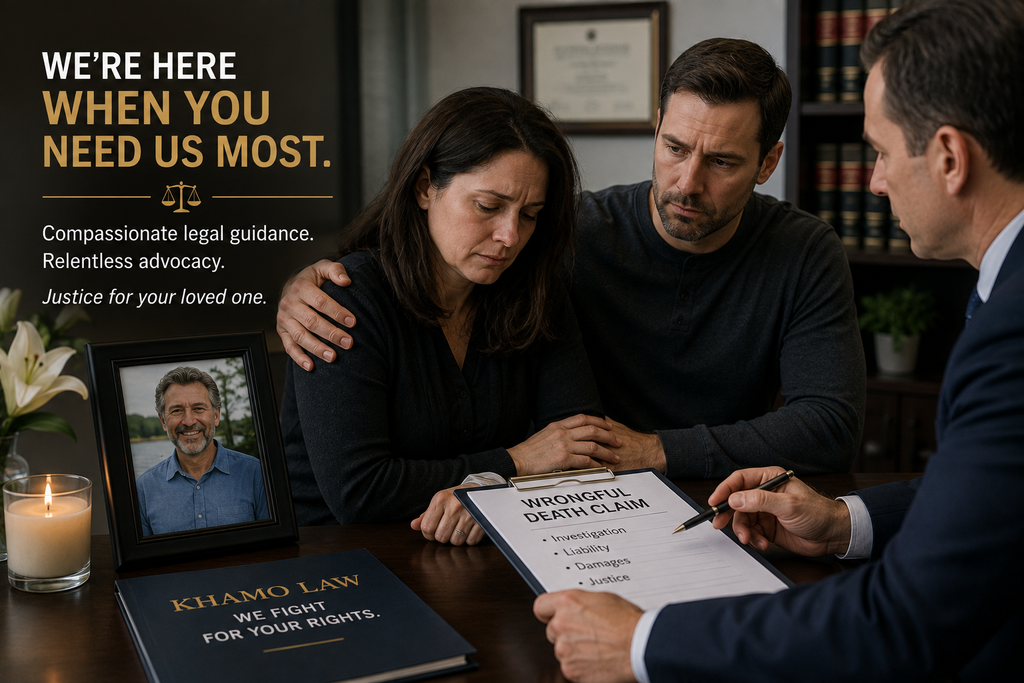
Wrongful death claims can involve accident investigation, insurance coverage, estate procedures, financial support losses, and loss of society and companionship for surviving family members.
Wrongful Death Cases in Clinton Township
A wrongful death claim may arise when a person’s death results from another party’s wrongful act, neglect, or fault.
Potential fatal incidents can include:
- Car accidents
- Commercial truck crashes
- Motorcycle accidents
- Pedestrian collisions
- Bicycle crashes
- Dangerous property conditions
- Slip and fall accidents
- Other negligence-related incidents
The legal issues depend on what caused the death.
A fatal motor-vehicle collision may involve Michigan No-Fault insurance, liability insurance, and crash evidence, while a death caused by a dangerous property condition may involve premises liability law.
How a Clinton Township Wrongful Death Attorney Can Help
Wrongful death claims can involve several legal processes at the same time.
Khamo Law can help by:
- Investigating how the death occurred
- Identifying potentially responsible people or companies
- Preserving photographs, video, and physical evidence
- Obtaining police or incident reports
- Interviewing witnesses
- Evaluating available insurance policies
- Communicating with insurance companies
- Gathering medical and financial records
- Documenting funeral and burial expenses
- Evaluating loss of financial support
- Documenting loss of society and companionship
- Coordinating with the estate’s personal representative
- Working with qualified professionals when appropriate
- Filing a lawsuit when necessary
The investigation should address both liability and the losses caused by the death.
What Is Wrongful Death Under Michigan Law?
Michigan’s Wrongful Death Act is found at MCL 600.2922.
The statute applies when a person’s death or injuries resulting in death are caused by another person’s:
- Wrongful act
- Neglect
- Fault
The underlying conduct still must support a legally actionable claim.
A wrongful death case does not create liability merely because a death occurred. The evidence must establish the legal basis for holding another person or entity responsible.
Who Files a Michigan Wrongful Death Lawsuit?
Under Michigan law, a wrongful death action is brought by the personal representative of the deceased person’s estate.
That is an important distinction.
Individual relatives do not simply file separate wrongful-death lawsuits in their own names.
The estate’s personal representative brings the action and the statutory process determines which eligible people may receive damages from a settlement or judgment.
What Is a Personal Representative?
The personal representative is the person legally authorized to administer the deceased person’s estate.
That person may be appointed through the probate process.
The personal representative can have responsibilities involving:
- Estate administration
- Working with the wrongful death attorney
- Filing the wrongful death action
- Providing required notices
- Considering settlement issues
- Participating in distribution proceedings
The wrongful-death lawsuit and probate process can therefore intersect.
Who May Be Entitled to Wrongful Death Damages?
Michigan law identifies categories of people who may be entitled to damages from a wrongful death recovery.
Depending on the family structure and circumstances, this can include certain:
- Spouses
- Children
- Descendants
- Parents
- Grandparents
- Brothers and sisters
- Other persons identified by the statute
- Certain beneficiaries under a will
Eligibility and the amount ultimately distributed are separate questions.
A person being within a statutory category does not automatically mean every person receives an equal share.
How Are Wrongful Death Proceeds Distributed?
Wrongful death proceeds are not necessarily divided equally among surviving family members.
Michigan law provides procedures for settlement approval and distribution.
The court may consider the relative damages suffered by the eligible persons.
Depending on the case, the process may include:
- Notice to people who may be entitled to damages
- Claims submitted to the personal representative
- Court approval of settlement
- A petition for distribution
- Allocation of appropriate expenses
- Distribution among qualifying persons
Where all eligible parties agree and legal requirements are satisfied, a written agreement may sometimes determine the distribution.
What Damages May Be Available in a Michigan Wrongful Death Case?
Depending on the facts, Michigan wrongful death damages may include:
- Reasonable medical expenses for which the estate is liable
- Reasonable hospital expenses
- Funeral expenses
- Burial expenses
- Conscious pain and suffering experienced by the deceased before death
- Loss of financial support
- Loss of society and companionship
- Other damages allowed under Michigan law
The specific damages depend on the evidence.
Loss of Financial Support
A family’s financial losses can be substantial after an unexpected death.
Potential evidence may include:
- Earnings history
- Employment records
- Tax records
- Benefits
- Household contributions
- Work history
- Other financial documentation
The goal is not to guess what the deceased might have earned.
Financial losses should be established with reasonable evidentiary support.
Loss of Society and Companionship
Michigan wrongful death law can also recognize the loss of society and companionship experienced by surviving family members.
These losses are different from ordinary financial expenses.
The evidence may involve the nature of the relationship between the deceased and surviving family members.
Every family’s circumstances are different.
Conscious Pain and Suffering Before Death
When evidence shows that the deceased remained conscious and experienced pain or suffering between the injury and death, that suffering may become part of the wrongful-death damages analysis.
Potential evidence may include:
- Emergency medical records
- Hospital records
- EMS records
- Witness testimony
- Medical testimony
This issue is highly fact-specific.
Funeral and Burial Expenses
Reasonable funeral and burial expenses for which the estate is liable may also be recoverable under Michigan’s Wrongful Death Act.
Families should preserve:
- Funeral-home invoices
- Burial expenses
- Cemetery expenses
- Other related documentation
Fatal Clinton Township Car Accidents
A fatal car crash may involve:
- Driver negligence
- Speeding
- Distracted driving
- Failure to yield
- Impaired driving
- Unsafe turns
- Intersection collisions
- Hit-and-run crashes
- Other negligent driving
Potential evidence may include police reports, dashcam footage, surveillance video, witness statements, vehicle damage, electronic data, and insurance records.
For local automobile information, visit our Clinton Township car accident lawyer page.
Fatal Truck Accidents
Commercial truck crashes can involve additional evidence and potentially responsible companies.
Potential issues may include:
- Driver conduct
- Hours-of-service records
- Electronic logging data
- Truck maintenance
- Driver qualification files
- Dispatch records
- Cargo issues
- Truck electronic data
- Motor-carrier policies
- Commercial insurance
For truck-specific information, visit our Clinton Township truck accident lawyer page.
Fatal Motorcycle Accidents
Motorcycle fatalities can involve disputes regarding:
- Left-turn collisions
- Driver visibility
- Unsafe lane changes
- Failure to yield
- Speed
- Motorcycle-specific insurance
- Comparative fault
The fact that someone was riding a motorcycle does not determine who caused the collision.
Visit our Clinton Township motorcycle accident attorney page.
Fatal Pedestrian Accidents
Pedestrians have little physical protection when struck by a motor vehicle.
A fatal pedestrian case may involve:
- Crosswalks
- Traffic signals
- Driver visibility
- Turning vehicles
- Speed
- Distracted driving
- Hit-and-run conduct
For pedestrian-specific issues, visit our Clinton Township pedestrian accident attorney page.
Fatal Bicycle Accidents
A bicyclist killed in a motor-vehicle collision may have been traveling on:
- A roadway
- An intersection
- A bicycle lane
- A safety path
- A sidewalk or crossing where permitted
The investigation may involve roadway position, passing distance, visibility, turns, traffic signals, and other evidence.
Visit our Clinton Township bicycle accident attorney page.
Fatal Slip and Fall or Premises Liability Accidents
Serious falls and dangerous property conditions can sometimes result in fatal injuries.
Potential issues include:
- Snow and ice
- Unsafe stairs
- Dangerous walking surfaces
- Poor lighting
- Property defects
- Other dangerous conditions
Visit our Clinton Township premises liability attorney page for broader dangerous-property claims.
For fall-specific information, visit our Clinton Township slip and fall attorney page.
What Evidence Matters in a Wrongful Death Case?
Potential evidence depends on how the death occurred.
It may include:
- Police reports
- Crash reports
- Incident reports
- Photographs
- Surveillance footage
- Dashcam video
- Witness statements
- Electronic vehicle data
- Commercial records
- Property-maintenance records
- Medical records
- Autopsy records when relevant
- Death certificates
- Employment records
- Tax records
- Insurance policies
Preserving evidence early can be especially important.
Why Early Investigation Matters
A wrongful death filing deadline may be months or years away, but important evidence can disappear much sooner.
For example:
- Surveillance video can be overwritten
- Vehicles can be repaired or destroyed
- Commercial electronic data can be lost
- Property conditions can change
- Witnesses can become difficult to locate
- Physical evidence can be discarded
The legal deadline should not be confused with the practical deadline for preserving evidence.
Insurance Issues After a Fatal Accident
Depending on the type of incident, multiple insurance policies may be involved.
Potential coverage may include:
- Automobile liability insurance
- Michigan No-Fault coverage
- Uninsured or underinsured motorist coverage
- Commercial liability policies
- Trucking-company insurance
- Homeowner’s insurance
- Business liability coverage
- Other applicable policies
The responsible insurance coverage should be determined from the facts rather than assumed.
Michigan No-Fault Benefits After a Fatal Motor-Vehicle Crash
When a death results from a motor-vehicle collision, Michigan No-Fault insurance may also create separate benefits or issues.
Depending on the facts and coverage, potential benefits may involve:
- Certain medical expenses
- Funeral-related benefits
- Survivor’s loss benefits
- Other benefits permitted by Michigan law
Those benefits are legally distinct from the wrongful-death liability claim against an at-fault party.
For broader No-Fault information, visit our Michigan No-Fault car accident lawyer resource.
What If Criminal Charges Are Filed?
A criminal prosecution and a civil wrongful death claim are separate proceedings.
A driver or other person may face criminal charges arising from the same event.
The criminal case is brought by the government.
The wrongful death case is a civil claim brought through the deceased person’s estate.
A civil claim may exist even if:
- No criminal charges are filed
- Charges are dismissed
- The criminal case has not concluded
The standards and purposes of the two proceedings are different.
What If No Criminal Charges Are Filed?
The absence of criminal charges does not automatically mean there is no wrongful-death claim.
Civil liability is evaluated under civil law and the applicable burden of proof.
The investigation should focus on:
- What happened
- What evidence exists
- What duty was owed
- Whether that duty was breached
- Whether the wrongful conduct caused the death
What If the Insurance Company Blames the Deceased?
Comparative-fault allegations can arise in fatal accident cases.
An insurer may claim that the deceased:
- Was speeding
- Failed to yield
- Was distracted
- Entered a roadway unexpectedly
- Encountered an obvious condition
- Otherwise contributed to the event
Those allegations should be tested against the evidence.
The legal effect of comparative fault can depend on the type of underlying claim and damages involved.
Wrongful Death Claims Against Government Entities
Claims involving government agencies or employees can be subject to governmental immunity and special statutory requirements.
Potential examples can involve:
- Government vehicles
- Public road conditions
- Public buildings
- Other government-controlled property
Special notice requirements can be significantly shorter than ordinary lawsuit deadlines.
For more information, see Khamo Law’s Michigan wrongful death claims against government entities resource.
What Role Does Probate Court Play?
Because the wrongful death action is brought by the estate’s personal representative, probate proceedings may be necessary.
Probate issues may include:
- Appointment of a personal representative
- Estate administration
- Notice to interested persons
- Settlement approval
- Distribution of wrongful-death proceeds
Michigan law also includes specific procedures for court approval and distribution of wrongful-death settlements.
What Happens If Family Members Disagree About Distribution?
A disagreement among family members does not necessarily determine whether the underlying wrongful-death claim can proceed.
Distribution of proceeds is a separate issue.
If qualifying parties cannot agree, the court may determine distribution after considering the relative damages suffered.
Families should receive advice based on the specific estate and family circumstances.
How Long Do I Have to File a Michigan Wrongful Death Claim?
There is not one universal rule that every Michigan wrongful-death claim expires exactly three years after the date of death.
Wrongful-death timing generally depends on the limitations period applicable to the underlying legal claim, along with Michigan’s wrongful-death and estate rules.
Different claims may therefore involve different deadlines.
Additional timing rules can also apply to:
- Government claims
- Michigan No-Fault matters
- Insurance claims
- Other specialized causes of action
Because deadlines can vary, families should not rely on a generic “three years from death” rule.
What Should a Family Do After a Fatal Accident?
There is no single checklist that fits every family, but practical steps may include:
- Focus on immediate family and funeral needs.
- Preserve police or incident-report information.
- Save photographs and video connected to the accident.
- Keep insurance correspondence.
- Preserve funeral and burial invoices.
- Keep medical bills and records.
- Preserve employment and income information.
- Identify potential witnesses.
- Avoid signing insurance releases you do not understand.
- Determine whether an estate and personal representative are needed.
Families do not need to handle every legal issue immediately, but evidence should not be unnecessarily lost.
What Is a Clinton Township Wrongful Death Case Worth?
There is no reliable average wrongful-death settlement.
Potential value may depend on:
- How the death occurred
- Strength of the liability evidence
- Conscious pain and suffering
- Medical expenses
- Funeral and burial expenses
- Financial support provided by the deceased
- Family relationships
- Loss of society and companionship
- Comparative fault
- Available insurance coverage
The value must be based on the actual evidence and losses.
Clinton Township Wrongful Death FAQs
Who files a wrongful death lawsuit in Michigan?
The personal representative of the deceased person’s estate brings the action.
Can a spouse file the lawsuit directly?
The spouse may be among the people entitled to damages, but the wrongful-death action itself is brought by the estate’s personal representative.
Can children recover wrongful-death damages?
Potentially. Michigan law identifies categories of family members and other persons who may be entitled to damages, depending on the circumstances.
Does every family member get the same amount?
Not necessarily. Distribution depends on Michigan law, the damages suffered, settlement procedures, and potentially court approval.
What if the deceased survived for a period before dying?
Conscious pain and suffering experienced between the injury and death may be recoverable when supported by evidence.
Can funeral expenses be recovered?
Reasonable funeral and burial expenses for which the estate is liable may be recoverable under Michigan law.
Can we bring a claim if nobody was criminally charged?
Potentially. Civil wrongful-death liability is separate from criminal prosecution.
What if the death resulted from a car crash?
Visit our Clinton Township car accident lawyer page.
What if a commercial truck was involved?
Visit our Clinton Township truck accident lawyer page.
What if the death resulted from a dangerous property condition?
Visit our Clinton Township premises liability attorney page.
How much does Khamo Law charge for a consultation?
Khamo Law offers free consultations for potential wrongful-death cases.
Why Choose Khamo Law for a Clinton Township Wrongful Death Case?
Wrongful-death claims can involve several separate issues.
What caused the death?
The underlying accident determines which liability rules apply.
Who may be responsible?
Drivers, trucking companies, businesses, property possessors, contractors, or other legally responsible parties may need to be investigated.
What evidence must be preserved?
Video, physical evidence, records, witnesses, and electronic data can disappear.
Who brings the lawsuit?
Michigan law requires the estate’s personal representative to bring the wrongful-death action.
What losses must be documented?
Medical and funeral expenses, financial support, conscious pain and suffering, and family losses may all require evidence.
Khamo Law can investigate the underlying incident, preserve evidence, evaluate insurance, work with the personal representative, document recoverable losses, communicate with insurers, and pursue litigation when appropriate.
Services are available in English, Arabic, and Chaldean.
Call 248-466-0606 for a free consultation.
Speak With a Clinton Township Wrongful Death Attorney
If your family lost someone because of another person’s or company’s legally actionable conduct in Clinton Township, Khamo Law can investigate what happened, identify potentially responsible parties, preserve evidence, evaluate insurance coverage, work with the estate’s personal representative, document legally recoverable losses, and explain the options available under Michigan law.
For broader injury representation in the area, visit our Clinton Township personal injury attorney page.
Call 248-466-0606 or contact Khamo Law online for a free consultation.