










A Troy brain injury attorney at Khamo Law can help if you suffered a concussion, traumatic brain injury, or other serious head injury because of another person’s negligence. Brain injuries can affect memory, concentration, mood, balance, sleep, work, relationships, and day-to-day independence long after an accident.
If your injury happened in a car crash, pedestrian collision, bicycle accident, fall, or another preventable incident in Troy, Michigan, you may be entitled to compensation for medical expenses, lost income, pain and suffering, future care, and other losses.
Brain injury cases are often more complicated than other personal injury claims because the symptoms are not always visible. A person may look physically normal while struggling with headaches, confusion, slowed thinking, memory problems, irritability, dizziness, fatigue, or difficulty returning to work.
A Troy traumatic brain injury lawyer at Khamo Law can investigate what caused the injury, collect medical and accident evidence, identify responsible parties and insurance coverage, and pursue the compensation available under Michigan law.
Contact Khamo Law today for a free consultation with a Troy brain injury attorney. You pay no attorney fees unless we recover compensation for you.
For information about other injury claims in the city, visit our Troy Personal Injury Lawyer page. For broader information about Brain Injuries, visit our Michigan Brain Injury resource.
How a Troy Brain Injury Attorney Can Help
Traumatic brain injury claims require careful documentation.
Insurance companies may question whether a concussion was serious, whether symptoms are related to the accident, whether the injured person should already have recovered, or whether complaints such as memory loss, headaches, or concentration problems can be objectively established.
A Troy brain injury attorney can help build the evidence needed to answer those arguments.
Depending on the circumstances, Khamo Law may:
- Investigate how the accident occurred
- Obtain police and incident reports
- Locate witnesses
- Preserve surveillance or dash-camera video
- Review photographs and physical evidence
- Obtain emergency-room and hospital records
- Collect neurology and rehabilitation records
- Review diagnostic testing
- Document cognitive and behavioral symptoms
- Obtain employment and wage-loss records
- Gather testimony from family members or coworkers when relevant
- Work with medical or rehabilitation experts when appropriate
- Analyze future medical and care needs
- Identify applicable insurance policies
- Handle communications with insurance companies
- Negotiate for a fair settlement
- File a lawsuit when necessary
- Prepare the case for trial
A strong brain injury claim should show not only what diagnosis appears in the medical records, but also how the injury changed the person’s life.
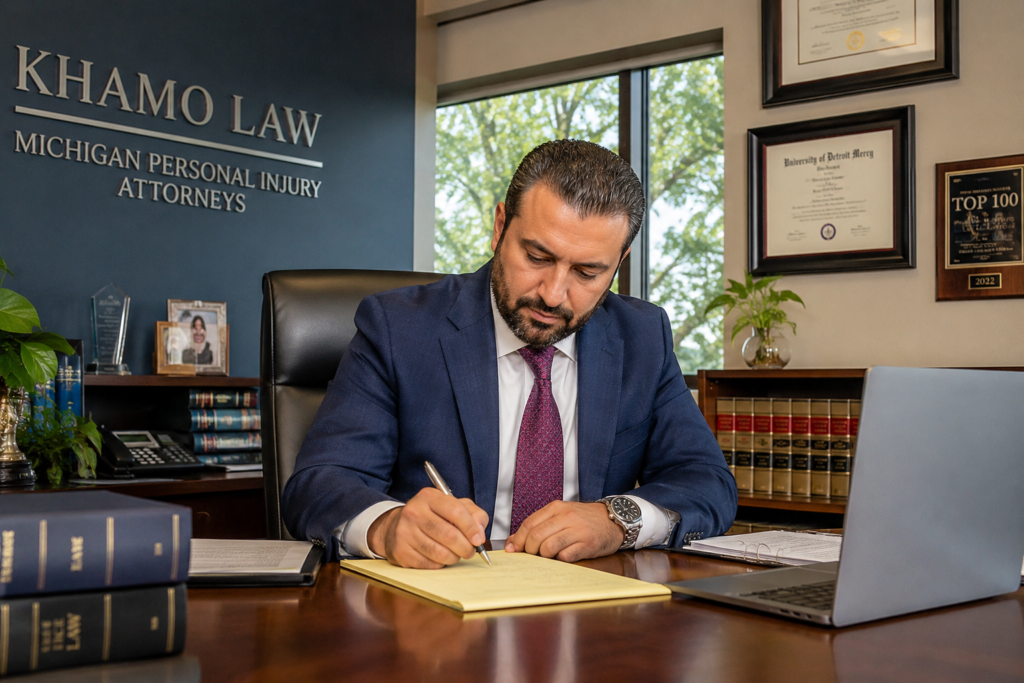
A Troy brain injury attorney meeting with a client to discuss a traumatic brain injury claim and available legal options.
What Is a Traumatic Brain Injury?
A traumatic brain injury, commonly called a TBI, occurs when an external force disrupts normal brain function.
A TBI may result from a direct blow to the head, but a person does not necessarily have to strike their head against an object to suffer a brain injury. Rapid acceleration and deceleration can cause the brain to move inside the skull.
Traumatic brain injuries can range from relatively mild concussions to severe injuries involving bleeding, swelling, prolonged loss of consciousness, or permanent neurological impairment.
Federal medical guidance recognizes both penetrating and non-penetrating traumatic brain injuries. Motor vehicle crashes, falls, and being struck by an object are among the recognized causes of closed-head or non-penetrating TBI.
Concussions Are Traumatic Brain Injuries
One of the most important things for accident victims to understand is that a concussion is a form of traumatic brain injury.
The word “mild” in mild traumatic brain injury describes the initial clinical classification of the injury. It does not mean every person will experience only minor or short-lived effects.
CDC guidance explains that concussion symptoms can affect how a person thinks, feels, acts, and sleeps. Symptoms can include headaches, dizziness, balance problems, fatigue, memory problems, concentration difficulties, irritability, anxiety, emotional changes, and sleep disturbances. Some symptoms may begin immediately, while others can appear hours or days later.
That delayed or less-visible nature is one reason traumatic brain injury claims can become disputed.
Symptoms of a Traumatic Brain Injury
Brain injury symptoms vary considerably from person to person.
Common symptoms may include:
Cognitive Symptoms
- Memory problems
- Difficulty concentrating
- Slowed thinking
- Confusion
- Trouble following conversations
- Difficulty multitasking
- Problems with planning or organization
- Difficulty making decisions
- Feeling mentally “foggy”
Physical Symptoms
- Headaches
- Dizziness
- Nausea
- Balance problems
- Fatigue
- Vision problems
- Sensitivity to light
- Sensitivity to noise
- Coordination problems
Emotional and Behavioral Symptoms
- Irritability
- Anxiety
- Mood changes
- Increased emotional sensitivity
- Frustration
- Personality changes
- Difficulty controlling emotions
Sleep Problems
- Trouble falling asleep
- Sleeping more than usual
- Sleeping less than usual
- Interrupted sleep
- Daytime fatigue
Government medical sources recognize that TBI symptoms can affect cognition, behavior, perception, balance, sleep, and emotional functioning.
Can You Have a Brain Injury With a Normal CT Scan?
Yes, depending on the circumstances.
This is an important issue in mild traumatic brain injury cases.
A CT scan is commonly used after head trauma to look for serious problems such as skull fractures, bleeding, swelling, or other acute abnormalities. But a routine CT scan is not required to diagnose a mild traumatic brain injury or concussion.
CDC guidance explains that concussion is generally evaluated through symptoms and clinical testing, including tests of learning, memory, concentration, and problem-solving. A brain scan may be used when doctors are concerned about bleeding or other structural injury, but a normal CT does not automatically rule out concussion.
That means an insurance company should not be able to reduce the entire case to a single sentence such as, “Your CT was normal.”
The medical history, symptoms, examinations, follow-up care, cognitive testing, work limitations, and changes in daily functioning may all be relevant.
Do You Have to Lose Consciousness to Suffer a TBI?
No.
A traumatic brain injury does not necessarily require prolonged loss of consciousness.
Some people remain awake during and after an accident but still experience confusion, memory gaps, dizziness, headache, slowed thinking, balance issues, or other neurological symptoms.
For that reason, the absence of documented unconsciousness does not automatically mean a person did not suffer a brain injury.
Common Causes of Brain Injuries in Troy
A Troy brain injury lawyer may handle TBI claims arising from many types of preventable accidents.
Common causes include:
- Car accidents
- Rear-end collisions
- Intersection crashes
- Side-impact collisions
- Head-on crashes
- Pedestrian accidents
- Bicycle accidents
- Motorcycle crashes
- Truck accidents
- Falls
- Unsafe property conditions
- Falling objects
- Workplace-related third-party incidents
- Other traumatic impacts
The legal issues depend heavily on what caused the injury.
A brain injury caused by a car crash may involve Michigan no-fault insurance, liability coverage, and the serious-impairment threshold.
A brain injury caused by an unsafe property condition may involve questions about ownership, notice, maintenance, and premises liability.
A thorough investigation starts by identifying why the injury occurred and who had a legal duty to prevent it.
Brain Injuries From Troy Car Accidents
Motor vehicle collisions are an important source of traumatic brain injury claims.
Troy includes major roads and commercial corridors such as:
- Big Beaver Road
- Rochester Road
- Maple Road
- Crooks Road
- Livernois Road
- John R Road
- Dequindre Road
- Long Lake Road
- Stephenson Highway
- I-75 interchange areas
Crashes on large multi-lane roads may involve substantial forces even when vehicles do not appear catastrophically damaged.
A driver’s head can move rapidly forward, backward, or sideways during impact. A person may also strike the steering wheel, window, headrest, door, airbag, or another part of the vehicle.
The specific mechanics of the collision can become relevant when a TBI diagnosis is disputed.
Why Local Evidence Matters in a Troy TBI Case
A serious brain injury case can depend on evidence that disappears quickly.
The City of Troy’s Traffic Safety Unit investigates accidents and targets accident-causing violations, while Troy Traffic Engineering maintains records involving crashes, traffic signals, signs, sidewalks, and traffic volume. Those records can sometimes help establish the traffic environment surrounding a collision.
Depending on the location and circumstances, useful evidence may include:
- Troy Police crash reports
- Witness statements
- Business surveillance footage
- Residential security-camera footage
- Dash-camera video
- Traffic-signal information
- Roadway photographs
- Vehicle damage
- Event data recorder information when applicable
- Cellphone evidence when legally obtainable
- Emergency medical records
- Ambulance records
- Hospital records
- Neurology records
- Rehabilitation records
Early preservation can be especially important when a claimant has memory gaps and cannot fully describe the collision.
Troy Emergency Response After a Serious Head Injury
After a serious head injury, immediate medical evaluation may be critical.
The City of Troy contracts with a private emergency medical provider for paramedic first-response and advanced life support ambulance services.
Emergency documentation can later become an important part of a brain injury claim because it may record symptoms such as confusion, loss of consciousness, disorientation, headache, nausea, vomiting, or memory problems close in time to the accident.
When Should You Seek Emergency Care for a Head Injury?
Some head injury symptoms require immediate medical attention.
CDC guidance identifies emergency warning signs such as:
- A worsening headache
- Repeated vomiting
- Seizures
- Weakness or numbness
- Slurred speech
- Unusual behavior
- Increasing confusion
- Difficulty waking
- Loss of consciousness
- Unequal pupil size
Anyone experiencing serious or worsening symptoms after a head injury should seek emergency medical care.
Mild, Moderate, and Severe Brain Injuries
Traumatic brain injuries vary greatly in severity.
Mild TBI
A concussion is generally categorized as a mild traumatic brain injury.
Symptoms may nevertheless interfere with:
- Work
- Driving
- School
- Reading
- Screen use
- Concentration
- Exercise
- Household tasks
- Social activities
Moderate TBI
Moderate brain injuries can involve more significant neurological impairment and may require hospitalization, rehabilitation, extended time away from work, and assistance with daily activities.
Severe TBI
Severe brain injuries may result in:
- Extended unconsciousness
- Significant cognitive impairment
- Speech problems
- Motor impairment
- Permanent disability
- Need for long-term care
- Loss of independence
- Major behavioral changes
The severity of the claim should ultimately be evaluated based on the person’s actual medical condition and functional losses, not merely the label attached to the diagnosis.
What Compensation Can a Troy Brain Injury Attorney Pursue?
The value of a traumatic brain injury case depends on the cause of the injury, available insurance, medical evidence, legal liability, and the effect the injury has had on the victim.
Potential compensation may include:
Medical Expenses
Brain injury treatment can involve:
- Emergency treatment
- Hospitalization
- Diagnostic testing
- Neurology care
- Physical therapy
- Occupational therapy
- Speech therapy
- Vestibular therapy
- Cognitive rehabilitation
- Psychological care
- Prescription medication
- Follow-up appointments
- Future treatment
Lost Income
A person with a TBI may be physically capable of appearing at work but unable to perform the same cognitive demands as before.
Problems with memory, concentration, fatigue, decision-making, multitasking, or emotional regulation can interfere with many occupations.
Reduced Earning Capacity
Some brain injuries permanently reduce a person’s ability to work at the same level.
A serious claim may therefore include future lost earning capacity when supported by the evidence.
Pain and Suffering
Depending on the legal basis for the claim, compensation may include noneconomic losses such as:
- Physical pain
- Emotional distress
- Cognitive limitations
- Loss of enjoyment of life
- Loss of independence
- Disability
- Changes in relationships
- Inability to participate in previous activities
Future Care and Assistance
Severe TBIs may create long-term needs involving:
- Ongoing rehabilitation
- Medical monitoring
- In-home assistance
- Transportation
- Adaptive equipment
- Home modifications
- Cognitive support
- Long-term care
Future needs should be considered before a serious brain injury claim is resolved.
Michigan No-Fault Benefits for Brain Injuries Caused by Car Accidents
When a TBI results from a motor vehicle accident, Michigan’s no-fault system may become an important part of the case.
Depending on the circumstances and applicable coverage, PIP benefits may relate to medical care, wage loss, replacement services, and other qualifying losses.
At the same time, the injured person may also have a separate liability claim against an at-fault driver for damages allowed under Michigan law.
These two components should not be confused.
A Troy traumatic brain injury attorney can review both the no-fault benefits available and the potential third-party claim.
Michigan’s Serious Impairment Threshold and Brain Injury Claims
For motor vehicle accidents, Michigan law generally limits recovery of noneconomic damages against an at-fault driver to cases involving:
- Death
- Serious impairment of body function
- Permanent serious disfigurement
Michigan defines serious impairment of body function through a three-part analysis involving an objectively manifested impairment, an important body function, and an effect on the injured person’s general ability to lead their normal life. The statute specifically states that this assessment is fact-specific and compares the person’s life before and after the incident.
This framework can be especially important in TBI cases because the injury may interfere with memory, concentration, balance, judgment, communication, work, and daily activities.
Michigan Law Has a Specific Provision for Closed-Head Injuries
Michigan’s motor vehicle statute contains language specifically addressing closed-head injuries.
When there is a factual dispute about the nature and extent of the injury, Michigan law provides that a question of fact for the jury can arise if a licensed physician who regularly diagnoses or treats closed-head injuries testifies under oath that there may be a serious neurological injury.
That does not mean every concussion automatically satisfies Michigan’s legal threshold.
It does mean that closed-head injuries receive specific treatment within the statute, making accurate medical documentation particularly important.
Why Brain Injury Cases Are Often Disputed by Insurance Companies
Brain injury cases can create unique evidentiary problems.
An insurer may argue:
- The person never lost consciousness
- The CT scan was normal
- There was no visible head injury
- Symptoms appeared later
- The person returned to work
- Symptoms are subjective
- Cognitive problems existed before the accident
- The collision was too minor to cause a TBI
- Treatment lasted too long
- The person should already have recovered
Each argument should be evaluated against the actual medical and factual evidence.
A traumatic brain injury case may involve far more than imaging.
Symptoms, neurological examinations, cognitive assessments, treatment history, rehabilitation, work performance, family observations, and changes in daily activities may all become important.
Neuropsychological and Cognitive Testing After a TBI
Some brain injury cases involve testing designed to evaluate areas such as:
- Memory
- Attention
- Concentration
- Processing speed
- Executive functioning
- Problem-solving
- Language
- Learning
CDC guidance recognizes neuropsychological and neurocognitive testing as tools healthcare providers may use when evaluating mild TBI and concussion.
Whether particular testing is appropriate is a medical decision.
From a legal perspective, reliable medical evaluation can help document symptoms that may otherwise be difficult to demonstrate through photographs or ordinary imaging.
How a TBI Can Affect Work
A brain injury can interfere with employment in ways that are not immediately obvious.
An injured person may struggle to:
- Remember instructions
- Maintain attention
- Complete tasks on schedule
- Manage multiple responsibilities
- Work around noise or bright lights
- Communicate effectively
- Control fatigue
- Drive
- Make complex decisions
- Handle stress
- Maintain productivity for a full workday
Someone who technically “returned to work” may still experience substantial impairment.
For that reason, employment records and testimony about changed performance can become important evidence in a serious TBI case.
How Brain Injuries Can Affect Family and Daily Life
A traumatic brain injury can affect much more than employment.
The injured person may have difficulty:
- Managing finances
- Cooking
- Driving
- Shopping
- Caring for children
- Following conversations
- Remembering appointments
- Participating in hobbies
- Exercising
- Maintaining relationships
- Tolerating noise or crowds
- Sleeping normally
Family members may notice personality changes, forgetfulness, irritability, fatigue, or reduced independence before the injured person fully recognizes them.
Those changes may help demonstrate the real-world impact of the injury.
What Evidence Can Strengthen a Troy Brain Injury Claim?
Useful evidence may include:
- Medical records
- Emergency department records
- Ambulance documentation
- Diagnostic imaging
- Neurology records
- Therapy records
- Rehabilitation records
- Neuropsychological testing
- Medication records
- Work restrictions
- Wage records
- Employment evaluations
- School records when relevant
- Journals documenting symptoms
- Statements from family members
- Statements from coworkers
- Accident photographs
- Video footage
- Police reports
- Expert opinions when appropriate
The most persuasive evidence often shows a consistent timeline from the accident through diagnosis, treatment, symptoms, limitations, and recovery.
Keep a Record of Brain Injury Symptoms
Because TBI symptoms can fluctuate, keeping a written record may help a patient accurately communicate with healthcare providers.
A symptom record may include:
- Headache frequency
- Dizziness
- Memory problems
- Sleep difficulties
- Sensitivity to light or noise
- Missed work
- Difficulty driving
- Problems completing household tasks
- Fatigue
- Changes in mood
- Missed appointments
- Difficulty concentrating
The purpose should be to accurately document what is actually happening—not exaggerate symptoms.
What to Do After a Brain Injury Accident in Troy
1. Seek Medical Care
Head injuries should be evaluated by an appropriate healthcare professional.
2. Follow Medical Instructions
Attend recommended appointments and follow treatment instructions.
3. Report the Accident
If the injury resulted from a motor vehicle crash, fall, or another reportable event, make sure the incident is properly documented.
4. Preserve Evidence
Save photographs, video, damaged property, witness information, and related documents.
5. Track Your Symptoms
Brain injury symptoms may change over time.
6. Keep Financial Records
Save medical bills, receipts, wage information, and documents showing missed work.
7. Avoid Guessing With Insurance Adjusters
Do not speculate about symptoms, diagnosis, speed, distance, or recovery.
8. Speak With a Troy Brain Injury Attorney
A lawyer can review liability, insurance coverage, medical evidence, deadlines, and potential compensation.
How Long Do You Have to File a Brain Injury Lawsuit in Michigan?
Michigan generally provides a three-year limitations period for many personal injury lawsuits, but the deadline applicable to a particular case can depend on the legal theory, defendant, insurance claim, and other circumstances.
Waiting can also make a TBI case harder to prove.
Video may be deleted. Witnesses may become unavailable. Records may become harder to obtain. The connection between the accident and symptoms may become more disputed.
A brain injury case should be evaluated early enough to preserve evidence and identify every applicable deadline.
Brain Injuries Caused by Falls in Troy
Falls are another recognized cause of traumatic brain injury.
A serious head injury may occur when someone falls because of a dangerous condition and strikes:
- Concrete
- Pavement
- Stairs
- A wall
- Shelving
- Furniture
- Another hard surface
These claims may arise in:
- Stores
- Restaurants
- Office buildings
- Apartment complexes
- Parking areas
- Commercial properties
- Other premises
The legal issues differ from motor vehicle cases, so identifying the exact cause of the fall and the responsible party is critical.
Brain Injuries From Pedestrian and Bicycle Accidents in Troy
Pedestrians and bicyclists are particularly vulnerable to head trauma because they lack the structural protection provided by a passenger vehicle.
A person may suffer a TBI from:
- The initial vehicle impact
- Being thrown onto the pavement
- Striking the hood or windshield
- A secondary impact
- A collision with another object
Helmet use may affect the medical facts in some bicycle cases, but it does not answer the question of whether a negligent driver caused the crash.
A Troy TBI attorney can evaluate both liability and the medical consequences of the injury.
Severe Traumatic Brain Injuries and Long-Term Care
Severe brain injuries can permanently alter a person’s ability to live independently.
Long-term consequences may include:
- Cognitive disability
- Speech impairment
- Mobility problems
- Behavioral changes
- Memory loss
- Seizure disorders
- Need for supervision
- Loss of employment
- Inability to drive
- Need for home assistance
- Rehabilitation needs
Michigan maintains TBI-specific public resources and service information for injured people and their families, reflecting the broad range of support that some brain injury survivors may require.
A severe injury claim should consider future needs rather than only expenses already incurred.
Fatal Brain Injuries and Wrongful Death Claims
Some traumatic brain injuries are fatal.
When another person’s negligence causes a fatal injury, surviving family members may have rights under Michigan wrongful death law.
These cases can involve:
- Medical expenses
- Funeral and burial expenses
- Loss of financial support
- Losses suffered by eligible family members
- Other damages permitted under Michigan law
A wrongful death claim requires careful handling of liability, damages, insurance, and estate-related issues.
Why Choose Khamo Law as Your Troy Brain Injury Attorney?
Brain injuries are different from injuries that can be easily photographed or measured.
The real damage may appear in a person’s memory, concentration, endurance, mood, work performance, relationships, and ability to live independently.
Khamo Law represents injured people and families throughout Metro Detroit.
Our role is to investigate the cause of the injury, preserve evidence, understand the medical record, identify responsible parties and insurance coverage, and pursue the compensation our client is legally entitled to seek.
For a serious TBI case, that means paying attention not only to what happened on the day of the accident, but also to what changed afterward.
Speak With a Troy Brain Injury Attorney
If you or someone you love suffered a concussion or traumatic brain injury because of another person’s negligence, you may have significant medical, financial, and legal questions.
A Troy brain injury attorney at Khamo Law can review the accident, determine what evidence should be preserved, evaluate applicable insurance coverage, and explain your options under Michigan law.
Contact Khamo Law today for a free consultation with a Troy traumatic brain injury lawyer. You pay no attorney fees unless we recover compensation for you.
Frequently Asked Questions About Troy Brain Injury Claims
What Is the Difference Between a Concussion and a TBI?
A concussion is a type of traumatic brain injury.
Concussions are generally classified as mild TBIs, but symptoms can still interfere with memory, concentration, balance, sleep, work, and daily activities.
Can I Have a TBI if My CT Scan Was Normal?
Yes.
A normal CT scan does not automatically rule out a mild traumatic brain injury or concussion. CDC guidance explains that a CT is not required to identify mild TBI or concussion and may instead be used when there is concern about structural problems such as bleeding.
Can TBI Symptoms Show Up Later?
Yes.
Some concussion and mild TBI symptoms may appear immediately, while others can develop hours or days after the injury.
Do I Need to Lose Consciousness to Have a Brain Injury?
No.
Traumatic brain injury can occur without prolonged loss of consciousness. Symptoms such as confusion, memory problems, dizziness, concentration difficulty, and headache can still occur.
Can a Car Accident Cause a Brain Injury Without My Head Hitting Anything?
Potentially.
Rapid movement of the head and brain can cause traumatic brain injury even without a direct blow to the skull.
Can I Sue After a TBI From a Car Accident in Troy?
Potentially.
Michigan law allows certain claims against at-fault drivers, including noneconomic damages when the statutory threshold requirements are satisfied. The facts, injuries, insurance coverage, and fault must be evaluated individually.
What Does Michigan Law Say About Closed-Head Injuries?
Michigan’s motor vehicle statute contains a specific closed-head injury provision. In certain cases involving a factual dispute, physician testimony that there may be a serious neurological injury can create a question of fact for the jury.
What if I Returned to Work but Still Have TBI Symptoms?
Returning to work does not necessarily mean a person has fully recovered.
Memory problems, fatigue, concentration difficulty, headaches, light sensitivity, slower processing, and other symptoms may still affect job performance and daily life.
How Much Is a Troy Brain Injury Case Worth?
There is no standard settlement amount.
Important factors may include:
- Severity of the TBI
- Duration of symptoms
- Medical treatment
- Future care needs
- Lost wages
- Reduced earning ability
- Permanent impairment
- Effects on daily life
- Strength of the liability evidence
- Insurance coverage
- Comparative fault
The value should be based on the individual evidence rather than an average online settlement figure.
When Should I Contact a Troy Brain Injury Lawyer?
It is generally beneficial to investigate a serious brain injury claim early.
Medical documentation can develop over time, while accident evidence such as video, witness information, and physical evidence may disappear quickly.
How Much Does a Troy Brain Injury Attorney Cost?
Khamo Law handles personal injury cases on a contingency-fee basis.
You pay no attorney fees unless we recover compensation for you.
Call Khamo Law today at (248) 466-0606 or contact us online for a free consultation.
Legally reviewed by Attorney Koro E. Khamo
Attorney at Khamo Law, PLLC