


A dangerous condition on someone else’s property can cause serious injuries in a matter of seconds. Defective stairs, broken handrails, falling merchandise, unsafe walkways, inadequate lighting, damaged pavement, poorly maintained entrances, and other property hazards can expose visitors to preventable harm.
A Troy premises liability attorney at Khamo Law can investigate what caused the injury, determine who owned or controlled the property, preserve photographs and surveillance footage, examine maintenance and inspection records, identify witnesses, evaluate insurance coverage, and pursue compensation supported by the evidence.
Khamo Law has a Troy office at:
1120 E. Long Lake Road
Suite 250
Troy, MI 48085
Call 248-466-0606 for a free consultation.
For information about other injury claims in the city, visit our Troy Personal Injury Lawyer page. For broader information about premise liability, visit our Michigan Premises Liability page.
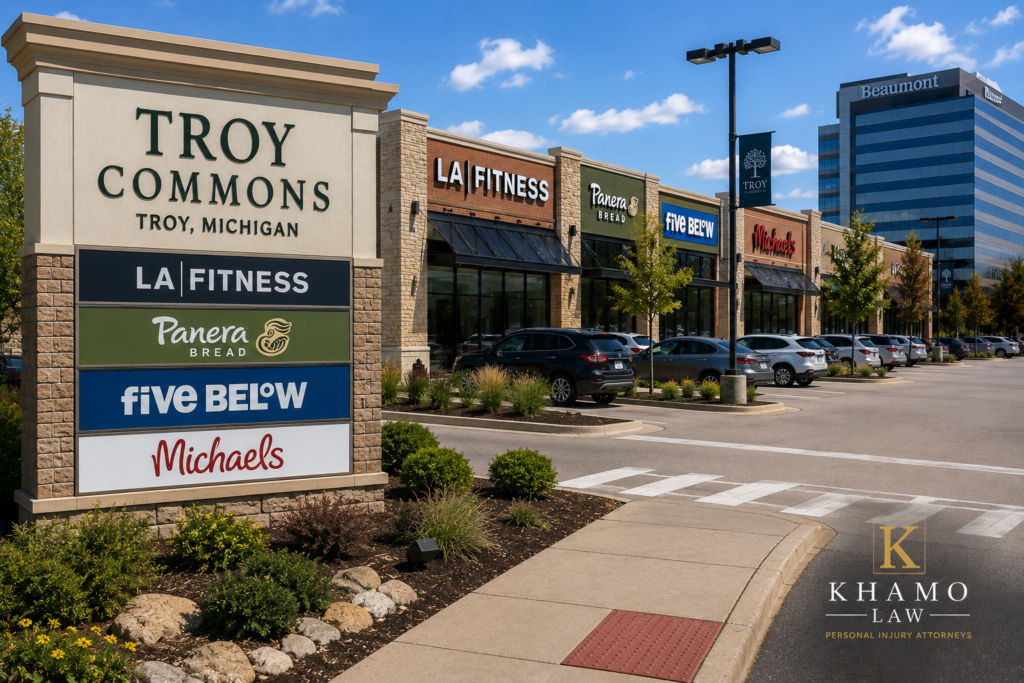
Unsafe property conditions in Troy can require investigation of ownership, maintenance, inspections and available evidence.
What Is Premises Liability?
Premises liability is an area of Michigan personal injury law involving injuries caused by dangerous conditions on land or property.
Potential premises liability cases may involve:
- Defective stairs
- Loose or broken handrails
- Falling merchandise
- Unsafe shelving
- Uneven flooring
- Poorly maintained walkways
- Potholes
- Broken pavement
- Inadequate lighting
- Unsafe entrances or exits
- Defective doors or gates
- Dangerous construction or repair areas
- Snow and ice conditions
- Wet or slippery floors
- Other unsafe property conditions
A premises liability claim does not automatically exist simply because someone was injured on another person’s property.
Important questions can include who possessed or controlled the property, what condition caused the injury, what responsibility the defendant had for that condition, what the defendant knew or should have known, and whether the condition caused the injuries.
For a more detailed explanation of the statewide legal framework, see our Michigan Premises Liability Laws resource.
Premises Liability vs. Slip and Fall Accidents
A slip and fall is one type of premises liability case, but premises liability is broader.
This page focuses on unsafe-property claims involving conditions such as:
- Defective stairs
- Broken railings
- Falling objects
- Dangerous entrances
- Structural hazards
- Poor lighting
- Parking-area defects
- Defective fixtures
- Other unsafe property conditions
If your injury specifically resulted from slipping or tripping on a dangerous walking surface, visit our Troy Slip and Fall Lawyer page.
For broader statewide information about fall claims, Khamo Law also maintains a Michigan Slip and Fall Lawyer resource.
Keeping these pages separate allows the Troy premises liability page to remain the broader unsafe-property resource while the Troy slip-and-fall page addresses the narrower fall-specific topic.
Where Premises Liability Accidents Can Happen in Troy
Unsafe-property injuries can occur at many types of Troy properties, including:
- Retail stores
- Grocery stores
- Restaurants
- Hotels
- Shopping properties
- Office buildings
- Apartment complexes
- Parking lots
- Parking structures
- Private homes
- Common areas
- Sidewalks and walkways
- Commercial entrances
- Other properties open to visitors
Troy includes a substantial mix of retail, office, residential, hospitality, and commercial properties. Each premises liability case should therefore be investigated based on the actual property and the people or companies responsible for maintaining it.
The type of property can affect who controls the area, who performs inspections and maintenance, what surveillance may exist, and what records should be preserved.
Premises Liability Accidents at Stores and Businesses
Customers can encounter unsafe conditions at stores, restaurants, shopping properties, hotels, and other businesses.
Potential hazards may include:
- Merchandise left in aisles
- Falling products
- Broken shelving
- Damaged flooring
- Unsafe entryways
- Poor lighting
- Defective stairs
- Unmarked elevation changes
- Parking-lot defects
- Wet or contaminated floors
After an injury at a business, employees may create an incident report.
The property may also have surveillance cameras, inspection records, cleaning logs, maintenance records, or other evidence showing what happened before and after the injury.
Because some of that evidence can disappear, identifying it promptly can be important.
Apartment and Rental-Property Injuries
Premises liability claims can also arise at apartments and rental properties.
Potentially dangerous conditions may exist in:
- Stairwells
- Hallways
- Common entrances
- Parking areas
- Walkways
- Laundry areas
- Shared recreational spaces
- Other common areas
Responsibility may depend on who possessed or controlled the particular area and who was responsible for inspection, maintenance, repair, or snow and ice removal.
Depending on the facts, potentially relevant parties may include a landlord, property-management company, contractor, maintenance company, or another party responsible for the area.
Parking Lot and Parking Structure Injuries
Parking areas can create risks when walking surfaces, stairs, ramps, lighting, curbs, or other features are not reasonably maintained.
Potential conditions may include:
- Potholes
- Broken pavement
- Uneven surfaces
- Damaged curbs
- Poor lighting
- Snow or ice
- Debris
- Defective stairs
- Unsafe ramps
An investigation may consider who owned or controlled the parking area, who was responsible for maintenance, whether the condition had been reported, and whether repairs or warnings were provided.
Photographs taken soon after the injury may be particularly important because parking-area conditions can change through repairs, snow removal, resurfacing, or maintenance.
Defective Stairs and Handrails
Stairs can cause serious injuries when they are damaged, uneven, inadequately maintained, poorly lit, or missing appropriate railings.
Potential evidence can include:
- Photographs
- Measurements
- Surveillance footage
- Witness statements
- Maintenance records
- Repair records
- Inspection information
- Building records where relevant
Documenting the condition before repairs or alterations are made can help preserve evidence of what existed when the injury occurred.
Falling Merchandise and Objects
Premises liability is not limited to falls.
Visitors can also be injured by objects that fall from shelves, displays, fixtures, elevated areas, or work zones.
A falling-object investigation may examine:
- How merchandise was stacked
- Whether shelving was secure
- Whether employees handled the display
- Whether similar problems had been reported
- Inspection practices
- Surveillance footage
- Witness accounts
- Photographs of the area
The responsible party will depend on the actual circumstances.
Poor Lighting and Visibility Hazards
Inadequate lighting can make stairs, elevation changes, damaged pavement, obstacles, and other conditions more difficult to see.
Relevant evidence may include:
- Photographs
- Surveillance footage
- Witness statements
- Maintenance records
- Lighting-repair records
- The location of fixtures
- Whether lighting was functioning at the time
When lighting is an important issue, conditions at the time of the accident may matter more than photographs taken days or weeks later.
Who May Be Responsible for an Unsafe Property?
The property owner is not always the only potentially responsible party.
Depending on the circumstances, responsibility may involve:
- A property owner
- A commercial tenant
- A business operating on the property
- A landlord
- A property-management company
- A maintenance contractor
- A snow or ice removal company
- A construction contractor
- Another company responsible for part of the premises
Contracts and maintenance agreements can become important because they may identify who agreed to inspect, clean, repair, maintain, or control the area.
A thorough investigation should identify the people and businesses actually connected to the hazardous condition rather than assuming only the titled owner can be responsible.
Michigan Premises Liability Law
Michigan premises liability law examines the duties owed by people who possess or control property and the circumstances surrounding the dangerous condition.
Michigan’s legal framework changed significantly with the Michigan Supreme Court’s decision in Kandil-Elsayed v. F & E Oil, Inc..
Because those rules apply throughout Michigan rather than only in Troy, this page provides a practical summary while our Michigan Premises Liability Laws page provides the deeper statewide discussion.
What If the Dangerous Condition Was Open and Obvious?
Do not assume that a premises liability claim automatically fails because a hazard was visible.
After Kandil-Elsayed, Michigan no longer treats the open-and-obvious nature of a condition under the former framework that automatically eliminated a land possessor’s duty in many cases.
The visibility of a condition can still matter when evaluating whether reasonable care was used and whether the injured person shares some responsibility.
Potentially relevant evidence may include:
- Lighting
- Property layout
- Visibility
- Distractions
- Weather
- Warnings
- Photographs
- Surveillance footage
- Witness statements
The circumstances should be evaluated from the evidence rather than relying only on the label “open and obvious.”
What Evidence Matters in a Troy Premises Liability Case?
Unsafe-property claims often depend heavily on evidence showing what the property looked like when the injury occurred.
Potential evidence may include:
- Photographs of the hazard
- Video of the surrounding area
- Surveillance footage
- Witness information
- Incident reports
- Inspection records
- Cleaning records
- Maintenance records
- Repair records
- Prior complaints when relevant
- Contracts with maintenance companies
- Medical records
- Employment records
- Insurance correspondence
The condition itself may change quickly.
A spill can be cleaned. Broken pavement can be repaired. Snow can be removed. Lighting can be fixed. Defective equipment can be replaced. Merchandise can be rearranged.
That makes early documentation important.
Surveillance Video After a Property Injury
Stores, apartment complexes, hotels, office buildings, parking facilities, and other properties may use surveillance systems.
Video may potentially show:
- How the condition developed
- How long it existed
- Whether employees encountered the condition
- Whether warnings were present
- The accident itself
- Conditions immediately before or after the injury
Video is not guaranteed to exist, and businesses may retain footage for different periods.
Identifying potential cameras as soon as reasonably possible can therefore be valuable.
Incident Reports, Maintenance Records, and Inspection Records
Businesses and property managers may create records concerning:
- The accident
- Property inspections
- Cleaning
- Repairs
- Maintenance
- Complaints
- Snow or ice treatment
- Building conditions
These records can help establish who was responsible for the area and what occurred before the injury.
Which records matter depends on the type of hazard involved.
Common Injuries in Premises Liability Accidents
Unsafe-property accidents can cause injuries such as:
- Traumatic brain injuries
- Concussions
- Spinal injuries
- Broken bones
- Shoulder injuries
- Knee injuries
- Hip injuries
- Back injuries
- Cuts and lacerations
- Nerve damage
- Scarring
- Other serious injuries
For significant neurological injuries, visit our Troy Brain Injury Attorney and Troy Spinal Cord Injury Attorney pages.
What Compensation May Be Available?
Compensation depends on the injuries and circumstances of the case.
Potential damages may include:
- Emergency treatment
- Hospital expenses
- Doctor visits
- Surgery
- Rehabilitation
- Physical therapy
- Medication
- Future medical expenses
- Lost income
- Reduced earning capacity
- Pain and suffering when legally recoverable
- Disability
- Scarring or disfigurement
- Loss of normal activities
- Other legally recoverable losses
There is no universal settlement value for a premises liability case.
Potential value depends on factors including the severity of the injuries, treatment, future needs, financial losses, evidence of responsibility, comparative fault, insurance coverage, and long-term effects.
Insurance Issues After a Premises Liability Accident
Premises liability claims may involve insurance carried by:
- Businesses
- Property owners
- Commercial landlords
- Homeowners
- Apartment complexes
- Property-management companies
- Contractors
- Other potentially responsible parties
Insurance companies may investigate whether the insured controlled the property, whether a dangerous condition existed, how long it existed, whether warnings were provided, and whether the injured person shares responsibility.
The existence of insurance coverage does not establish liability.
A premises liability investigation should first determine what happened and who may legally be responsible.
What If I Was Partly Responsible?
Michigan applies comparative-fault principles to personal injury claims.
Under MCL 600.2959, damages can be reduced according to the injured person’s percentage of fault.
An insurer may argue that an injured person:
- Was not paying attention
- Should have noticed the condition
- Ignored a warning
- Chose an unsafe route
- Otherwise contributed to the accident
Those allegations should be tested against the evidence rather than automatically accepted.
What Should You Do After an Injury on Someone Else’s Property?
Your medical needs should come first.
When circumstances allow:
- Report the accident to the property owner, business, manager, landlord, or another responsible person.
- Seek appropriate medical treatment.
- Photograph the exact condition that caused the injury.
- Photograph the surrounding area.
- Obtain witness names and contact information.
- Ask whether an incident report was created.
- Note nearby surveillance cameras.
- Preserve shoes, clothing, or damaged personal property when relevant.
- Keep medical bills and treatment records.
- Document missed work and lost income.
- Save communications from the property owner or insurer.
- Be cautious about signing documents or accepting a settlement you do not understand.
For more detailed statewide guidance, see our Steps to Take After a Premises Liability Accident in Michigan.
Troy Property and Code Resources
Local government information can sometimes provide useful context when investigating the condition of a Troy property.
The City of Troy Building Department administers local building-related permitting and inspection functions.
The City of Troy Planning Department also provides information concerning local property, planning, zoning, and development matters.
Troy maintains a Citizen Request Portal that residents can use for city service and code-related requests.
These municipal resources do not determine whether someone is civilly liable for an injury, but they may provide useful context when researching local property conditions.
How Long Do You Have to File a Michigan Premises Liability Lawsuit?
Michigan’s general personal-injury limitations statute provides a three-year period for most actions seeking damages for injury to a person, subject to exceptions and other rules.
The statutory language appears in MCL 600.5805.
Different procedures or shorter notice requirements may apply in particular situations, including some claims involving governmental entities.
Do not assume every property-injury claim has exactly the same deadline.
Acting promptly can also help preserve surveillance video, photographs, witness information, maintenance records, and other evidence.
Fatal Premises Liability Accidents
Unsafe property conditions can sometimes cause fatal injuries.
When legally actionable conduct causes a death, Michigan wrongful-death law may apply.
For more information about those claims, visit our Troy Wrongful Death Attorney page.
Why Choose Khamo Law for a Troy Premises Liability Case?
Premises liability cases can involve disputes concerning property control, maintenance responsibility, inspections, surveillance footage, notice, comparative fault, insurance coverage, and serious injuries.
Khamo Law can investigate:
- Who owned or controlled the property
- What condition caused the injury
- What evidence exists
- Whether maintenance or inspection records are available
- Whether surveillance footage may exist
- Whether another company had responsibility for the area
- What injuries and financial losses resulted
- What insurance coverage may apply
Khamo Law has a Troy office at:
1120 E. Long Lake Road
Suite 250
Troy, MI 48085
Personal injury cases are handled on a contingency-fee basis.
Call 248-466-0606 for a free consultation.
Troy Premises Liability Attorney FAQs
Is a slip and fall the same as premises liability?
A slip and fall is one type of premises liability case. Premises liability can also involve defective stairs, unsafe railings, falling merchandise, poor lighting, unsafe entrances, structural hazards, and other dangerous property conditions.
Can a business be responsible for an injury on its property?
Potentially. Responsibility depends on who possessed or controlled the property, what legal duties existed, what condition caused the injury, and whether reasonable care was used under the circumstances.
What if the dangerous condition was obvious?
An obvious condition does not automatically eliminate a premises liability claim under Michigan’s current framework. The visibility of the condition can still matter to the analysis, including breach and comparative fault.
What if a property-management or maintenance company controlled the area?
That company may be relevant depending on its contractual responsibilities, actual control of the area, conduct, and the circumstances surrounding the injury.
Should I take photographs after a premises liability accident?
When it can be done safely and without delaying necessary medical care, photographs of the exact condition and surrounding area may be valuable because property conditions can change quickly.
What if surveillance cameras recorded the accident?
Identify the cameras promptly. Video may be overwritten or deleted according to ordinary retention practices.
What if I was partly at fault?
Michigan comparative-fault law can reduce damages based on the percentage of fault assigned to the injured person.
How long do I have to file a premises liability case?
Michigan’s general limitations statute provides three years for most personal-injury actions, but exceptions and different procedural requirements may apply.
How much is a Troy premises liability case worth?
There is no standard value. Potential compensation depends on the injuries, medical treatment, future needs, lost income, long-term effects, evidence of responsibility, comparative fault, and available insurance.
How much does it cost to hire Khamo Law?
Khamo Law handles personal injury matters on a contingency-fee basis. Attorney fees depend on obtaining a recovery rather than hourly billing throughout the case.
Talk With a Troy Premises Liability Attorney
If you were injured because of a dangerous condition at a store, apartment complex, hotel, office building, parking area, home, or other property in Troy, Khamo Law can investigate the condition, identify potentially responsible parties, preserve important evidence, evaluate insurance coverage, and pursue compensation supported by the facts.
Call 248-466-0606 or contact Khamo Law online for a free consultation.