






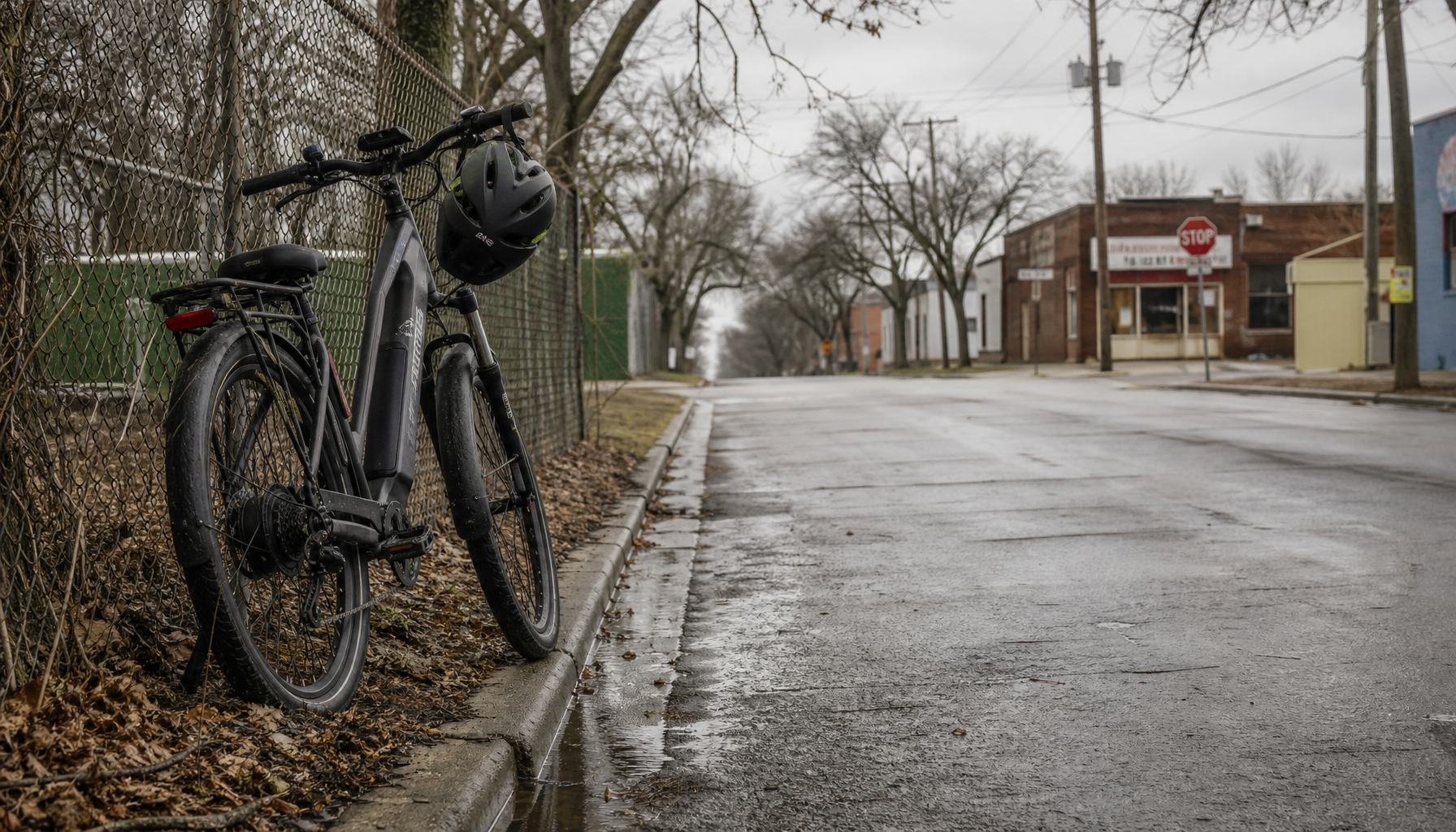
When an e-bike crash kills someone, Michigan families have the right to file a wrongful death claim — and in most cases, they have three years from the date of death to do it. The process involves the no-fault system, potential third-party liability, and a probate court appointment. It is not simple, and insurers will not walk you through it. A Detroit bicycle accident lawyer can.
A Lincoln Park family is now living that reality. According to WDIV Local 4, a mother was killed in an e-bike crash in Lincoln Park, and her family is now speaking out to warn others. Lincoln Park sits in Wayne County, just south of Detroit along Dix Highway — a corridor with heavy traffic, driveways cutting across bike routes, and very few protected lanes. This was not a freak accident in an isolated spot. It happened where people live and ride every day.
If your family is dealing with something similar — a loved one killed or seriously hurt on an e-bike — the information below is for you. Our attorneys handle Detroit bicycle accident claims and Michigan bicycle accident cases across Wayne, Macomb, and Oakland counties. For more information about Michigan E-Bikes, here is our resource.
What Happens Legally After a Fatal E-Bike Crash in Michigan
Michigan’s legal system treats a fatal crash differently from an injury crash, and the differences matter from day one.
When someone dies, the right to sue passes to their estate — not automatically to the spouse or children. A personal representative has to be appointed through probate court first. That step alone surprises most families, and it takes time. The clock on the wrongful death statute of limitations keeps running while probate sorts itself out.
Under MCL 600.5805(2), the general personal injury statute of limitations in Michigan is three years. Wrongful death claims follow the same timeline. Three years sounds like a long time. It isn’t, once you account for probate, investigation, gathering crash reports, and trying to figure out who is actually liable.
Who Can File a Wrongful Death Claim
Under Michigan’s Wrongful Death Act (MCL 600.2922), the personal representative of the deceased person’s estate files the lawsuit. Damages recovered are then distributed to the surviving spouse, children, parents, or other dependents — depending on who is left and what losses they suffered. Those losses can include:
- Loss of financial support
- Loss of companionship and society
- Funeral and burial expenses
- Medical bills incurred before death
- Pain and suffering the deceased experienced between the crash and death
No checklist covers every family’s situation, but those are the categories Michigan courts recognize.
E-Bikes and Michigan No-Fault Insurance — a Real Source of Confusion
Here’s where most families get tripped up. Michigan’s no-fault law was written for cars. E-bikes are newer, and the rules around them are still catching up.
As of recent amendments to the Michigan Vehicle Code, Class 1, 2, and 3 e-bikes are generally treated more like bicycles than motor vehicles for licensing and registration purposes. But that classification affects who owes PIP benefits — and the answer isn’t always obvious.
If the e-bike rider was struck by a car or truck, the at-fault driver’s insurance is the first place to look for both no-fault PIP benefits and third-party liability. Under MCL 500.3107, PIP benefits cover medical expenses, lost wages, and replacement services. In a fatal crash, the estate can also claim survivor’s loss benefits for up to three years.
If no motor vehicle was involved — say, the crash was a solo fall or a collision with a fixed object — the picture is more complicated. The rider’s own household auto policy may cover them, or it may not, depending on how the policy is written and how Michigan defines the e-bike in question.
According to NHTSA data, e-bike fatalities and injuries have risen sharply as ridership has increased — with thousands of emergency department visits attributed to e-bikes annually. Michigan has seen the same trend. The law hasn’t fully caught up to the hardware.
Why the E-Bike’s Classification Matters
Michigan law defines three classes of e-bikes based on motor output and whether the motor assists only while pedaling or can propel the bike independently:
- Class 1: Pedal-assist only, motor cuts off at 20 mph
- Class 2: Throttle-assisted, motor cuts off at 20 mph
- Class 3: Pedal-assist only, motor cuts off at 28 mph
The class affects where the bike can legally be ridden and, in some disputes, whether a manufacturer or retailer could be liable for a defect. If the e-bike malfunctioned — brake failure, throttle sticking, battery fire — there may be a product liability claim on top of the crash claim.
Who Might Be Liable in a Lincoln Park-Area E-Bike Fatality
Liability in a fatal e-bike crash doesn’t always land in one place. Depending on what happened, responsible parties could include:
- The driver of a motor vehicle that struck the rider — this is the most common scenario and typically the most straightforward path to a third-party claim
- A municipality if a dangerous road condition, missing signage, or defective infrastructure contributed to the crash — Lincoln Park and Wayne County road authorities both have exposure here under certain conditions
- The e-bike manufacturer or retailer if a mechanical defect caused or worsened the crash
- A property owner if the crash happened on private property with a known hazard
Figuring out which of these applies — and which combination — is exactly what a crash investigation does. Police reports are a starting point, but they rarely capture everything.
Steps to Take Right Now If You Lost a Family Member
If you’re reading this in the days after losing someone, here is what matters most:
- Get a copy of the police crash report. In Wayne County, you can request it through the Lincoln Park Police Department or the Michigan State Police, depending on who responded.
- Preserve everything you can. Photos of the scene, the e-bike, the rider’s clothing, any dashcam footage from nearby businesses. Evidence disappears fast.
- Do not give a recorded statement to any insurance company — not the driver’s insurer, not your own — before you’ve spoken with an attorney. Adjusters ask questions designed to limit what they’ll eventually pay.
- Start the probate process. A probate attorney or a personal injury attorney experienced in wrongful death can help you get the personal representative appointed so the estate can act.
- Write down what you remember. Dates, conversations, what you were told at the scene or at the hospital. Memory fades and notes become important later.
- Talk to a lawyer. The consultation is free. The information you get is not.
What Michigan’s Threshold Law Means for Your Claim
Michigan’s no-fault law limits when you can sue a driver for non-economic damages — things like pain, suffering, and loss of companionship. Under MCL 500.3135, a plaintiff must show the injured person suffered death, serious impairment of body function, or permanent serious disfigurement.
Death clears that threshold. If your family member was killed, the threshold is met and a third-party lawsuit against the at-fault driver is available if negligence caused the crash.
For surviving injured riders who aren’t sure whether their injuries meet the threshold, that’s a conversation worth having with an attorney before assuming you don’t have a case. Courts have interpreted “serious impairment of body function” broadly in recent years, and what feels like a minor injury may qualify.
See our broader discussion of why having a bicycle accident attorney matters when the threshold question is in play.
The Dix Highway Corridor and Lincoln Park Road Conditions
Lincoln Park’s road grid was designed decades before e-bikes existed. Dix Highway, Fort Street, and Southfield Road carry significant traffic volumes, and most of the side streets have no bike infrastructure at all. Riders share lanes with cars, trucks, and delivery vehicles — often without any buffer.
Our five-year crash analysis of Michigan pedestrian and cyclist incidents shows that Wayne County roads outside the City of Detroit — including communities like Lincoln Park, Wyandotte, and Allen Park — account for a disproportionate share of serious cyclist injuries. The infrastructure gap is real.
When a crash happens on a road like that, the question isn’t just “who ran the stop sign.” It’s also whether the road design, signage, and maintenance met the standard required by law.
Frequently Asked Questions
Can my family sue after an e-bike fatality in Michigan even if the rider wasn’t wearing a helmet?
Yes. Michigan doesn’t require helmets for adult e-bike riders, and the absence of a helmet doesn’t bar a wrongful death claim. It could come up in arguments about comparative fault, but it doesn’t eliminate your family’s right to recover damages. An attorney can address how that argument plays out in your specific case.
Does the e-bike rider’s own auto insurance cover an e-bike crash?
It depends on the policy. Some Michigan auto policies extend PIP coverage to household members injured on e-bikes when a motor vehicle is involved in the crash. Others don’t. The e-bike’s classification and how the policy defines “motor vehicle” both matter. This is one of the first things an attorney will review.
How long does a wrongful death case in Michigan take?
Most wrongful death cases take one to three years from filing to resolution, though some settle faster and some go longer if they go to trial. The probate process to appoint a personal representative adds a few months at the front end. Starting early gives your attorney more time to investigate and negotiate from a position of strength.
What if the driver who hit the e-bike doesn’t have insurance?
Michigan requires uninsured motorist (UM) coverage as an option on auto policies. If the at-fault driver had no insurance, your family may be able to claim against the deceased’s own household policy if it included UM coverage. The Michigan Assigned Claims Plan may also provide a path to PIP benefits in certain situations.
Is there a difference between a wrongful death claim and a survival action in Michigan?
Yes. A wrongful death claim compensates the family members who lost their loved one — for their losses going forward. A survival action compensates the estate for what the deceased person suffered before death: medical bills, pain, and lost wages from the time of the crash to the time of death. In Michigan, both can be pursued together under MCL 600.2922. A lawyer will make sure neither is missed.
What if the e-bike malfunctioned and that caused the crash?
If a defect in the e-bike itself — a brake failure, a throttle that wouldn’t disengage, a battery that caught fire — contributed to the crash, the manufacturer, distributor, or retailer may face product liability. That claim runs parallel to any negligence claim against a driver. Preserving the e-bike as evidence is important from the very first day.
If you lost a family member in an e-bike crash — in Lincoln Park, anywhere along the Downriver corridor, or elsewhere in Wayne County — talk to us before you sign anything or speak to an insurer. Khamo Law, PLLC offers a free consultation. Call 248-466-0606 or reach us through the contact form on our site. We serve Detroit, Lincoln Park, and the surrounding communities throughout Wayne, Macomb, and Oakland counties.