






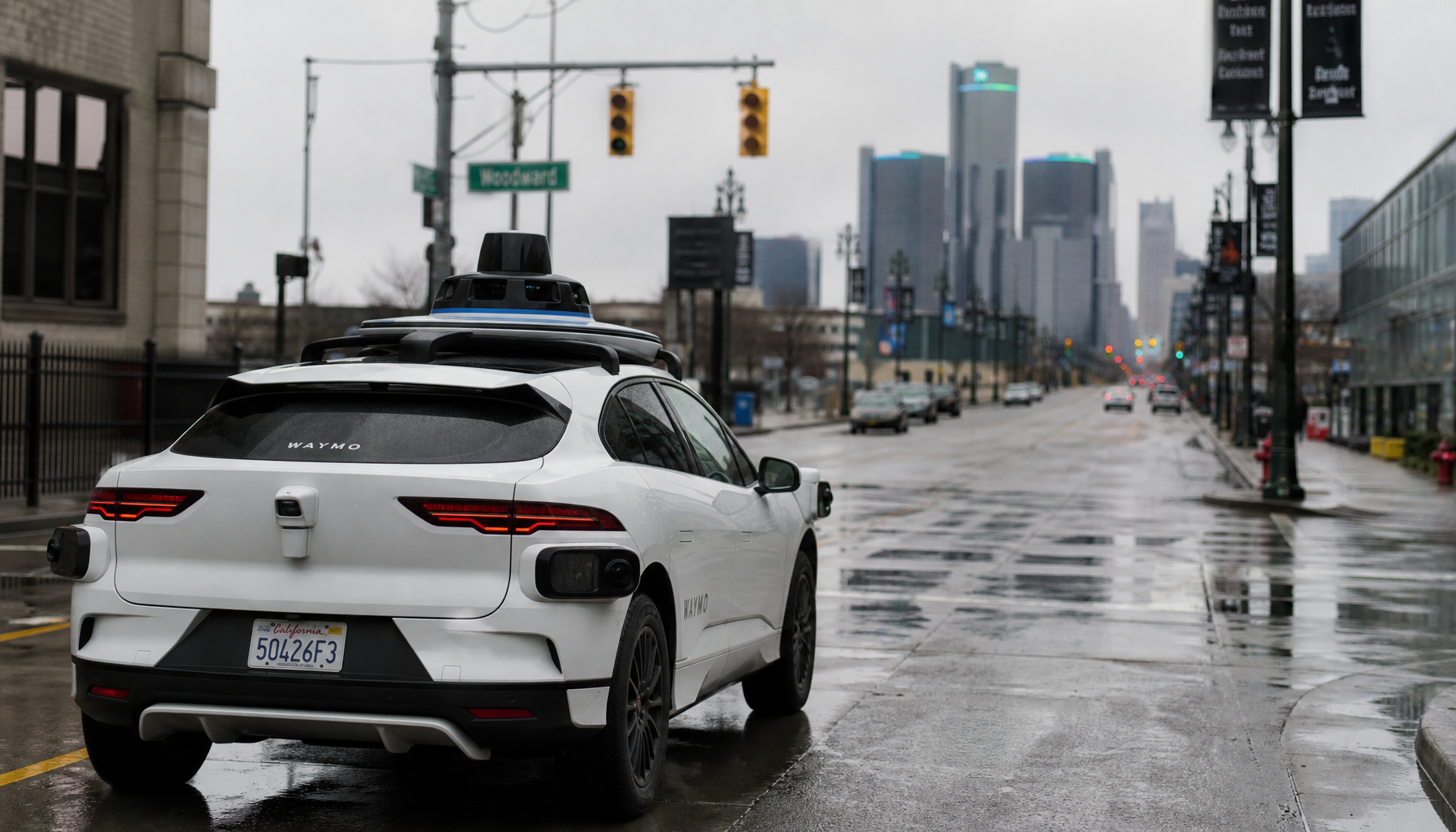
Waymo’s fully autonomous vehicles are now operating on Detroit streets — and that raises a question most Michigan drivers haven’t had to think about before: if one of those cars hits you, who is responsible? Autonomous vehicle accident liability in Michigan falls on the vehicle’s manufacturer, the software developer, a human operator, or some combination of all three — depending on what went wrong. Michigan’s no-fault system still applies, but figuring out who owes you what is more complicated than a standard two-car crash.
As reported by ClickOnDetroit / WDIV Local 4, Waymo began fully autonomous rides in Detroit — no safety driver, no human backup behind the wheel. That’s a first for this city. If you’ve already seen one of those white vehicles on Jefferson or Woodward, this is what you need to know before you’re ever involved in a crash with one.
If you’ve been hurt in any kind of crash on Detroit roads, an experienced Detroit car accident lawyer can help you sort out who’s liable before the insurance companies do it for you. Waymo accidents add a layer of complexity that a standard fender-bender doesn’t have — and that complexity usually benefits the company, not you, if you’re navigating it alone. Our broader guide to Michigan car accident claims covers the no-fault framework that applies to every crash in the state, including those involving autonomous vehicles.
How Autonomous Vehicle Accident Liability Works in Michigan
Michigan is one of the most AV-forward states in the country. The legislature passed laws specifically allowing fully driverless vehicles to operate here, and Waymo’s Detroit launch is a direct result of that legal opening. But the law on who pays when one of these cars causes a crash is still catching up.
When a human driver causes an accident, liability is relatively straightforward: the at-fault driver’s insurance covers damages, and Michigan’s no-fault system covers your own medical bills regardless of fault. With a driverless car, there’s no at-fault driver — at least not a human one. That shifts the focus to three other parties.
The Vehicle Manufacturer
If a defect in the car’s physical hardware — brakes, sensors, steering — contributed to the crash, the manufacturer could face a product liability claim. This isn’t unique to autonomous vehicles. Auto manufacturers have faced defect claims for decades. What’s different here is that the “defect” might be harder to identify and the company has significant resources to contest it.
The Software Developer (Waymo itself)
Waymo doesn’t just make the car — it makes the brain. The software system that decides when to stop, when to turn, and how to respond to a pedestrian stepping off a curb is Waymo’s product. If that system made a bad decision that a reasonably designed AI should not have made, Waymo could be liable under a product liability theory. According to NHTSA’s Standing General Order on crash reporting, automated driving system companies are required to report crashes to the federal government — which means there’s already a paper trail when things go wrong.
A Human Operator or Third Party
Even in a fully autonomous vehicle, there may be a remote human monitor. And the other driver in the crash might have been the one at fault. Autonomous vehicle accident liability doesn’t automatically mean Waymo pays — it means every possible cause has to be investigated carefully.
Michigan No-Fault Still Applies — Up to a Point
Under MCL 500.3107, Michigan’s Personal Injury Protection (PIP) benefits cover your medical expenses, lost wages, and replacement services regardless of who caused the crash. That part doesn’t change just because the other vehicle drove itself. Your own PIP policy kicks in first.
The harder question is non-economic damages — pain, suffering, permanent injury. Under MCL 500.3135, you can only pursue those damages against a third party if your injury meets a legal threshold: serious impairment of a body function, permanent serious disfigurement, or death. If your injury clears that bar, you can bring a claim against whoever was responsible for the AV’s actions — and that’s where having a skilled car accident lawyer in Detroit becomes the difference between a real recovery and a denial letter.
Michigan’s three-year statute of limitations under MCL 600.5805(2) still applies. Don’t assume the clock isn’t running just because the case is complicated.
What Makes AV Crash Cases Different From Regular Accidents
A few things change when the vehicle that hit you has no human driver.
Evidence collection is different. Waymo vehicles generate enormous amounts of sensor data — LIDAR point clouds, camera footage, accelerometer readings, GPS logs. That data exists, Waymo has it, and they won’t hand it over voluntarily. Preserving and obtaining that evidence requires legal action, and it has to happen quickly before data is overwritten or “archived.”
The defense will be well-funded. Waymo is a subsidiary of Alphabet — Google’s parent company. Their legal team is not a small regional insurer. If you’re making a claim against them, you want someone on your side who isn’t intimidated by that.
Liability may be spread across multiple defendants. The car’s manufacturer, Waymo’s software division, a third-party sensor maker, and a maintenance contractor could all share responsibility. A thorough investigation has to look at all of them.
Federal regulators are watching. NHTSA has been collecting AV crash data since 2021. The NHTSA AV crash data portal shows hundreds of reported incidents nationally. That data can support your case — or become part of Waymo’s defense. It matters who knows how to use it.
Steps to Take If a Waymo Vehicle (or Any AV) Hits You
- Call 911 and get a police report. The report should note that the vehicle was operating autonomously — make sure the officer records that.
- Photograph everything: the Waymo vehicle, its sensor pods, any visible damage, the scene, your injuries.
- Note the time and location precisely. AV systems log data by timestamp and GPS, so accuracy matters.
- Get medical attention the same day, even if you feel okay. Soft-tissue injuries from crashes can take hours or days to fully present.
- Do not speak to Waymo’s insurance representatives or sign anything. Their adjusters are not on your side.
- Contact an attorney before your PIP insurer asks for a recorded statement. What you say in those early conversations can affect your claim.
For a fuller picture of how the post-crash process works, our post on dealing with insurance companies after a Detroit crash walks through what to expect and what to avoid.
Detroit’s Roads Present Specific Challenges for AV Systems
Detroit’s infrastructure is uneven. Potholes on the Lodge. Lane markings worn off on parts of I-94. Construction zones that shift weekly. AV systems trained in Phoenix or San Francisco may behave unpredictably on Detroit streets — and Waymo knows that, which is why the Detroit launch was phased. But “phased” doesn’t mean “safe,” and the most dangerous corridors in metro Detroit aren’t forgiving of a software miscalculation.
When road conditions contributed to a crash — a pothole that caused an AV to swerve, a missing lane marking that confused its sensors — there may also be a government liability angle. Our post on the Telegraph Road sinkhole and driver rights covers how government liability for road conditions works in Michigan.
What Michigan Law Still Doesn’t Answer
Here’s the honest truth: Michigan law hasn’t fully resolved autonomous vehicle accident liability. The statutes that govern negligence and product liability were written for a world with human drivers. Courts will eventually fill in the gaps, but the first cases to go through the system will be the ones that set the standard.
That means victims who settle quickly — without an attorney, before the full picture is known — may be giving up far more than they realize. A company like Waymo has every incentive to close claims fast and cheap.
For context on how injury settlements work in this city, our guide to car crash injury settlements in Detroit breaks down what goes into a fair number and what insurers don’t volunteer to tell you.
Frequently Asked Questions
Can I sue Waymo if one of their cars hits me in Detroit?
Yes, you can bring a claim against Waymo if their autonomous vehicle caused your injuries. The legal theory would typically be product liability — the argument that Waymo’s software or hardware was defective and caused the crash. Michigan’s no-fault system covers your immediate medical costs through PIP, but a separate claim against Waymo or the vehicle manufacturer is how you pursue pain, suffering, and serious injury damages once you clear the threshold under MCL 500.3135.
Who does my PIP claim go through after an AV crash?
Your own Michigan no-fault insurer pays PIP benefits first, regardless of who caused the crash. That covers medical expenses, up to three years of wage loss (subject to monthly caps), and household replacement services. If you don’t have your own no-fault policy, the claim may flow through the Michigan Assigned Claims Plan or the AV owner’s insurer. The rules here are the same as any other crash — the vehicle without a human driver doesn’t change the PIP structure.
How do I get the data Waymo recorded from the crash?
Waymo’s vehicles collect continuous sensor and camera data. To obtain it, your attorney typically sends a litigation hold letter immediately after the crash demanding that Waymo preserve all data related to the incident. If a lawsuit is filed, that data becomes subject to discovery. Waiting too long can result in data being overwritten under routine retention schedules — which is another reason to contact a lawyer quickly, not months later.
Does it matter if a human passenger was in the Waymo vehicle?
For liability purposes, a human passenger in a Waymo robotaxi is not considered the vehicle’s operator. They didn’t control the car and can’t be held responsible for how it drove. Their presence might matter for witness purposes — they may have seen what happened — but it doesn’t shift liability away from Waymo’s autonomous system.
How long do I have to file a claim after an AV accident in Michigan?
Three years from the date of the crash under MCL 600.5805(2). That’s the standard personal injury statute of limitations in Michigan, and it applies to AV crashes the same as any other. If the at-fault party includes a government entity — say, a city vehicle or a road-condition claim — the notice period can be as short as 60 days. Don’t sit on this.
Is there anything special about AV accidents that could hurt my case if I’m not careful?
A few things. Recorded statements made to Waymo’s insurer early on can be used against you later. Delaying medical treatment creates gaps that insurers exploit to argue your injuries weren’t serious. And failing to preserve evidence — photos, location details, witness names — before the scene clears makes reconstruction harder. Autonomous vehicle cases also tend to involve sophisticated defense teams from day one. Getting legal advice before you talk to anyone on Waymo’s side costs you nothing and protects you from mistakes that can’t be undone.
If you’ve been hurt in a crash involving a Waymo vehicle or any autonomous vehicle in the Detroit area, talk to us before you sign anything or give a recorded statement. Khamo Law, PLLC offers a free consultation — call 248-466-0606 or reach us through the contact form on our site. We serve Detroit and the surrounding metro area, and our team includes Arabic-speaking and Chaldean-speaking attorneys for clients who prefer to discuss their case in Arabic or Chaldean.