






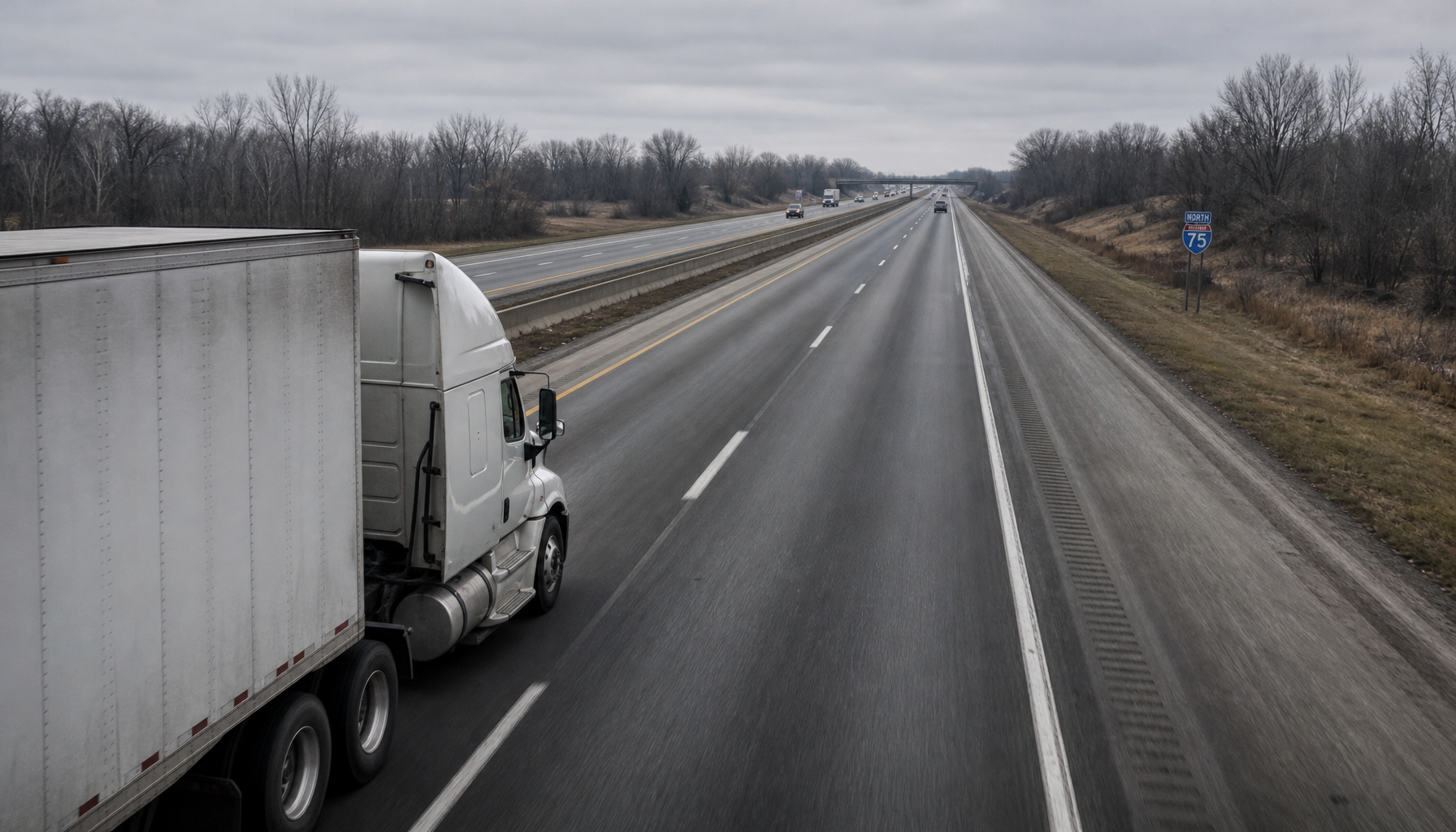
When a commercial truck driver violates federal truck driver hours of service rules — pushing past legal drive-time limits to meet a deadline — and then causes a crash, those violations aren’t just regulatory infractions. They’re evidence of negligence. Under federal law and Michigan’s no-fault system, a documented hours-of-service (HOS) violation can directly support your injury claim and affect how much compensation you can recover.
If you were hit by a semi on I-75 near Flint or Monroe, or on I-94 through the Detroit metro, this is what you need to understand before you talk to an insurance adjuster.
What Are Federal Hours of Service Rules?
Federal hours of service regulations — set by the Federal Motor Carrier Safety Administration under 49 CFR Part 395 — cap how long a commercial truck driver can be on the road before mandatory rest. The rules exist because drowsy driving kills. According to FMCSA’s Large Truck Crash Causation Study, fatigued driving is a recognized factor in a significant share of serious commercial vehicle crashes nationwide.
Here’s what the core rules actually say:
For property-carrying drivers (most semi-truck operators):
- 11-hour driving limit — A driver may drive a maximum of 11 hours after 10 consecutive hours off duty.
- 14-hour window — A driver cannot drive beyond the 14th hour after coming on duty, regardless of breaks taken.
- 60/70-hour weekly limit — Drivers cannot drive after reaching 60 hours on duty in 7 consecutive days (or 70 hours in 8 days for carriers operating every day of the week).
- 30-minute break requirement — A driver who has driven 8 cumulative hours without at least 30 minutes off must take a break before continuing.
- Sleeper berth provision — Drivers using a sleeper berth must take at least 10 hours off, split in a specific way (a minimum 7-hour sleeper period paired with at least 2 hours off).
These aren’t suggestions. They are federal law.
How Michigan Truck Accidents Connect to HOS Violations
Federal HOS rules apply to any commercial motor vehicle operating in interstate commerce — which covers nearly every semi-truck you see on Michigan highways. As an experienced Michigan truck accidents lawyer will tell you, the first thing to investigate after a serious commercial vehicle crash isn’t just the driver’s speed or road conditions. It’s the electronic logging device (ELD) data.
Since December 2017, most commercial carriers have been required by federal law to use ELDs — electronic devices that automatically record driving time and engine activity. If a driver exceeded their legal hours before a crash, that data doesn’t lie. It creates a timestamped record of every violation.
What the ELD data can show
- Exact hours driven in the 24 hours before the crash
- Whether the driver skipped or shortened a mandatory rest period
- Whether the carrier was aware of or directed the violation
- Pattern violations that pre-date the crash
That last point matters. If a carrier has a history of pushing drivers past legal limits — pressuring them with delivery schedules, paying by the load rather than the hour, or ignoring logs — that opens the door to a claim not just against the driver but against the company itself.
Michigan’s I-75 corridor and fatigue-related crashes
I-75 runs more than 395 miles through Michigan, from the Ohio border up through Detroit, Flint, Saginaw, and all the way to the Sault Ste. Marie area. It carries some of the heaviest commercial traffic in the Midwest. Overnight hauls from Ohio and Indiana — where drivers may have already burned through hours before they even cross into Michigan — mean fatigued truckers regularly operate on this stretch of highway. The same is true along US-23 and I-94.
If your crash happened on a highway that sees heavy overnight freight traffic, HOS compliance should be one of the first things your attorney investigates.
Why HOS Violations Matter for Your Injury Claim
Michigan is a no-fault state under the Michigan No-Fault Act (MCL 500.3107), which means your own insurance covers your initial medical bills and lost wages regardless of who caused the crash. But truck accident injuries are frequently severe enough to exceed what PIP benefits cover — and to cross the threshold for pursuing additional damages against the at-fault driver and carrier.
Under MCL 500.3135, you can pursue non-economic damages (pain, suffering, loss of normal life) against an at-fault driver if your injury meets the serious impairment threshold. A documented HOS violation doesn’t just show the driver was tired — it shows the crash was preventable. That’s exactly the kind of evidence that supports a negligence claim.
What HOS violation evidence can support in your claim:
- Negligence per se — the driver broke a federal safety law and caused injury as a direct result
- Negligent entrustment or supervision — the carrier knew or should have known the driver was over-hours
- Punitive damages in extreme cases — if the carrier’s conduct was reckless or deliberate
You have three years from the date of the crash to file a personal injury lawsuit under MCL 600.5805(2). Don’t wait. ELD data, driver logs, and dispatch records can be deleted or lost if your attorney doesn’t send a spoliation letter quickly.
How to Recognize Signs of Driver Fatigue at the Scene
You may not know the driver was over-hours until your attorney subpoenas the records. But certain facts at the scene point toward fatigue as a cause:
- The crash happened between midnight and 6 a.m., or between 2 p.m. and 4 p.m. (the two windows when drowsy-driving risk peaks, per the CDC)
- The truck drifted into another lane without braking
- There were no skid marks, suggesting the driver made no attempt to stop
- The driver seemed confused or disoriented after the crash
- It was a long-haul rig, not a local delivery vehicle
Document everything you can at the scene. Photograph the truck’s DOT number and license plate. Get the driver’s employer name from the cab door. Write down the time — that matters for HOS calculations.
For a full breakdown of what to do in the immediate aftermath, see our guide on steps to take after a truck accident in Michigan.
What Carriers Do to Hide Violations — and How Attorneys Find Them
Some carriers know their drivers are routinely over-hours. They also know what happens if that gets out after a crash. Here’s what your attorney should be looking for:
- Falsified paper logs — Before ELDs became mandatory, paper logbook fraud was common. Some carriers still use paper logs for short-haul exemptions, and those can be altered.
- Multiple log books — The old practice of keeping two sets of logs — one for inspectors, one with actual hours — still surfaces in litigation.
- GPS data inconsistencies — Truck GPS records can contradict a driver’s official log if the ELD was tampered with or the carrier used an exemption improperly.
- Dispatch records — Text messages and load dispatch software often show when a driver was assigned a load that was physically impossible to complete within legal hours.
Carriers are required under 49 CFR Part 396 to maintain inspection, repair, and maintenance records. Those records — alongside ELD data — form a paper trail that an experienced attorney can use to build your case.
To understand the broader landscape of why these crashes happen, our post on common causes of truck accidents in Michigan covers HOS violations alongside other contributing factors.
Who Is Liable When a Fatigued Trucker Causes a Crash?
The driver isn’t always the only responsible party — and in many cases, isn’t even the most financially significant one. Depending on the facts:
- The trucking company may be liable if it pressured drivers to skip rest, set impossible delivery schedules, or failed to audit driver logs
- A freight broker may share liability if it hired a carrier with a known safety violation history
- A shipper may be responsible if unrealistic loading or departure times made legal HOS compliance impossible
- A leasing company may be liable if it placed a fatigued driver with a carrier without proper vetting
This is why it matters that your attorney moves fast and sends preservation letters to all potentially liable parties — not just the driver’s employer.
If you were hit by a commercial truck in Michigan and aren’t sure who’s responsible, the answer often requires pulling records from multiple parties.
Frequently Asked Questions
How many hours can a truck driver legally drive in Michigan?
Michigan follows federal FMCSA rules for commercial vehicles in interstate commerce. A property-carrying driver can drive a maximum of 11 hours after 10 consecutive hours off duty, and cannot drive beyond the 14th hour after coming on duty. Weekly limits cap driving at 60 hours over 7 days or 70 hours over 8 days.
What is an electronic logging device (ELD) and why does it matter after a crash?
An ELD is a device connected to a truck’s engine that automatically records drive time, engine status, and location. Since December 2017, most commercial carriers have been required to use them. After a crash, ELD data is some of the most objective evidence available — it shows exactly how many hours a driver had been on duty and whether they violated federal limits before the collision.
Can I sue a trucking company for an hours-of-service violation?
Yes, if the violation caused or contributed to the crash that injured you. A documented HOS violation supports a negligence claim against the driver and potentially a separate negligence claim against the carrier for failing to enforce legal rest requirements. Michigan law allows you to pursue non-economic damages if your injury meets the serious impairment standard under MCL 500.3135.
How long do I have to file a truck accident lawsuit in Michigan?
Three years from the date of the crash, under MCL 600.5805(2). That may sound like a long time, but ELD data, dispatch records, and driver logs can be overwritten or destroyed quickly if no one demands their preservation. The sooner you involve an attorney, the better your chances of securing the records you need.
What if the trucker was an independent contractor, not a company employee?
That distinction matters less than carriers want you to believe. Courts look at the degree of control the carrier exercised over the driver — not just the label on the contract. If the carrier set routes, delivery times, or dispatch schedules, it may still be liable even if the driver was technically classified as an independent contractor.
Does Michigan’s no-fault law limit what I can recover from a fatigued truck driver?
Michigan no-fault law covers your initial medical bills and lost wages through your own PIP coverage, regardless of fault. But it does not cap your ability to pursue additional compensation from the at-fault party — including pain and suffering, long-term disability, and excess economic losses — once your injuries cross the serious impairment threshold set by MCL 500.3135. Truck accidents frequently produce injuries that meet that threshold.
If you were injured by a commercial truck and think the driver may have been over-hours, talk to us before you sign anything — including any release from the carrier’s insurance company. Khamo Law, PLLC offers a free consultation with attorneys who know how to pull ELD data and hold carriers accountable. Call 248-466-0606 or reach us through the contact form. We handle truck accident cases across Michigan. نتكلم العربي والكلداني — تواصل معنا بلغتك.