










A car accident in Detroit can raise several legal and insurance issues at the same time. Depending on the circumstances, an injured person may need to address Michigan No-Fault/PIP benefits, medical expenses, lost wages, vehicle damage, insurance coverage, and a potential claim against an at-fault driver.
Khamo Law represents people injured in car accidents throughout Detroit and Wayne County. When investigating a crash, our attorneys may review police reports, photographs and video, witness statements, vehicle damage, medical records, insurance policies, and other available evidence to determine how the collision occurred and what sources of compensation may be available.
Detroit’s road network includes major freeways and heavily traveled surface streets, and the circumstances of a crash can affect both the investigation and the insurance issues involved. Collisions on I-75, I-94, the Lodge Freeway, or the Southfield Freeway may involve high speeds or multiple vehicles, while crashes on city streets and intersections can raise different questions about right-of-way, traffic signals, witnesses, and available video evidence.
A Detroit car accident claim can become more complicated when fault is disputed, several vehicles are involved, a driver is uninsured or underinsured, the crash involves a commercial or rideshare vehicle, or injuries interfere with a person’s ability to work. Khamo Law handles communications with insurers, documents injuries and financial losses, evaluates available coverage, and pursues claims supported by the evidence and Michigan law.
For representation involving other types of injuries in Detroit, visit our Detroit Personal Injury Attorney page. For a more detailed explanation of Michigan No-Fault benefits, liability, insurance coverage, and compensation after a collision, see our Michigan Car Accident Attorney resource.
Call 248-466-0606 or contact Khamo Law online for a free consultation.
Legally reviewed by Attorney Koro E. Khamo
Founder & Managing Attorney at Khamo Law, PLLC
REPRESENTATIVE RESULTS
Khamo Law has obtained millions of dollars in recoveries for injured clients.
Past results do not guarantee or predict a similar outcome.
Every case depends on its individual facts, injuries, liability,
insurance coverage, and applicable law.
Results That Reflect the Cases We Handle
How a Detroit Car Accident Lawyer Can Help After a Crash
Detroit car accident claims can involve both Michigan No-Fault benefits and potential claims against an at-fault driver.
Khamo Law can help by:
- Investigating how the collision occurred
- Obtaining police and crash reports
- Preserving photographs and video
- Documenting vehicle damage
- Seeking surveillance or dashcam footage
- Identifying witnesses
- Reviewing applicable insurance policies
- Evaluating available PIP benefits
- Documenting medical treatment
- Calculating lost income
- Evaluating future medical and rehabilitation needs
- Responding to comparative-fault allegations
- Negotiating with insurance companies
- Filing a lawsuit when appropriate
- Preparing the case for litigation when necessary
Early investigation can matter because vehicles may be repaired, surveillance footage may be overwritten, road conditions may change, and witnesses may become harder to locate.
Car Accidents in Detroit Have Distinct Local Context
Detroit has a dense transportation network that includes freeways, major arterial roads, neighborhood streets, commercial corridors, transit routes, pedestrian crossings, and freight traffic.
Major Detroit routes include:
- I-75
- I-94
- I-96
- M-10 / Lodge Freeway
- Woodward Avenue
- Gratiot Avenue
- Grand River Avenue
- Michigan Avenue
- Jefferson Avenue
- Eight Mile Road
The location of a crash does not establish fault.
It can, however, affect:
- Which police agency investigated
- What traffic controls were present
- Whether nearby businesses had surveillance cameras
- Roadway configuration
- Construction conditions
- Potential witnesses
- Transit activity
- What local records may be available
Detroit is also implementing its Safe Streets for Detroit program, which includes transportation-safety improvements on priority corridors throughout the city.
Those improvements do not establish negligence in any individual crash, but they provide useful local context when investigating Detroit roadway conditions and available evidence.
Common Causes of Detroit Car Accidents
Detroit car crashes may be caused by:
- Distracted driving
- Texting while driving
- Speeding
- Following too closely
- Failure to yield
- Unsafe lane changes
- Running red lights
- Running stop signs
- Alcohol or drug impairment
- Driving too fast for conditions
- Fatigued driving
- Unsafe turns
- Failure to check blind spots
A collision can involve more than one contributing factor.
Detroit collisions can happen in very different ways depending on the roadway and traffic movement involved. Rear-end crashes, left-turn collisions, freeway accidents, lane-change crashes, hit-and-runs, and intersection collisions can each involve different evidence and liability questions. Our guide to common car accidents in Detroit explains these crash patterns and the evidence that can become important after each type of collision.
T-Bone and Side-Impact Accidents in Detroit
T-bone or side-impact crashes commonly occur at intersections when one vehicle enters the path of another.
Potential causes include:
- Running a red light
- Running a stop sign
- Failure to yield
- Unsafe left turns
- Misjudging approaching traffic
- Distracted driving
Potential evidence may include:
- Traffic-signal information
- Business surveillance footage
- Witness statements
- Dashcam footage
- Vehicle damage
- Crash-scene photographs
Side-impact collisions can cause serious injuries because the side of a passenger vehicle generally provides less distance between the occupant and the point of impact than the front or rear.
Rear-End Collisions
Rear-end crashes may occur when a driver:
- Follows too closely
- Looks at a cellphone
- Drives too fast
- Fails to account for stopped traffic
- Does not react in time
Potential injuries can include:
- Whiplash
- Neck injuries
- Back injuries
- Concussions
- Shoulder injuries
- Nerve injuries
For deeper information about this crash type, visit our Michigan rear-end collision lawyer page.
Hit-and-Run Accidents
A hit-and-run collision can create additional evidence and insurance issues.
Potential evidence may include:
- Witness descriptions
- Surveillance footage
- Dashcam video
- Vehicle debris
- License-plate information
- Traffic-camera footage
If the responsible driver cannot be identified, applicable uninsured-motorist coverage may need to be reviewed.
For the statewide legal and insurance framework, visit our Michigan hit-and-run accident lawyer resource.
Distracted Driving Accidents
Distracted driving may involve:
- Texting
- Social media
- Navigation systems
- Phone calls
- Passengers
- Food
- Other in-vehicle distractions
Evidence may include witness testimony, video footage, statements made after the collision, and cellphone information when legally obtainable.
Drunk or Drug-Impaired Driving Accidents
Alcohol or drug impairment can affect judgment, reaction time, coordination, vision, and vehicle control.
A civil injury claim is separate from any criminal prosecution involving the driver.
Potential evidence may include:
- Police reports
- Toxicology information
- Field sobriety evidence
- Witness statements
- Video
- Other legally relevant records
Multi-Vehicle Accidents
Crashes involving several vehicles can create disputes over the sequence of events and the percentage of responsibility assigned to different drivers.
Evidence may include:
- Vehicle damage patterns
- Event data recorder information
- Dashcam video
- Witness accounts
- Police diagrams
- Crash-scene photographs
- Accident reconstruction evidence when appropriate
More than one driver may share responsibility.
Rollover and High-Impact Crashes
High-impact and rollover collisions can cause severe or catastrophic injuries.
Potential factors can include:
- Excessive speed
- Vehicle instability
- Road departure
- Collision forces
- Multiple impacts
Potential injuries include:
- Traumatic brain injuries
- Spinal injuries
- Broken bones
- Internal injuries
- Nerve damage
- Permanent impairment
For serious neurological trauma, visit our Detroit brain injury attorney page.
Who May Be Responsible for a Detroit Car Accident?
Potentially responsible parties may include:
- Another driver
- More than one negligent driver
- A vehicle owner in circumstances where Michigan law permits liability
- An employer when an employee was acting within the scope of employment
- A commercial motor carrier in a truck-related collision
- Other legally responsible people or companies
Liability depends on the actual evidence.
A serious injury alone does not establish that another person was negligent.
Michigan No-Fault Insurance After a Detroit Car Accident
Michigan uses a No-Fault automobile insurance system.
Personal Injury Protection, or PIP, can provide qualifying benefits for medical care, rehabilitation, wage loss, replacement services, and other covered losses depending on the applicable coverage and circumstances.
Michigan permits multiple PIP medical coverage options. Depending on eligibility and the policy selected, a person may have unlimited coverage, a limited medical coverage level, or another permitted arrangement.
That means it is not accurate to assume every Michigan auto policy provides unlimited medical coverage.
Insurance questions can become more complicated when:
- Multiple policies may apply
- Household members have different coverage
- PIP medical coverage was limited
- A person qualified to opt out or exclude coverage
- The injured person was a passenger
- The injured person did not own a vehicle
- The collision involved an uninsured or underinsured driver
For a deeper statewide explanation, visit our Michigan No-Fault Insurance Lawyer resource.
The Michigan Department of Insurance and Financial Services also provides official information about Michigan auto insurance.
Who Pays Medical Bills After a Detroit Car Accident?
The answer depends on the injured person’s insurance circumstances.
PIP medical coverage may pay qualifying accident-related medical expenses up to the applicable coverage level.
Other insurance may also become relevant depending on the policy, the injured person’s health coverage, and the circumstances of the crash.
Because coverage structures vary, the actual insurance policies should be reviewed rather than assuming the same answer applies to every Detroit collision.
Can PIP Pay Lost Wages?
Michigan PIP may provide qualifying wage-loss benefits when accident-related injuries prevent someone from working.
The amount and duration depend on Michigan law and the person’s circumstances.
A separate claim against an at-fault driver may also involve certain economic losses not fully compensated through No-Fault benefits when Michigan law allows.
Can I Sue the Driver Who Caused the Crash?
Potentially.
Michigan law permits certain claims against an at-fault driver after a motor-vehicle accident.
For noneconomic damages such as pain and suffering, Michigan law generally requires a qualifying injury involving:
- Death
- Permanent serious disfigurement
- Serious impairment of body function
The applicable injury threshold should be evaluated using the medical evidence and the effect of the injury on the person’s life.
What Is a Serious Impairment of Body Function?
Michigan law defines serious impairment of body function through specific statutory requirements.
The analysis generally considers whether the impairment:
- Is objectively manifested
- Involves an important body function
- Affects the injured person’s general ability to lead their normal life
Relevant evidence may include:
- Medical records
- Diagnostic imaging
- Physician evaluations
- Work restrictions
- Physical limitations
- Changes in daily activities
- Changes in recreation, family responsibilities, or independence
The analysis is highly fact-specific and generally involves comparing the person’s life before and after the collision.
What If I Was Partially at Fault?
Michigan applies comparative-fault principles in automobile cases.
The legal effect can depend on the percentage of responsibility and the category of damages involved.
An insurance company may claim that an injured person:
- Was speeding
- Failed to yield
- Was distracted
- Made an unsafe turn
- Failed to maintain control
- Could have avoided the collision
Those allegations should be compared against the actual evidence before responsibility is accepted.
An insurer’s accusation is not the same thing as proof.
Evidence That May Matter After a Detroit Car Accident
Potential evidence includes:
- Detroit Police crash reports
- Crash-scene photographs
- Vehicle photographs
- Dashcam footage
- Nearby business surveillance
- Witness statements
- Traffic-control information
- Cellphone evidence when legally obtainable
- Event data recorder information
- Medical records
- Employment records
- Insurance policies
- Insurance correspondence
In some cases, qualified accident-reconstruction or other expert analysis may also become useful.
Different crashes require different evidence.
Preservation should begin as soon as reasonably practical.
Detroit Police Crash Reports
Detroit Police provides a process for obtaining crash reports.
The City of Detroit’s Detroit Police Department Records and Reports page explains how accident reports may be obtained.
Depending on the request method, identifying information about the crash may be needed, such as:
- Date of the collision
- Location or cross streets
- Identification or other required information
A police report can provide useful details about the people, vehicles, location, and circumstances involved.
It does not automatically determine civil liability.
What Compensation May Be Available?
Depending on the circumstances and applicable law, recoverable losses may include:
- Medical expenses
- Future medical care
- Rehabilitation
- Lost wages
- Reduced earning capacity
- Pain and suffering when legally recoverable
- Disability
- Scarring
- Disfigurement
- Loss of normal activities
- Vehicle or property losses when legally recoverable
- Other damages permitted by Michigan law
Not every category is available in every case. The value of a car accident claim depends on the individual facts rather than an online average or fixed formula. The severity and permanence of the injuries, medical treatment, lost income, effect on daily life, available insurance, evidence, and disputed fault can all matter. Our guide to Detroit car accident settlements and compensation explains these factors and the different sources of compensation that may be involved.
How Much Is a Detroit Car Accident Case Worth?
There is no standard settlement amount.
Potential value can depend on:
- Liability
- Comparative fault
- Severity of the injuries
- Length of treatment
- Whether surgery was required
- Permanent impairment
- Future medical needs
- Lost wages
- Reduced earning capacity
- Pain and suffering
- Available insurance coverage
- Strength of the evidence
- Number of responsible parties
Online “average settlement” figures cannot reliably determine the value of a particular Detroit car accident claim.
What If the Other Driver Has No Insurance?
An uninsured-driver crash may involve several potential sources of recovery.
Depending on the policy and circumstances, these can include:
- PIP benefits
- Uninsured motorist coverage
- Underinsured motorist coverage
- Other legally available claims
Uninsured and underinsured motorist coverage is generally governed by the terms of the applicable insurance policy.
Khamo Law maintains a statewide resource explaining what happens when the at-fault driver does not have insurance in Michigan.
Uber and Lyft Accidents in Detroit
Rideshare crashes can involve additional insurance questions depending on what the driver was doing when the collision occurred.
Coverage issues can depend on whether the driver was:
- Logged into the app
- Waiting for a ride request
- Traveling to pick up a passenger
- Transporting a passenger
For deeper information, visit our Michigan Uber and Lyft accident lawyer resource.
Commercial Vehicle and Truck Accidents
A collision involving a semi-truck, tractor-trailer, delivery truck, or another commercial vehicle can involve different evidence and potentially responsible companies.
Commercial cases may involve:
- Driver qualification records
- Electronic logging information
- Maintenance records
- Inspection records
- Dispatch information
- Electronic vehicle data
- Motor-carrier records
- Commercial insurance
Visit our Detroit truck accident Lawyer page for commercial truck claims.
What Should You Do After a Detroit Car Accident?
Your health and immediate safety come first.
When circumstances allow:
- Move to a safe location when possible.
- Call 911 when appropriate.
- Seek medical attention.
- Exchange required driver and insurance information.
- Photograph the vehicles.
- Photograph the crash location.
- Obtain witness contact information.
- Note nearby cameras.
- Report the accident to the appropriate insurer.
- Keep medical records and bills.
- Document missed work.
- Preserve damaged property.
- Save insurance communications.
- Avoid guessing about fault.
- Avoid signing settlement documents you do not understand.
Do not delay necessary medical care solely to collect evidence.
You should also use care when posting detailed information about the collision, your activities, or your medical condition on social media while a disputed claim is pending.
How Long Do You Have to File After a Detroit Car Accident?
Different deadlines can apply to different parts of an automobile claim.
Michigan generally provides a three-year limitations period for many personal injury actions, subject to exceptions.
No-Fault PIP claims have separate statutory timing requirements.
That means a person should not assume every part of an auto case follows the same three-year deadline.
The proper deadline can depend on:
- The type of claim
- The insurance benefit involved
- When the loss occurred
- Whether notice was provided
- Whether benefits were previously paid
- Other statutory rules or exceptions
Because evidence can disappear long before a formal filing deadline expires, investigation should not be delayed simply because a limitations period may still be open.
What If the Insurance Company Denies or Undervalues the Claim?
An insurer may dispute:
- Fault
- Causation
- Medical treatment
- Pre-existing conditions
- Wage loss
- Future care
- Pain and suffering
- Insurance coverage
- The seriousness of the injury
A denial or low settlement offer does not necessarily establish the legal value of the case.
A Detroit car accident attorney can review the evidence, policy language, and reason for the insurer’s position before determining what steps may be appropriate.
Khamo Law also maintains a dedicated resource about dealing with insurance companies after a Detroit car accident. A Detroit car accident claim can involve several issues at the same time, including medical documentation, Michigan No-Fault benefits, insurance coverage, evidence preservation, and a potential claim against an at-fault driver. Our Detroit car accident claim process guide explains what typically happens from the initial crash investigation through treatment, insurance claims, negotiations, and possible litigation.
How Long Does a Detroit Car Accident Case Take?
There is no reliable standard timeline.
A case may take longer when:
- Injuries are severe
- Medical treatment is ongoing
- Liability is disputed
- Several vehicles are involved
- Insurance coverage is contested
- Experts are needed
- Litigation becomes necessary
A claim should generally be developed enough to understand the injuries and reasonably anticipated future losses before final resolution.
Detroit Car Accident Attorney vs. Personal Injury Attorney
A car accident claim is one type of personal injury case.
This page focuses specifically on:
- Detroit motor-vehicle collisions
- Michigan No-Fault insurance
- At-fault driver claims
- Automobile evidence
- PIP benefits
- UM/UIM issues
- Michigan’s automobile injury threshold
For broader claims involving unsafe property, dog bites, pedestrian injuries, bicycle crashes, catastrophic injuries, wrongful death, and other forms of negligence, visit our Detroit personal injury attorney page.
This separation helps injured people reach the resource that most directly matches the type of claim involved.
Why Choose Khamo Law After a Detroit Car Accident?
A car accident case can involve several issues at once.
What caused the crash?
The collision must be investigated.
Who may be responsible?
Liability should be determined from evidence rather than assumptions.
What insurance applies?
PIP, liability, uninsured motorist, underinsured motorist, and other coverage may need to be reviewed.
What evidence exists?
Reports, photographs, video, witnesses, vehicle evidence, and medical records can matter.
How serious are the injuries?
Current and future medical consequences should be documented.
How has work been affected?
Lost wages and reduced earning capacity may need to be evaluated.
Khamo Law can investigate the crash, communicate with insurers, preserve evidence, document damages, and pursue litigation when appropriate.
Services are available in English, Arabic, and Chaldean.
Personal injury matters are handled on a contingency-fee basis for qualifying cases.
Call 248-466-0606 for a free consultation.
Detroit Car Accident Lawyer FAQs
Do I need a lawyer after every Detroit car accident?
No. Some minor crashes may be handled without legal representation. Legal help can become more important when injuries are serious, fault is disputed, coverage is unclear, multiple vehicles are involved, or the insurer denies or undervalues the claim.
Does Michigan No-Fault mean I cannot sue the driver who caused the crash?
No. Michigan law permits certain claims against an at-fault driver, including qualifying claims for noneconomic damages when the statutory injury threshold is met.
Does PIP always pay unlimited medical expenses?
No. Michigan permits multiple PIP medical coverage options. Available medical coverage depends on the policy and other circumstances.
Can I recover lost wages?
PIP may provide qualifying wage-loss benefits when accident-related injuries prevent someone from working. Other wage-loss claims may also become relevant depending on the circumstances.
Can I recover if I was partly responsible?
Potentially. Comparative fault can affect damages, and the legal effect depends on the percentage of fault and the category of damages involved.
What if the other driver fled?
A hit-and-run case may involve surveillance footage, witnesses, police investigation, uninsured-motorist coverage, and other insurance issues.
What if the other driver was uninsured?
Your own PIP benefits and optional UM/UIM coverage may become important, depending on the policy and circumstances.
What if I was riding in an Uber or Lyft?
Rideshare crashes may involve additional insurance depending on the driver’s status in the app and whether a passenger was being transported.
What if a commercial truck hit me?
Commercial truck collisions can involve additional evidence and responsible parties. Visit our Detroit truck accident attorney page.
What if I suffered a brain injury?
Traumatic brain injuries can involve long-term cognitive, neurological, and functional consequences. Visit our Detroit brain injury attorney page.
What evidence should I save?
Photographs, video, police reports, witness information, medical documentation, insurance records, vehicle information, and other crash-specific evidence may be important.
How long do I have to file?
Different deadlines can apply to liability claims and No-Fault benefits. The applicable deadline should be determined from the specific claim rather than assuming everything follows one limitations period.
How much is my Detroit car accident case worth?
There is no standard amount. Potential value depends on liability, comparative fault, medical treatment, future needs, lost income, insurance coverage, and other evidence.
How much does Khamo Law charge?
Khamo Law handles qualifying personal injury matters on a contingency-fee basis. Attorney fees are generally tied to obtaining a recovery rather than hourly billing throughout the case.
Speak With a Detroit Car Accident Lawyer
If you were injured in a Detroit car accident, Khamo Law can investigate the collision, preserve important evidence, evaluate applicable PIP and liability coverage, respond to insurance disputes, document your losses, and pursue compensation when supported by Michigan law and the facts.
Call 248-466-0606 or contact Khamo Law online for a free consultation.
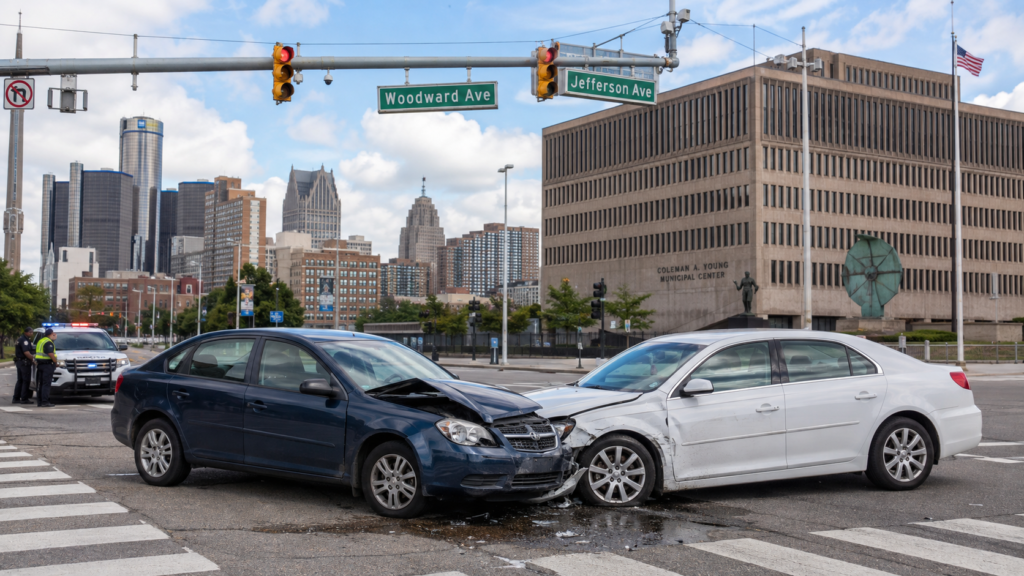
A car accident at Woodward Avenue and Jefferson Avenue in downtown Detroit, near Hart Plaza and the riverfront.