






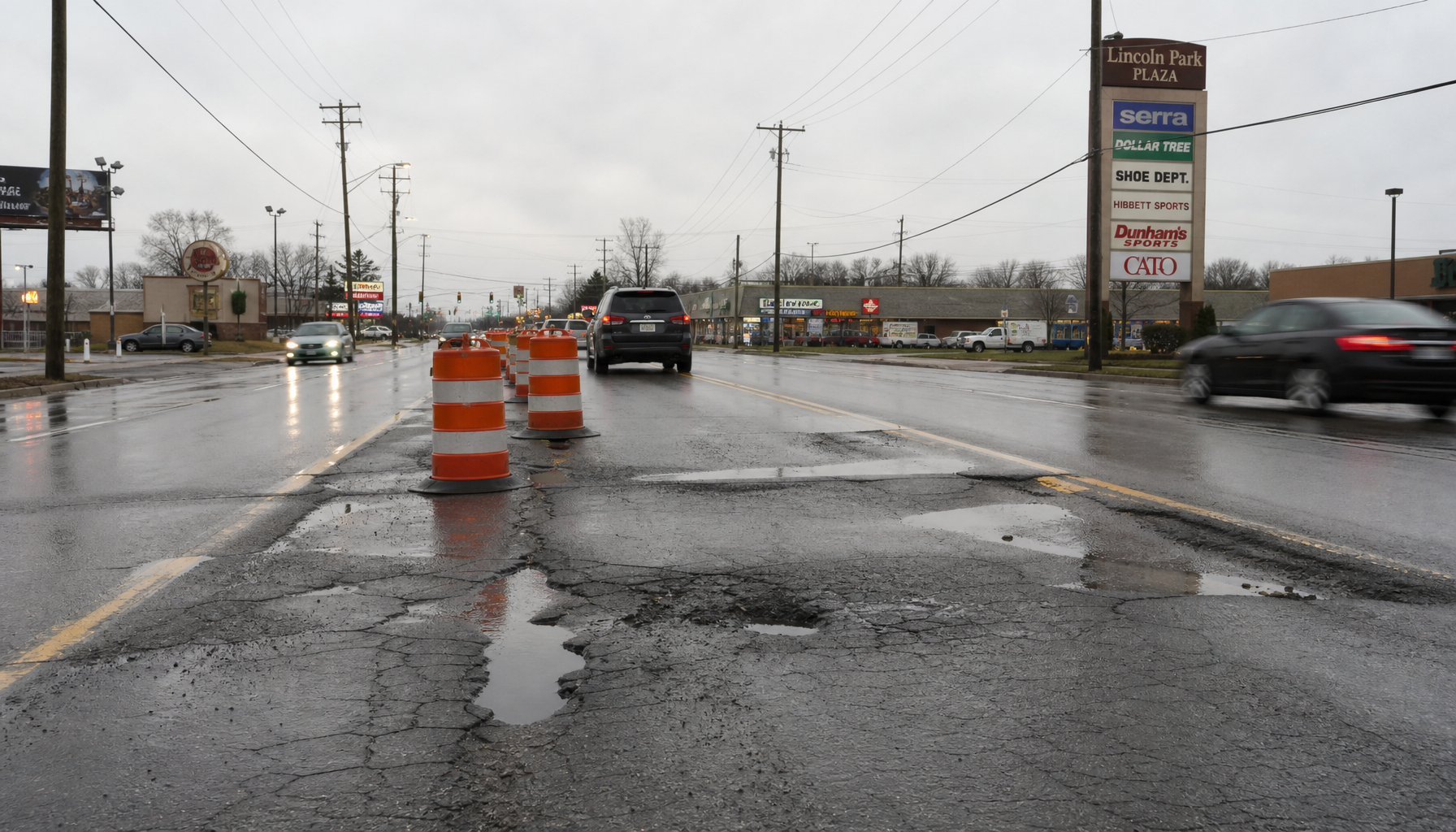
If you were in a crash near the Telegraph Road closure at I-75, you may have a claim — not just against another driver, but potentially against the government agency responsible for maintaining that road. Road hazard accidents in Michigan follow specific rules, and the window to act is shorter than most people realize. A detroit car accident lawyer can tell you quickly whether you have a case worth pursuing.
As reported by WDIV Local 4, a stretch of Telegraph Road near I-75 is closing because of a sinkhole. That section of Telegraph carries thousands of commuters daily — people heading to work in Southgate, Taylor, and Romulus, and freight moving toward the Detroit Metro Airport corridor. When a road like that shuts down without warning, traffic backs up fast, drivers make rushed detours, and accidents happen.
If you were hurt in one of those accidents — or if your vehicle was damaged by the sinkhole itself — this post explains what you’re dealing with and what steps protect you. For a broader overview of your options after any Michigan collision, our Michigan Car Accident Attorney page covers the full picture. If your crash happened in the city itself, the Detroit car accidents lawyer page is the right starting point.
What’s Happening on Telegraph Road Near I-75
The sinkhole has forced a full closure on a segment of Telegraph that sits at the intersection of two heavy-traffic patterns: north-south commuter flow on Telegraph and the east-west interchange traffic feeding I-75. When that node closes, GPS apps reroute drivers onto side streets in communities like Brownstown Township and Riverview — roads that weren’t built for sudden volume spikes.
More crashes tend to follow closures like this for three reasons:
- Unfamiliar detour routes mean more driver hesitation, late braking, and wrong turns
- Side streets often lack the signage and lane markings of arterials like Telegraph
- Frustration and time pressure push drivers to speed or run stops
According to Michigan State Police crash data, Wayne County consistently ranks among the highest in the state for traffic fatalities. Detour-related crashes aren’t tracked separately, but road-closure events reliably spike local accident rates in the days immediately following.
Who Is Legally Responsible for a Sinkhole-Related Crash?
This depends on exactly how the crash happened. There are two distinct situations.
If the Sinkhole Itself Damaged Your Vehicle
When a road defect — including a sinkhole — directly damages your car or causes a crash, you may have a claim against the government agency that owns and maintains that road. In Michigan, that’s typically the Michigan Department of Transportation (MDOT) for state highways or the county road commission for county roads.
The catch: Michigan law puts strict limits on suing government entities for road defects. Under MCL 691.1402, a governmental agency has a duty to keep public roads in reasonable repair, but you have to prove the agency had actual or constructive knowledge of the defect and failed to fix it within a reasonable time. You also have to file a formal notice of intent to sue — and you have only 60 days from the date of the incident to do it.
Sixty days sounds like a long time. It isn’t, especially when you’re dealing with medical bills, a damaged car, and an insurance company asking for statements.
If Another Driver Caused the Crash During the Detour
This is the more common scenario. A driver unfamiliar with the detour route rear-ends you on Sibley Road. Someone runs a stop sign on Van Horn. A driver cuts across two lanes trying to get back to a familiar street.
These crashes work like any other Michigan auto accident. Michigan is a no-fault state, which means your own Personal Injury Protection (PIP) coverage pays your medical bills and a portion of lost wages first, regardless of who was at fault — that’s MCL 500.3107.
But if your injuries are serious enough, you can step outside no-fault and sue the at-fault driver for pain and suffering. The threshold for doing that is set by MCL 500.3135 — you need to show a serious impairment of body function, permanent disfigurement, or death.
The general deadline to file a personal injury lawsuit in Michigan is three years from the date of the crash under MCL 600.5805(2). Government claims are shorter — don’t wait on those.
What to Do Right Now
If you were in a crash near the Telegraph Road closure, here’s what matters in the next few days:
- Get medical care, even if you feel okay. Adrenaline masks pain. Whiplash and soft-tissue injuries often don’t show up for 24 to 72 hours.
- Report the crash to police if you haven’t already. A police report creates an official record of where the accident happened — important if the sinkhole or poor detour conditions contributed.
- Photograph everything. The road conditions at the scene, your vehicle, any skid marks, missing or damaged signage on the detour route.
- Don’t give a recorded statement to any insurance company — yours or the other driver’s — before you talk to an attorney.
- If your car was damaged by the sinkhole directly, document the damage with photos and note the exact location before the road is repaired. Once MDOT fills the hole, physical evidence disappears.
- Contact a car accident lawyer in Detroit before that 60-day government notice window closes.
What Insurance Will (and Won’t) Cover
Your PIP coverage handles medical bills and lost wages. Your collision coverage handles your vehicle damage if the other driver can’t be identified or if the sinkhole itself caused the damage — subject to your deductible.
What insurance companies won’t tell you: they have a financial interest in closing your claim quickly and for as little as possible. Adjusters are trained to get recorded statements and quick settlements before you fully understand your injuries. A settlement you sign in week two might not cover the physical therapy you need in month four.
For a closer look at how this plays out, our post on dealing with insurance companies after a Detroit car accident walks through the tactics adjusters use and how to respond.
Why Detour Crashes Are Harder to Litigate
They’re not harder to win — they’re harder to investigate if you wait. Detour routes are temporary. Signage gets removed. Road conditions get fixed. Witnesses scatter.
If the sinkhole or the government’s failure to adequately mark the closure contributed to your crash, building that case means capturing evidence now. An experienced attorney can send a preservation letter to MDOT or the county road commission requiring them to retain maintenance records, inspection logs, and communications about the sinkhole.
The most dangerous roads and intersections in Metro Detroit have a history — and that history often becomes relevant evidence when a driver argues a road agency knew about a problem and did nothing.
Frequently Asked Questions
Can I sue MDOT if the sinkhole damaged my car?
You can file a claim, but Michigan law requires you to prove the agency knew or should have known about the road defect and failed to repair it. You also must file a notice of intent within 60 days. Whether you have a strong claim depends on the specific facts — talk to an attorney before that window closes.
My crash happened on a side street during the detour, not on Telegraph itself. Does that matter?
It can. The side street may be maintained by the county road commission rather than MDOT, which changes who you’d file a government claim against. If the crash was caused by another driver rather than the road itself, it’s a standard no-fault claim and the location matters less.
I feel fine right now. Do I still need to see a doctor?
Yes. Many soft-tissue injuries — including whiplash and minor disc injuries — don’t produce significant pain for one to three days. Seeing a doctor creates a medical record that connects any injury to the crash date. If you wait and the symptoms appear later, the insurance company will argue the injuries weren’t caused by the accident.
The other driver says it was my fault because I was on an unfamiliar road. What do I do?
Fault is determined by the evidence, not by what either driver says at the scene. Police reports, photos, traffic camera footage, and witness accounts all factor in. Don’t admit fault and don’t argue fault at the scene. Let the investigation do the work.
What’s the difference between a PIP claim and a lawsuit against the at-fault driver?
Your PIP claim pays your medical bills and a portion of lost wages through your own insurance, regardless of fault. A lawsuit against the at-fault driver seeks additional compensation — pain and suffering, quality of life losses — but only if your injuries meet Michigan’s serious impairment threshold under MCL 500.3135. Both can run simultaneously.
How long does a Michigan car accident claim take to resolve?
It varies widely. A straightforward PIP claim might resolve in a few months. A lawsuit against an at-fault driver, especially one involving serious injuries or a government defendant, can take one to three years. The more complex the liability picture — and a sinkhole-related closure adds complexity — the longer it tends to run.
If you were hurt or your vehicle was damaged near the Telegraph Road closure, talk to us before you sign anything. Khamo Law, PLLC offers a free consultation — call 248-466-0606 or message us through the contact form. We serve Detroit and the surrounding Wayne, Oakland, and Macomb County communities. Arabic and Chaldean speakers are welcome — our team can work with you in your language.