










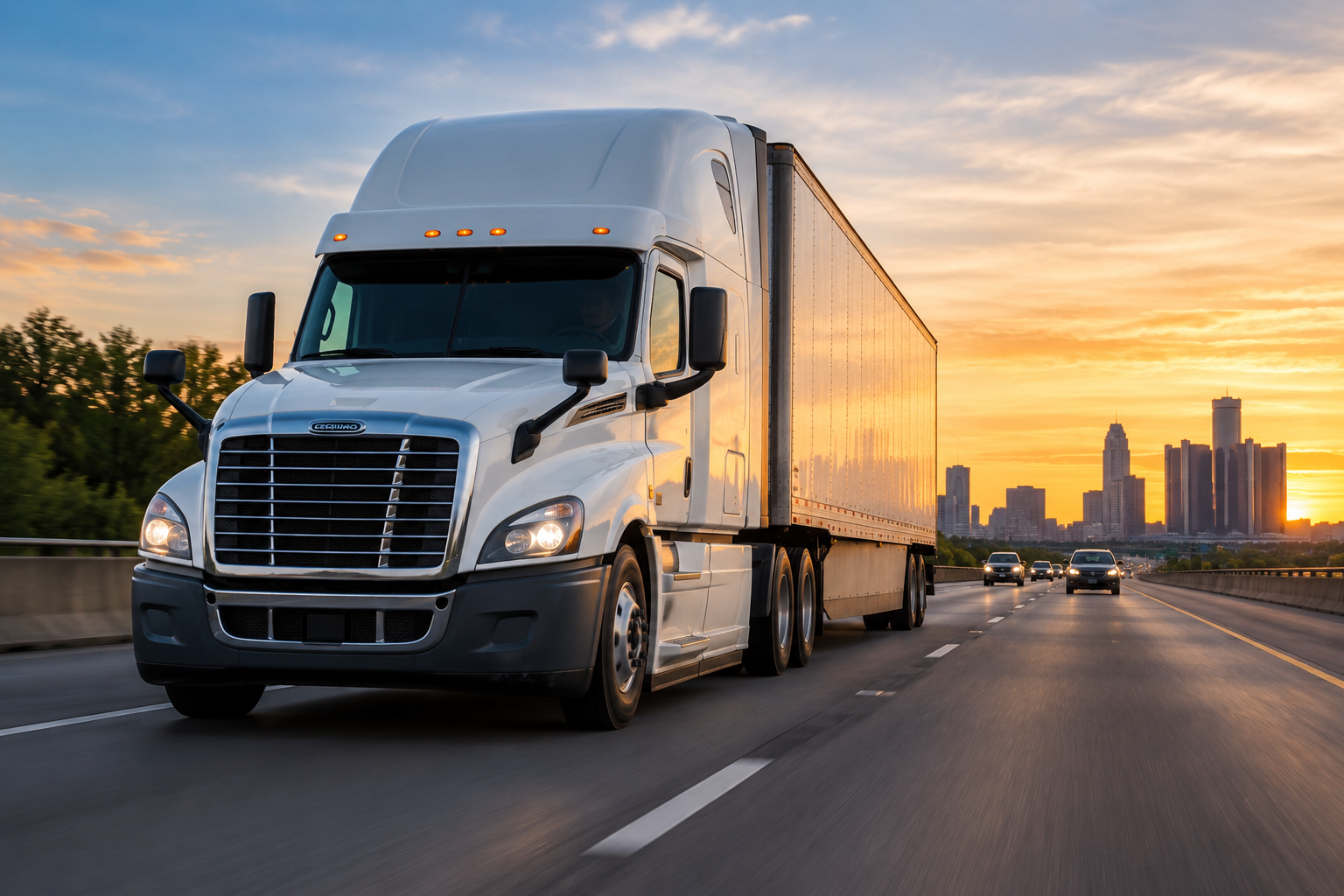
A serious truck accident can leave you dealing with major injuries, medical treatment, lost income, vehicle damage, and questions about which insurance company or business is responsible. Unlike many ordinary car accidents, a commercial truck crash may involve the driver, trucking company, truck or trailer owner, maintenance providers, cargo-related companies, and multiple insurance policies.
Khamo Law’s Michigan truck accident lawyers represent people injured in crashes involving semi-trucks, tractor-trailers, 18-wheelers, delivery trucks, box trucks, and other commercial vehicles throughout Michigan. Our Michigan truck accident attorneys investigate how the collision occurred, preserve important trucking evidence, identify potentially responsible parties, evaluate available insurance coverage, and pursue claims supported by the facts and Michigan law.
For broader information about serious injury claims, visit our Michigan personal injury attorneys page. If the crash resulted in a death, our Michigan wrongful death attorneys can explain the options available to the family.
Call 248-466-0606 for a free consultation.
Legally reviewed by Attorney Koro E. Khamo
Founder & Managing Attorney at Khamo Law, PLLC
Michigan Bar No. P80994
What Should I Do After a Semi-Truck Accident in Michigan?
The first priority after a serious truck crash is safety and appropriate medical care. When circumstances allow, there are also steps that may help preserve information about what happened.
After a commercial truck accident:
- Call 911 and report the collision.
- Seek appropriate medical attention.
- Photograph the vehicles, roadway, debris, skid marks, signs, traffic signals, and surrounding area when it is safe to do so.
- Obtain the truck driver’s name, employer, insurance information, license plate, and identifying information from the truck and trailer.
- Get contact information from witnesses.
- Preserve dashcam footage if you have it.
- Keep copies of medical records, bills, insurance correspondence, and documents showing missed work.
- Avoid guessing about fault or the extent of your injuries.
- Identify nearby businesses, homes, or traffic cameras that may have recorded the crash.
- Consider obtaining legal guidance before important evidence controlled by the trucking company is lost through ordinary retention practices.
Our detailed guide on how to file a truck accident claim in Michigan explains the process in greater detail.
Why Are Michigan Commercial Truck Accident Claims Different From Car Accident Claims?
A Michigan commercial truck accident can involve issues that do not usually arise in a typical two-car collision. Our Michigan semi-truck accident lawyers handle crashes involving tractor-trailers, 18-wheelers, commercial carriers, and other large trucks.
The truck may be owned by one company, operated by another, driven by an employee or contractor, loaded by another business, and maintained by a separate company. There may also be several insurance policies and layers of commercial coverage.
Truck accidents can also involve evidence such as:
- Electronic logging device records
- Driver qualification information
- Hours-of-service records
- Dispatch information
- Bills of lading
- Inspection reports
- Maintenance and repair records
- Electronic vehicle data
- GPS or fleet-management information
- Cargo records
- Driver training records
- Company safety policies
- Post-crash testing information when applicable
Determining what happened therefore may require investigating both the collision itself and the companies involved in putting the truck on the road.
If your accident involved passenger vehicles rather than a commercial truck, our Michigan car accident lawyers provide information about Michigan auto claims generally.
Who May Be Liable for a Truck Accident in Michigan?
The truck driver is not necessarily the only party whose conduct should be investigated.
Depending on the facts, potentially responsible parties may include:
The Truck Driver
Driver conduct may become relevant when a collision involves speeding, distraction, fatigue, unsafe lane changes, following too closely, impaired driving, failure to yield, or another driving error.
The Trucking Company
A motor carrier’s own conduct may need to be examined, including hiring, training, supervision, dispatch practices, maintenance practices, and compliance with applicable safety requirements.
The Truck Owner
The tractor or trailer may be owned or leased by a person or company other than the motor carrier operating it.
Maintenance and Repair Companies
When brakes, tires, steering components, lights, or other equipment become an issue, maintenance and repair history may be important.
Cargo Loaders and Shippers
Improperly loaded or secured cargo can affect a truck’s stability and handling. Cargo-related evidence may become important after a rollover, lost-load accident, or other crash involving load securement.
Parts or Vehicle Manufacturers
If a defective component contributed to the collision, additional product-liability issues may need to be investigated.
Other Drivers
Some commercial truck crashes involve several vehicles. Another motorist may have contributed to the chain of events even if that person was not driving the truck.
Our guide to who may be liable in a commercial truck accident in Michigan examines these potential parties in greater detail.
Can I Sue the Trucking Company After a Michigan Truck Accident?
Potentially.
Whether a trucking company may be legally responsible depends on the relationship between the driver and company and the facts surrounding the collision.
A trucking company’s conduct may also become independently relevant. Depending on the circumstances, an investigation might examine whether the company:
- Hired or retained an unsafe driver
- Failed to provide appropriate training or supervision
- Allowed unsafe driving practices
- Failed to properly inspect or maintain equipment
- Created schedules or practices that contributed to unsafe operation
- Failed to address known safety concerns
- Violated applicable trucking requirements
The legal analysis depends on the evidence rather than simply the name printed on the side of the truck.
What Evidence Matters in a Michigan Truck Accident Case?
Evidence can determine whether competing accounts of a truck crash can be independently tested.
Important evidence may include:
Photographs and Video
Scene photographs can document vehicle positions, damage, road conditions, skid marks, debris, traffic controls, weather conditions, and other physical evidence.
Dashcams, business surveillance systems, residential cameras, and traffic-related video may also capture part or all of a collision.
Electronic Logging Device Records
Many commercial drivers subject to federal hours-of-service requirements use electronic logging devices, commonly called ELDs, to record driving and duty status.
These records can become relevant when driver fatigue or hours of service are disputed.
Electronic Vehicle Data
Depending on the truck and systems involved, electronic data may contain information relevant to the vehicle’s operation before a collision.
Inspection and Maintenance Records
Maintenance history may become important when brakes, tires, lights, steering components, or other mechanical issues are suspected.
Dispatch and Fleet Records
Dispatch records, electronic communications, GPS information, trip records, and other company records may help establish the truck’s movements and operating circumstances.
Driver Qualification and Training Information
A driver’s licensing, qualifications, experience, training, safety history, and employment records may become relevant depending on the allegations involved.
Witness Statements
Independent witnesses may help establish how the collision occurred, particularly when drivers give conflicting accounts.
Police Documentation
Crash reports, photographs, diagrams, citations, and officer observations can provide additional information, although they should be evaluated together with the other available evidence.
Why Is Preserving Trucking Evidence Important?
Some evidence is retained for only limited periods.
For example, federal guidance states that motor carriers generally must retain electronic logging-device records of duty status and supporting documents for six months. That does not mean every piece of trucking evidence has the same retention period, but it illustrates why potentially relevant records should be identified promptly.
A truck may also be repaired or returned to service, surveillance video may be overwritten, and physical evidence at the crash scene may disappear.
When appropriate, steps can be taken to identify and request preservation of potentially relevant evidence.
What Federal Trucking Rules Can Matter After an Accident?
Commercial motor carriers and drivers may be subject to Federal Motor Carrier Safety Regulations as well as applicable Michigan requirements.
Depending on the truck and operation, regulations may address subjects such as:
- Hours of service
- Driver qualifications
- Electronic logging
- Vehicle inspection
- Repair and maintenance
- Cargo securement
- Drug and alcohol testing
- Commercial driver’s licenses
- Safe operation of commercial vehicles
A regulatory violation does not automatically answer every question about legal responsibility. The specific rule, evidence, and relationship between the alleged violation and the collision still need to be evaluated.
Our Michigan trucking laws and regulations guide explains these requirements in more detail.
How Can Driver Fatigue Contribute to Truck Accidents?
Commercial drivers may spend long periods behind the wheel, which is one reason federal hours-of-service rules regulate driving and rest periods for covered operations.
When fatigue is suspected, relevant evidence may include:
- Electronic logs
- Supporting records
- Dispatch information
- Trip schedules
- Fuel receipts
- Electronic communications
- GPS or fleet data
- Driver statements
- Witness observations
The existence of a long trip alone does not establish that fatigue caused a collision. The available records need to be examined together.
What If Poor Truck Maintenance Caused the Crash?
Commercial vehicles require regular inspection, repair, and maintenance.
Mechanical problems that may become relevant after a collision include:
- Brake failures
- Tire failures
- Steering problems
- Lighting defects
- Coupling problems
- Trailer equipment failures
- Other unsafe components
When a mechanical problem is suspected, inspection records, repair invoices, maintenance schedules, driver reports, post-crash inspections, and the physical truck itself may become important evidence.
What If Improper Cargo Caused the Accident?
Commercial cargo can affect a truck’s weight, balance, braking, and stability.
Depending on the load, an investigation may consider whether cargo was improperly distributed, overloaded, inadequately secured, or allowed to shift during transportation.
Cargo issues can be especially important in:
- Rollovers
- Jackknife crashes
- Lost-load accidents
- Trailer instability
- Collisions involving falling cargo
Responsibility may depend on which companies or individuals loaded, secured, inspected, or transported the cargo.
Common Causes of Michigan Truck Accidents
No two crashes are identical, but commercial truck accidents may involve:
- Driver fatigue
- Distracted driving
- Speeding
- Following too closely
- Unsafe lane changes
- Failure to yield
- Impaired driving
- Inadequate training
- Poor vehicle maintenance
- Brake or tire problems
- Improperly secured cargo
- Overloaded trailers
- Unsafe merging
- Weather and road conditions
- Construction zones
- Blind-spot collisions
Determining the cause requires evidence. A serious investigation should not assume that every truck crash occurred for the same reason.
Common Types of Commercial Truck Accidents
Truck collisions can occur in many different ways.
Rear-End Truck Accidents
A fully loaded commercial vehicle requires significant distance to slow and stop. Following distance, speed, traffic conditions, braking, distraction, and vehicle condition may all become relevant.
Jackknife Accidents
A jackknife occurs when the tractor and trailer move at an angle toward each other. Speed, braking, traction, cargo, and driver actions may need to be evaluated.
Truck Rollovers
Rollovers may involve speed, curves, steering inputs, cargo distribution, road conditions, or other factors.
Blind-Spot and Lane-Change Accidents
Large trucks have substantial areas around the vehicle that may not be visible to the driver. Lane positioning, signals, mirrors, video, witnesses, and vehicle damage can become important evidence.
Underride Collisions
Some collisions involve a smaller vehicle traveling underneath part of a commercial trailer. These crashes can result in catastrophic injuries.
Lost-Load Accidents
Cargo or equipment that falls from a commercial vehicle can create hazards for multiple motorists.
Multi-Vehicle Truck Crashes
Highway truck accidents can involve several vehicles, making it necessary to determine the sequence of impacts and the conduct of multiple drivers.
What About Delivery Trucks, Box Trucks, and Other Commercial Vehicles?
A truck accident does not have to involve an 18-wheeler.
Commercial-vehicle claims can involve:
- Delivery trucks
- Box trucks
- Moving trucks
- Dump trucks
- Construction vehicles
- Utility trucks
- Garbage trucks
- Tow trucks
- Work vans
- Other company vehicles
The laws, insurance policies, employment relationships, and evidence involved may differ depending on the type of vehicle and operation.
Michigan No-Fault Benefits After a Truck Accident
A collision involving a commercial truck may involve both Michigan No-Fault benefits and a potential claim involving an at-fault party.
Michigan’s Personal Injury Protection system can provide qualifying benefits for certain accident-related losses depending on the applicable coverage and circumstances. Michigan drivers can select among several PIP medical coverage levels, including unlimited coverage and certain limited options.
Potential No-Fault issues can involve medical treatment, wage loss, replacement services, attendant care, medical mileage, and other benefits depending on eligibility and coverage.
Our Michigan No-Fault Insurance Lawyer resource explains the system in greater detail.
The availability of No-Fault benefits does not necessarily answer whether an injured person also has a claim against a negligent truck driver, trucking company, or another responsible party.
Can I Bring a Claim Against the At-Fault Truck Driver or Company?
Potentially.
Michigan law allows certain injured people to pursue tort claims arising from motor-vehicle accidents. Whether a particular person may recover damages from another party depends on the facts, injuries, fault, insurance coverage, and applicable Michigan law.
Truck cases can be particularly complex because there may be several potentially responsible parties and multiple insurance policies.
An investigation may need to identify:
- Who employed or contracted with the driver
- Who owned the tractor
- Who owned the trailer
- Which motor carrier operated the vehicle
- Who maintained the equipment
- Who loaded or secured the cargo
- Whether another vehicle contributed to the collision
- Which insurance policies apply
What Compensation May Be Available After a Truck Accident?
The compensation and benefits available depend on the individual case.
Potential losses may include:
- Medical expenses
- Rehabilitation expenses
- Lost income
- Reduced earning capacity
- Future medical needs
- Pain and suffering
- Disability or physical limitations
- Scarring or disfigurement
- Other legally recoverable accident-related losses
There is no standard value for a Michigan truck accident claim.
A case involving temporary injuries and a relatively short recovery is fundamentally different from a collision involving permanent disability, traumatic brain injury, spinal injury, amputation, or death.
How Is a Michigan Truck Accident Claim Valued?
Factors that may affect a claim include:
- Nature and severity of the injuries
- Duration of medical treatment
- Whether surgery was required
- Permanent limitations or disability
- Future medical needs
- Lost wages and earning capacity
- Effect of the injuries on daily life
- Strength of the liability evidence
- Comparative-fault allegations
- Available insurance coverage
- Number of responsible parties
- Whether future losses can be established
Settlement amounts from unrelated cases should not be treated as a prediction of what another case will be worth.
What If the Truck Driver Says the Accident Was My Fault?
An accusation does not determine fault by itself.
Truck drivers, trucking companies, insurers, witnesses, and injured motorists may have different accounts of the same collision.
Evidence such as video, photographs, electronic data, vehicle damage, witnesses, driver logs, and reconstruction analysis may help determine what happened.
Michigan comparative-fault principles can also affect certain damages when an injured person shares responsibility for an accident.
Do not assume that a trucking company’s initial fault determination is the final answer.
What If the Trucking Company’s Insurance Adjuster Contacts Me?
Commercial insurers may begin investigating a serious collision quickly.
An adjuster may ask for:
- A recorded statement
- Details about how the collision happened
- Information about injuries
- Medical authorizations
- Prior medical history
- Documents relating to employment or wages
- A settlement discussion
Understand what information is being requested and why before signing documents or providing a detailed recorded statement.
Statements made early in the process can become important later if fault, injuries, or damages are disputed.
Truck Accidents on I-75 and Other Michigan Highways
Michigan’s interstate system carries substantial passenger and commercial traffic.
Freeway truck crashes can involve high speeds, congested traffic, lane changes, merging vehicles, construction zones, stopped traffic, and multi-vehicle impacts.
The location of a crash can also affect what evidence may exist, including roadway cameras, witnesses, commercial surveillance, police documentation, and physical evidence from the scene.
Our I-75 accident guide discusses issues that can arise after crashes along Interstate 75 in Michigan.
Serious Injuries Caused by Commercial Truck Accidents
Because of the size and weight difference between commercial trucks and passenger vehicles, occupants of smaller vehicles may suffer severe injuries.
Truck collisions can result in:
- Traumatic brain injuries
- Spinal cord injuries
- Neck and back injuries
- Broken bones
- Crush injuries
- Internal injuries
- Burns
- Amputations
- Permanent scarring
- Psychological trauma
- Fatal injuries
Serious injuries may require surgery, rehabilitation, assistive equipment, home modifications, future medical treatment, and extended time away from work.
Documenting the long-term effects of an injury can therefore be as important as establishing how the collision occurred.
Fatal Michigan Truck Accidents
When a commercial truck collision causes a death, surviving family members may face both emotional loss and substantial financial consequences.
A wrongful-death case may require investigation of the same trucking evidence involved in a nonfatal crash while also documenting the losses resulting from the death.
Our Michigan wrongful death attorneys can explain how Michigan wrongful-death claims may apply after a fatal commercial vehicle collision.
How Long Do I Have to File a Michigan Truck Accident Lawsuit?
Michigan imposes legal deadlines on personal-injury and wrongful-death claims, and additional notice or procedural requirements may apply in some circumstances.
But the legal filing deadline is not the only timing concern in a truck case.
Important evidence may disappear much sooner.
For example:
- Electronic records may be subject to retention schedules.
- Surveillance video may be overwritten.
- Vehicles may be repaired.
- Roadway evidence can disappear.
- Witnesses may become harder to locate.
- Companies may dispose of records in the ordinary course of business.
That is why preserving evidence can be important well before the ultimate lawsuit deadline approaches.
How Can a Michigan Truck Accident Lawyer Help?
A Michigan truck accident lawyer can investigate the collision, identify potentially responsible parties, preserve trucking evidence, evaluate insurance coverage, document damages, and prepare the claim for negotiation or litigation. A truck accident investigation should be tailored to the facts of the collision.
Depending on the case, Khamo Law may:
- Review police reports and crash documentation
- Obtain photographs and video
- Interview witnesses
- Investigate the truck driver and motor carrier
- Identify the tractor and trailer owners
- Seek preservation of relevant trucking records
- Review driver logs and electronic information
- Examine inspection and maintenance records
- Investigate cargo-loading issues
- Evaluate insurance policies
- Review medical documentation
- Document lost income and other losses
- Examine comparative-fault allegations
- Work with qualified experts when appropriate
- Prepare the case for negotiations or litigation
The goal is to develop an evidence-based understanding of how the crash occurred, who may be responsible, what insurance coverage applies, and how the injuries have affected the client.
Michigan Truck Accident Lawyers Serving Communities Across the State
Khamo Law represents people injured in commercial vehicle crashes throughout Michigan.
We also maintain dedicated resources for truck accidents in several Southeast Michigan communities:
- Troy truck accidents
- Sterling Heights truck accidents
- Warren truck accidents
- Detroit truck accidents
- Southfield truck accidents
- Clinton Township truck accidents
These local pages provide information about commercial-vehicle claims in the communities Khamo Law serves while this page remains the primary statewide Michigan truck-accident resource.
Frequently Asked Questions About Michigan Truck Accidents
Who is responsible for a semi-truck accident in Michigan?
Responsibility depends on how the crash occurred. Potentially responsible parties may include the driver, motor carrier, truck or trailer owner, maintenance company, cargo-loading company, manufacturer, or another motorist.
Can I sue a trucking company instead of only the driver?
Depending on the facts, a trucking company may be legally responsible for a driver’s conduct or for its own actions. Employment relationships, company practices, maintenance, supervision, and other evidence may need to be investigated.
What should I do after a semi-truck hits me?
Seek appropriate medical care, report the collision, document the scene when possible, obtain identifying information for the truck and company, collect witness information, preserve video, and keep relevant records. Our Michigan truck accident claim guide provides a more detailed step-by-step explanation.
When should I consult a lawyer after a truck accident?
You can seek legal guidance at any point after a truck accident, but early consultation may be useful when the crash involves serious injuries, disputed fault, a commercial trucking company, multiple insurance policies, or evidence that may not be preserved indefinitely. Trucking records, electronic data, surveillance footage, and other evidence may be subject to retention limits or otherwise become unavailable over time.
What evidence should be preserved after a truck accident?
Depending on the crash, important evidence may include photographs, video, witness information, driver logs, electronic data, dispatch records, maintenance records, inspection reports, cargo information, and company records.
What is an ELD in a truck accident case?
An electronic logging device records certain information relating to a commercial driver’s duty status. ELD information may become relevant when hours of service or driver fatigue are at issue.
How long are ELD records kept?
Federal guidance states that motor carriers generally must retain ELD records of duty status and supporting documents for six months. Different records may have different retention requirements.
Do truck drivers have limits on how long they can drive?
Covered commercial drivers are subject to federal hours-of-service rules that regulate driving and duty periods. The exact rules depend on the type of operation and circumstances.
Can a truck accident involve more than one insurance company?
Yes. Different policies may potentially cover the driver, motor carrier, truck owner, trailer owner, or other entities depending on the relationships and circumstances.
Does Michigan No-Fault apply to truck accidents?
Michigan No-Fault benefits may apply after qualifying motor-vehicle accidents depending on the person’s circumstances and applicable coverage. A separate liability claim against an at-fault party may also be possible.
What if I was a passenger when a truck hit our vehicle?
Passengers injured in commercial truck collisions may have claims and insurance benefits depending on the circumstances. The fact that you were not driving does not prevent the accident from being investigated.
What if the truck was from another state?
Interstate trucking is common. A truck or trucking company being based outside Michigan does not by itself prevent a claim arising from a Michigan collision, although jurisdiction, insurance, and regulatory issues may require additional analysis.
What if a delivery truck hit me?
Delivery trucks, box trucks, and other commercial vehicles can raise many of the same issues involving company responsibility, insurance coverage, driver conduct, and preservation of evidence.
How much is a Michigan truck accident case worth?
There is no universal settlement amount. Injury severity, medical treatment, permanent limitations, lost income, fault, insurance coverage, future losses, and other evidence can affect a claim.
Do all truck accident cases go to court?
No. Some claims resolve through negotiation, while others require litigation. The appropriate course depends on the evidence, disputed issues, offers made, and circumstances of the individual case.
Do I need a lawyer after a Michigan truck accident?
There is no rule requiring every injured person to hire an attorney. Truck cases can, however, involve evidence controlled by commercial entities, multiple potentially responsible parties, commercial insurance policies, federal regulations, and serious injuries. Those factors can make obtaining legal guidance useful.
How much does a Michigan truck accident lawyer cost?
Khamo Law handles qualifying personal-injury cases on a contingency-fee basis. Attorney fees are generally tied to obtaining a recovery rather than hourly billing or an upfront attorney fee. The specific fee arrangement is explained in the representation agreement before a client hires the firm.
Contact a Michigan Truck Accident Attorney
If you or a loved one was injured in a collision involving a semi-truck, tractor-trailer, delivery truck, box truck, or another commercial vehicle, Khamo Law can review what happened and explain the legal options that may be available.
Our attorneys handle serious injury cases throughout Michigan and can investigate the collision, identify potentially responsible parties, evaluate available insurance coverage, and work to preserve evidence relevant to the claim.
Call 248-466-0606 or contact Khamo Law online for a free consultation.
Khamo Law handles personal injury cases on a contingency-fee basis, meaning attorney fees are generally tied to obtaining a recovery rather than charged upfront.