










A Sterling Heights truck accident can involve a semi-truck, tractor-trailer, delivery truck, box truck, or other commercial vehicle and may require a more complex investigation than an ordinary passenger-vehicle crash.
A Sterling Heights truck accident lawyer at Khamo Law can investigate how the collision occurred, identify potentially responsible people and companies, preserve trucking and electronic evidence, evaluate available insurance coverage, document your injuries and financial losses, and pursue compensation supported by Michigan law and the evidence.
A Sterling Heights truck accident attorney can also help identify the motor carrier, preserve commercial trucking records, evaluate federal safety issues, and determine which companies and insurance policies may be involved.
Khamo Law has an office in Sterling Heights at:
36250 Dequindre Road
Suite 110
Sterling Heights, MI 48310
Call 248-466-0606 for a free consultation.
For broader injury representation, visit Khamo Law’s Sterling Heights Personal Injury Lawyers page. For statewide information about commercial truck accident claims, trucking liability, insurance coverage, and compensation for serious injuries, visit our Michigan Truck Accident Lawyer resource.
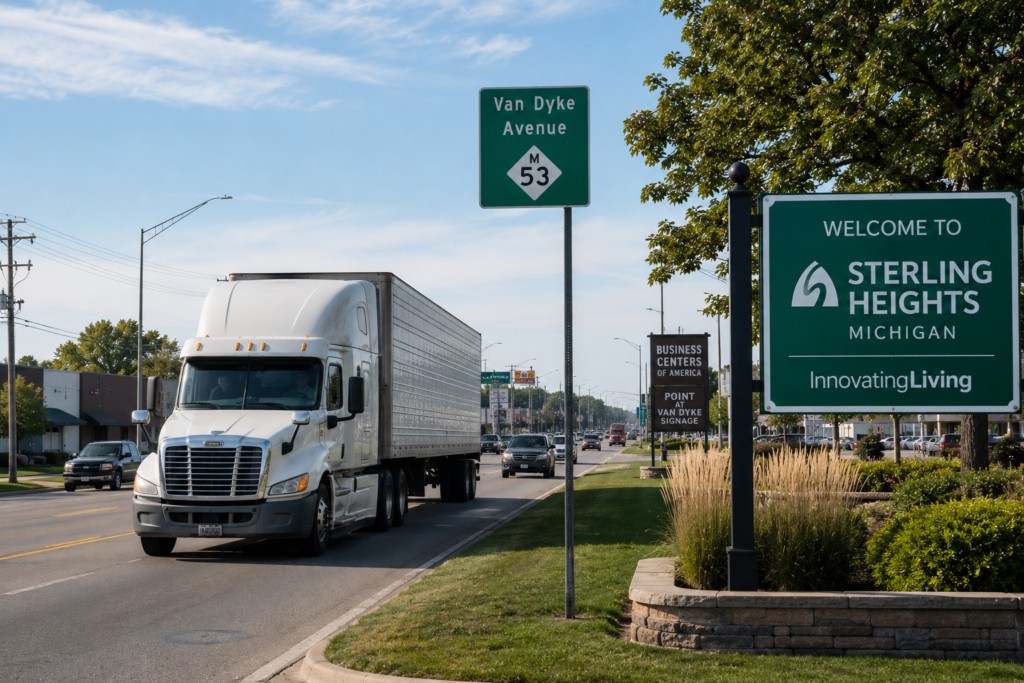
Commercial vehicles travel Sterling Heights corridors alongside passenger traffic, creating truck-specific evidence and regulatory issues when serious collisions occur.
Truck Accident Experience
Attorney Koro E. Khamo has experience representing people injured in trucking accidents and has successfully resolved truck accident claims in the past. Truck cases can involve commercial carriers, multiple insurance policies, electronic records, driver logs, maintenance records, and other evidence that may not exist in an ordinary passenger-vehicle accident.
Khamo Law evaluates each truck accident based on the specific evidence, applicable insurance coverage, Michigan law, and any relevant federal motor-carrier regulations.
Legally reviewed by Attorney Koro E. Khamo
Founder & Managing Attorney at Khamo Law
Michigan Bar No. P80994
How Can a Sterling Heights Truck Accident Attorney Help?
Commercial truck accidents can involve evidence and parties that do not usually exist in an ordinary car-accident case.
Depending on the collision, an investigation may involve:
- The commercial driver
- The motor carrier
- Driver qualification records
- Electronic logging information
- Vehicle inspection records
- Maintenance records
- Electronic vehicle data
- Cargo-loading information
- Dispatch or trip records
- Commercial insurance
- Federal safety regulations
- Multiple companies
Some of this evidence may be controlled by the trucking company or another business.
That makes identifying and preserving relevant records especially important.
Commercial Truck Traffic in Sterling Heights
Sterling Heights contains major commercial, industrial, and transportation corridors used by passenger vehicles and commercial traffic.
Local routes include:
- Van Dyke Avenue / M-53
- Mound Road
- Hall Road / M-59
- Dequindre Road
- Schoenherr Road
- 15 Mile Road
- Metropolitan Parkway / 16 Mile Road
- 17 Mile Road
- 18 Mile Road
- Clinton River Road
Commercial-vehicle activity also connects Sterling Heights with the broader Macomb County and Metro Detroit transportation network.
The City of Sterling Heights maintains specific rules and guidance concerning commercial motor vehicles and seasonal weight restrictions on locally controlled roads.
A crash occurring on a particular road does not establish negligence. The location can, however, affect what businesses, cameras, traffic controls, witnesses, road records, and commercial routes may become relevant to the investigation.
Michigan Truck Accident Statistics
Commercial-vehicle crashes remain a significant part of Michigan’s traffic-safety picture. According to Michigan Traffic Crash Facts, heavy trucks and buses were involved in 15,888 crashes in Michigan in 2024. Those crashes resulted in 110 fatalities and 3,613 injuries. Heavy trucks and buses were involved in approximately 5.5% of all reported Michigan traffic crashes that year.
Michigan Traffic Crash Facts also reported that heavy-truck and bus crashes were more likely than crashes overall to involve certain driving issues, including lane-use, turning, and backing errors, and were more frequently associated with sideswipe crashes, daytime crashes, and weekday travel.
These statistics do not establish fault in any individual Sterling Heights truck accident. However, they illustrate why commercial-vehicle crashes often require examination of driver conduct, vehicle movement, trucking-company records, electronic data, maintenance records, and compliance with applicable safety regulations.
Sterling Heights Commercial Vehicle Weight Restrictions
Sterling Heights has local commercial-vehicle rules that create a particularly useful local distinction for this page.
The City publishes information concerning seasonal commercial motor-vehicle weight restrictions, sometimes referred to as frost-law restrictions.
The City’s guidance explains that certain locally controlled roads may have reduced axle-weight and speed restrictions during seasonal-thaw periods, while designated all-season routes are treated differently.
The City identifies numerous locally controlled roads subject to seasonal restrictions and directs commercial operators to Michigan and Macomb County truck-route resources.
See the City of Sterling Heights’ Commercial Motor Vehicle Seasonal Weight Restrictions page for current information.
A weight restriction or route designation does not prove that a violation caused a particular collision. But commercial-vehicle routing, loading, and regulatory compliance can become relevant when supported by the facts.
Common Types of Truck Accidents
Commercial vehicle collisions may include:
- Rear-end crashes
- Intersection collisions
- Jackknife accidents
- Rollover crashes
- Lane-change collisions
- Wide-turn accidents
- Underride or override crashes
- Multi-vehicle collisions
- Cargo-related accidents
- Tire or mechanical-failure incidents
- Delivery-truck crashes
- Work-zone collisions
The type of collision can help determine which evidence should be investigated.
Driver Fatigue and Hours-of-Service Rules
Commercial drivers operating under federal rules may be subject to limits on driving and on-duty time.
The Federal Motor Carrier Safety Administration’s hours-of-service rules regulate driving and rest periods for covered commercial drivers.
Potential evidence may include:
- Electronic logging device data
- Records of duty status
- Dispatch information
- Fuel receipts
- Toll records
- Delivery records
- Driver communications
A violation of a federal rule does not automatically establish every element of a civil injury claim, but relevant violations may become important evidence when they contributed to the collision.
Khamo Law also maintains an existing resource concerning Michigan trucking laws and regulations.
Unsafe Cargo Loading and Securement
Commercial cargo must be properly loaded and secured.
Improper cargo can:
- Shift inside a trailer
- Affect vehicle stability
- Contribute to a rollover
- Fall from a vehicle
- Create road hazards
- Affect stopping or steering
The FMCSA’s cargo-securement rules establish federal requirements intended to prevent cargo from shifting or falling from covered commercial vehicles.
Depending on the case, cargo-related evidence may include loading records, bills of lading, photographs, trailer records, securement devices, and information identifying the company that loaded the vehicle.
Truck Maintenance and Mechanical Problems
Commercial vehicles require regular inspection and maintenance.
Potential mechanical issues can involve:
- Brakes
- Tires
- Steering components
- Lighting
- Coupling systems
- Suspension
- Other safety equipment
When a mechanical problem may have contributed to a collision, relevant evidence can include:
- Maintenance records
- Inspection records
- Repair invoices
- Driver inspection reports
- Post-crash inspections
- Physical examination of the vehicle
Responsibility depends on who had the relevant legal duties and what the evidence actually shows.
Who May Be Responsible for a Truck Accident?
Depending on the evidence, a Sterling Heights truck accident may involve liability by the truck driver, trucking company, maintenance provider, cargo-loading company, another driver, or another business whose conduct contributed to the crash.
Depending on the circumstances, an investigation may consider:
The Truck Driver
A driver may be responsible for conduct such as speeding, distraction, unsafe lane changes, impairment, following too closely, or violating applicable safety rules.
The Motor Carrier
A trucking company may become relevant when its own conduct or legal responsibilities contributed to the collision.
Potential issues may involve:
- Hiring
- Training
- Supervision
- Scheduling
- Maintenance
- Safety compliance
- Driver qualification
Maintenance Companies
A separate maintenance or repair company may require investigation if defective maintenance contributed to the crash.
Cargo Loaders or Shipping Companies
Responsibility for loading or securing cargo may depend on the transportation arrangement and facts.
Other Drivers
Some truck collisions involve negligence by more than one vehicle.
Khamo Law’s existing resource on liability in Michigan commercial truck accidents provides deeper statewide discussion of these issues.
What Evidence Should Be Preserved?
Truck cases can involve evidence that is especially important to identify quickly.
Potential evidence includes:
- Police reports
- Crash-scene photographs
- Witness statements
- Surveillance footage
- Dashcam footage
- Electronic logging device information
- Electronic vehicle or engine data
- Driver qualification records
- Maintenance records
- Inspection records
- Cargo records
- Bills of lading
- Dispatch information
- Driver communications
- Commercial insurance policies
- Medical records
- Wage documentation
The exact evidence depends on the crash.
Electronic Logging Devices and Vehicle Data
Electronic information can provide important evidence in some commercial vehicle cases.
Depending on the vehicle and system, electronic records may help show information concerning:
- Driver hours
- Vehicle movement
- Speed
- Braking
- Engine operation
- Other vehicle activity
Not every commercial vehicle contains the same systems or preserves the same information.
That is why the particular truck, motor carrier, and electronic systems involved should be identified rather than assuming specific data exists in every case.
Why Early Evidence Preservation Matters
Commercial trucks may return to service, be repaired, or undergo changes after a collision.
Business records can also be retained under different policies and regulatory requirements.
Potential evidence such as video, electronic records, physical vehicle evidence, and witness information can become more difficult to obtain as time passes.
Prompt investigation can help identify and preserve relevant evidence.
Common Truck Accident Injuries
Because commercial vehicles can be substantially larger and heavier than passenger vehicles, collisions may result in serious injuries.
Potential injuries include:
- Traumatic brain injuries
- Spinal cord injuries
- Neck and back injuries
- Broken bones
- Crush injuries
- Internal injuries
- Nerve damage
- Scarring
- Permanent impairment
When a collision causes significant neurological trauma, visit our Sterling Heights Brain Injury Attorney or Sterling Heights Spinal Cord Injury Attorney pages.
Fatal Truck Accidents
Some commercial vehicle crashes cause fatal injuries.
When legally actionable conduct causes a person’s death, Michigan wrongful-death law may apply.
Families dealing with a fatal commercial-vehicle collision can visit our Sterling Heights Wrongful Death Attorney page.
Does Michigan No-Fault Insurance Apply After a Sterling Heights Truck Accident?
Yes, Michigan No-Fault insurance may provide benefits after a truck accident depending on the injured person’s circumstances and applicable insurance coverage.
Depending on the circumstances and applicable policy, Personal Injury Protection benefits may involve:
- Medical expenses
- Wage-loss benefits
- Replacement services
- Attendant care
- Other benefits authorized under Michigan law
Because these insurance rules apply statewide rather than only in Sterling Heights, Khamo Law’s Michigan No-Fault Car Accident Lawyer page provides the deeper statewide discussion.
The Michigan Department of Insurance and Financial Services also provides official Michigan auto-insurance information.
Claims Against the Truck Driver and Other Responsible Parties
A claim against a negligent commercial driver or another responsible party is different from a claim for Michigan No-Fault benefits.
Depending on the circumstances, an injured person may have claims involving:
- The commercial driver
- A trucking company
- Another responsible business
- Commercial liability insurance
- Other applicable insurance policies
The availability and type of damages depend on Michigan law and the facts of the collision.
For the broader statewide truck-accident framework, visit our Michigan Truck Accident Lawyer page.
Comparative Fault
Truck collisions can involve disputes about the conduct of several drivers.
Michigan comparative-fault law may affect recovery when the injured person or multiple defendants are alleged to share responsibility.
That makes evidence concerning vehicle movement, traffic signals, lane position, witnesses, and electronic information particularly important in disputed-liability cases.
What Compensation May Be Available?
Depending on the facts, law, and applicable insurance, damages may include:
- Medical expenses
- Future medical treatment
- Rehabilitation
- Lost wages
- Reduced earning capacity
- Property-related losses where recoverable
- Pain and suffering when permitted by Michigan law
- Disability
- Scarring
- Disfigurement
- Loss of normal activities
- Other legally recoverable damages
There is no standard settlement amount for a Sterling Heights truck accident.
The value depends on the injuries, liability evidence, insurance coverage, future care, employment effects, and other case-specific circumstances.
Commercial Insurance Issues
Commercial truck cases may involve higher or multiple insurance policies compared with an ordinary passenger-vehicle accident, but available insurance depends on the vehicles, companies, policies, and operation involved.
Potential issues include:
- Motor-carrier liability coverage
- Additional insured parties
- Multiple companies
- Policy exclusions
- Coverage disputes
- Michigan No-Fault coverage
- Uninsured or underinsured motorist coverage where applicable
Insurance policies should be reviewed rather than assuming a particular amount of coverage exists.
What Should You Do After a Sterling Heights Truck Accident?
Your health and safety come first.
When circumstances allow:
- Call 911 if emergency assistance is needed.
- Seek appropriate medical evaluation.
- Photograph the vehicles and scene if it is safe.
- Obtain witness information.
- Identify the truck and trucking company.
- Photograph identifying markings on the commercial vehicle.
- Preserve dashcam or phone video.
- Keep medical records and bills.
- Save insurance communications.
- Document missed work.
- Avoid signing releases you do not understand.
- Consider obtaining legal advice before important commercial evidence disappears.
Never place yourself in danger to photograph a truck or accident scene.
Sterling Heights Police and Crash Reports
Truck accidents occurring within Sterling Heights may generate records through the Sterling Heights Police Department.
The City’s Crime and Accident Reports resources explain procedures for obtaining available local accident records.
A police report can provide useful information about the collision but does not necessarily determine every issue of civil liability.
Sterling Heights Commercial-Vehicle Resources
Sterling Heights’ local commercial-vehicle rules create additional local context that does not belong on every Michigan truck page.
The City’s seasonal commercial-vehicle guidance addresses:
- Weight restrictions
- Seasonal roads
- All-season roads
- Reduced speeds for certain heavy vehicles
- MDOT truck-route resources
- Macomb County truck-route resources
These rules can provide context when investigating commercial traffic within Sterling Heights.
They should not be used to imply that a trucking regulation caused a particular accident unless the evidence supports that conclusion.
How Long Do You Have to File a Truck Accident Lawsuit?
In Michigan, many truck accident personal-injury lawsuits generally must be filed within three years of the injury under MCL 600.5805. However, different deadlines or notice requirements may apply depending on the parties involved and the type of claim.
Insurance claims and particular defendants may involve additional requirements or deadlines.
The legal deadline is not the only reason to investigate promptly because trucking records, electronic data, video, and physical evidence can become unavailable earlier.
Why Choose Khamo Law After a Sterling Heights Truck Accident?
Truck-accident claims can involve multiple companies, commercial insurance, federal regulations, electronic evidence, maintenance records, driver records, serious injuries, and substantial financial losses.
Khamo Law can investigate:
- How the crash occurred
- Who may be responsible
- Which trucking records may exist
- What electronic evidence may be available
- Whether commercial safety rules are relevant
- What insurance policies may apply
- How the injuries affect work and daily life
- What current and future losses should be documented
Khamo Law has an office in Sterling Heights at:
36250 Dequindre Road
Suite 110
Sterling Heights, MI 48310
By Appointment
Personal-injury matters are handled on a contingency-fee basis.
Call 248-466-0606 for a free consultation.
Sterling Heights Truck Accident Lawyer FAQs
Why are truck accident cases more complicated than car accident cases?
Truck cases may involve a commercial driver, motor carrier, federal safety rules, electronic logs, maintenance records, commercial insurance, and additional potentially responsible companies.
What Is the Difference Between a Sterling Heights Truck Accident Lawyer and a Semi-Truck Accident Attorney?
These terms generally describe the same type of legal representation after a commercial-vehicle collision. A Sterling Heights truck accident lawyer or semi-truck accident attorney may investigate the driver, motor carrier, electronic logs, maintenance records, cargo information, commercial insurance, and other evidence relevant to the crash.
Who can be responsible for a semi-truck accident?
Depending on the evidence, potentially responsible parties can include the driver, motor carrier, maintenance company, cargo-related company, another driver, or another business whose conduct contributed to the crash.
Can driver fatigue be evidence in a truck case?
Potentially. Federal hours-of-service regulations limit covered drivers’ driving and duty time, and electronic logging information may become relevant when fatigue or excessive driving is at issue.
What records should be investigated after a truck crash?
Depending on the case, records may include electronic logs, driver qualification files, maintenance records, inspection records, cargo documents, dispatch information, electronic vehicle data, and insurance records.
What if improperly loaded cargo contributed to the crash?
The loading and securement process may require investigation. Federal rules govern cargo securement for covered commercial vehicles.
Does Michigan No-Fault still apply after a truck accident?
Potentially. Michigan No-Fault benefits may apply to people injured in motor-vehicle accidents depending on the applicable policy and circumstances.
Can I sue the trucking company?
Potentially. Whether a motor carrier or another business is legally responsible depends on its role, conduct, relationship to the driver, and the evidence.
How long do I have to file a truck-accident lawsuit?
Michigan generally applies a three-year limitations period to many personal-injury lawsuits, but exceptions and other deadlines can apply.
How much is a truck accident case worth?
There is no standard value. Potential recovery depends on liability, injuries, medical treatment, future needs, lost income, insurance coverage, and other evidence.
How much does it cost to hire Khamo Law?
Khamo Law handles personal-injury matters on a contingency-fee basis. Attorney fees depend on obtaining a recovery rather than hourly billing throughout the case.
Talk With a Sterling Heights Truck Accident Lawyer
If you were seriously injured in a collision with a semi-truck, delivery truck, box truck, or another commercial vehicle in Sterling Heights, Khamo Law can investigate what happened, preserve relevant trucking evidence, identify potentially responsible parties, evaluate insurance coverage, and pursue compensation supported by Michigan law and the facts.
Call 248-466-0606 or contact Khamo Law online for a free consultation.