










Truck accidents in Detroit can cause catastrophic injuries, substantial property damage, and complicated insurance disputes. Unlike an ordinary two-car collision, a commercial truck crash may involve the driver, motor carrier, maintenance contractors, cargo-loading companies, other businesses, and multiple insurance policies.
A Detroit truck accident lawyer at Khamo Law can investigate how the crash occurred, identify potentially responsible parties, preserve trucking-company records and electronic evidence, evaluate Michigan No-Fault and commercial insurance coverage, document your losses, and pursue compensation when supported by Michigan law and the facts.
Khamo Law represents people injured in commercial vehicle crashes throughout Detroit and Metro Detroit.
Call 248-466-0606 or contact Khamo Law online for a free consultation.
For statewide trucking claims, visit our Michigan truck accident lawyer resource. For broader injury representation in the city, visit our Detroit personal injury lawyer page.
Legally reviewed by Attorney Koro E. Khamo
Attorney at Khamo Law, PLLC
How a Detroit Truck Accident Lawyer Can Help
Truck accident cases often require evidence that does not exist in a typical passenger-car collision.
Khamo Law can help by:
- Investigating the crash scene
- Obtaining police and crash reports
- Preserving trucking-company records
- Seeking electronic logging information
- Examining maintenance and inspection records
- Reviewing driver qualification records
- Investigating hours of service
- Seeking electronic vehicle or engine data when available
- Reviewing dashcam and surveillance footage
- Investigating cargo loading and securement
- Identifying potentially responsible companies
- Reviewing applicable insurance policies
- Documenting medical expenses and lost income
- Evaluating future medical and rehabilitation needs
- Working with qualified professionals when appropriate
- Negotiating with insurers
- Filing a lawsuit when necessary
Commercial carriers and their insurers may begin investigating a serious collision quickly, which makes timely evidence preservation particularly important.
Why Commercial Truck Accidents Require a Different Investigation
Truck and passenger-vehicle crashes share some Michigan automobile laws, but commercial truck cases can involve additional parties, regulations, records, and insurance issues.
A trucking investigation may involve:
- Federal motor-carrier regulations
- Commercial driver requirements
- Electronic logs
- Driver qualification files
- Truck inspection records
- Maintenance records
- Cargo documents
- Employer policies
- Motor-carrier records
- Commercial insurance
- Electronic vehicle data
For crashes involving passenger vehicles rather than commercial trucks, visit our Detroit car accident lawyer page.
Truck Accidents on Detroit’s Major Freight Routes
Detroit occupies a significant position in Michigan’s commercial transportation network.
Truck traffic moves through and around the city on major routes including:
- I-75
- I-94
- I-96
- Routes serving Southwest Detroit
- Industrial and manufacturing corridors
- Routes connecting freight, logistics, and distribution facilities
Detroit’s location near international trade infrastructure, manufacturing operations, and regional freight routes can create a substantially different trucking environment from many suburban communities.
That does not mean a particular road is automatically dangerous or that truck traffic proves fault.
It can matter when investigating:
- Where the truck was coming from
- Where it was traveling
- Which carrier was involved
- The driver’s route and schedule
- Nearby surveillance cameras
- Roadway configuration
- Commercial facilities
- Potential witnesses
Local information should support an investigation, not substitute for evidence.
Common Causes of Detroit Truck Accidents
A commercial truck collision may result from one or several contributing factors, including:
- Driver fatigue
- Distracted driving
- Speeding
- Following too closely
- Unsafe lane changes
- Failure to yield
- Improper turns
- Inadequate driver training
- Unsafe hiring or supervision
- Brake problems
- Tire failure
- Poor maintenance
- Overloaded cargo
- Improperly secured cargo
- Driving too fast for conditions
- Hours-of-service violations
The truck driver should not automatically be assumed to be the only responsible party.
Truck Driver Fatigue and Hours of Service
Driver fatigue can affect reaction time, judgment, and vehicle control.
Federal hours-of-service rules regulate when many commercial drivers may drive and how much off-duty time is required.
Potential evidence can include:
- Electronic logging-device records
- Dispatch records
- Fuel receipts
- Bills of lading
- GPS information
- Cellphone information when legally obtainable
- Toll records
- Delivery schedules
Because these requirements apply far beyond Detroit, the deeper regulatory explanation belongs in Khamo Law’s Michigan trucking laws and regulations resource.
A regulatory violation may be important evidence, but it does not automatically establish every element of a civil claim.
Distracted Truck Driving
Commercial drivers may communicate with dispatchers, use navigation systems, manage delivery information, or perform other tasks while spending long periods on the road.
Potential distractions include:
- Cellphones
- Navigation systems
- Dispatch equipment
- Food or drinks
- Paperwork
- Other in-cab activity
Relevant evidence may include electronic communications, witness accounts, dashcam footage, cellphone information when legally obtainable, and vehicle data.
Speeding and Following Too Closely
Large commercial vehicles can require substantial distance to slow or stop.
When a truck follows too closely or travels too fast for traffic, road, or weather conditions, the driver may be unable to respond when vehicles ahead slow suddenly.
These situations can lead to:
- Rear-end collisions
- Multi-vehicle crashes
- Jackknife accidents
- Override or underride-type crashes
- Loss-of-control collisions
Blind Spots and Unsafe Lane Changes
Commercial trucks have significant areas around the tractor and trailer that may be difficult for a driver to see.
A collision may occur when a truck:
- Changes lanes into another vehicle
- Merges without adequate clearance
- Turns across another lane
- Fails to detect a nearby vehicle
Potential evidence may include:
- Truck cameras
- Dashcam footage
- Witness testimony
- Vehicle damage
- Electronic data
- Roadway video
Jackknife Truck Accidents
A jackknife occurs when the tractor and trailer move out of alignment and fold toward one another.
Possible contributing factors include:
- Hard braking
- Excessive speed
- Slippery conditions
- Loss of traction
- Improper braking
- Mechanical problems
- Driver error
A jackknifed trailer can block multiple lanes and involve several vehicles.
Rollover Truck Accidents
Commercial trucks may roll over during abrupt steering, excessive-speed turns, loss-of-control events, or cargo shifts.
An investigation may examine:
- Vehicle speed
- Cargo weight
- Cargo distribution
- Steering inputs
- Road conditions
- Trailer configuration
- Mechanical condition
Cargo-Related Truck Accidents
Improperly loaded or secured cargo can shift during transportation and affect a truck’s stability.
Potential evidence may include:
- Bills of lading
- Loading records
- Cargo weights
- Photographs
- Tie-down systems
- Trailer inspections
- Loading-company records
For deeper regulatory information, see Khamo Law’s Michigan trucking laws and regulations resource.
Depending on who loaded or secured the freight, responsibility may extend beyond the truck driver.
Maintenance and Mechanical Failure
Commercial vehicles require inspection and maintenance.
Potential mechanical problems include:
- Brake failure
- Tire failure
- Steering defects
- Lighting defects
- Coupling problems
- Trailer defects
Evidence may include:
- Maintenance records
- Inspection reports
- Repair invoices
- Driver inspection records
- Post-crash inspection evidence
A maintenance company or another business may become relevant when defective maintenance contributed to the collision.
Who Can Be Liable After a Detroit Truck Accident?
Commercial truck cases can involve several potentially responsible parties.
Truck Driver
A driver may be responsible for conduct such as:
- Speeding
- Distracted driving
- Unsafe lane changes
- Following too closely
- Fatigued driving
- Other negligent operation
Motor Carrier or Trucking Company
Depending on the relationship and evidence, a motor carrier may face responsibility connected with the driver’s conduct or its own actions.
Potential issues may involve:
- Hiring
- Training
- Supervision
- Maintenance
- Scheduling
- Safety practices
Cargo Loader or Shipper
A company responsible for loading or securing cargo may need to be investigated when cargo movement contributed to the crash.
Maintenance Contractor
A third-party maintenance business may potentially share responsibility if negligent inspection or repair contributed to a mechanical failure.
Manufacturer
A defective component may raise a separate product-liability issue in an appropriate case.
For a deeper statewide explanation of multiple-party responsibility, see Who Is Liable in a Commercial Truck Accident in Michigan?.
What Evidence Is Important After a Truck Accident?
Potential evidence includes:
- Police reports
- Crash-scene photographs
- Vehicle photographs
- Witness statements
- Surveillance footage
- Dashcam recordings
- Electronic logging-device data
- GPS records
- Driver qualification files
- Inspection reports
- Maintenance records
- Dispatch records
- Cargo documents
- Bills of lading
- Electronic vehicle data
- Insurance information
- Medical records
- Employment and wage records
Some of the most important evidence may be controlled by the motor carrier or another business.
That is why early preservation efforts can matter.
What Is a Truck’s “Black Box”?
“Black box” is an informal term often used to describe electronic systems capable of storing certain truck or engine information.
Depending on the vehicle and its equipment, available data may potentially include information concerning:
- Vehicle speed
- Braking
- Engine operation
- Other vehicle activity
Not every truck records the same information.
The availability and usefulness of electronic data must be determined from the actual vehicle involved.
Detroit Semi-Truck Crash Evidence
Detroit truck cases can have particularly useful local evidence because commercial crashes often occur near busy freeways, industrial facilities, businesses, and transportation infrastructure.
Potential sources may include:
- Detroit Police crash reports
- Business surveillance cameras
- Truck or fleet cameras
- Nearby dashcams
- Commercial facility cameras
- Traffic-control information
- Witnesses traveling the same route
Khamo Law also maintains a Detroit-specific informational resource explaining issues that can arise when someone is hit by a semi-truck in Detroit.
That article provides additional local information while this page remains the main Detroit commercial truck-accident resource.
Common Injuries in Truck Accidents
Commercial truck crashes can cause injuries such as:
- Traumatic brain injuries
- Concussions
- Spinal cord injuries
- Neck injuries
- Back injuries
- Herniated discs
- Broken bones
- Crush injuries
- Internal injuries
- Burns
- Amputations
- Scarring
- Permanent impairment
For serious neurological trauma, visit our Detroit brain injury attorney page. For injuries involving paralysis, loss of mobility, or long-term spinal cord damage, visit our Detroit spinal cord injury attorney page.
Michigan No-Fault Benefits After a Truck Accident
A person injured in a Michigan motor-vehicle crash may have rights to Personal Injury Protection benefits depending on the applicable insurance policies and circumstances.
Potential PIP benefits can include qualifying:
- Medical and rehabilitation expenses
- Wage loss
- Replacement services
Michigan allows multiple PIP medical coverage options, so the available benefits depend on the person’s actual insurance situation.
Because those rules apply statewide, the deeper No-Fault explanation should remain on Khamo Law’s Michigan automobile-insurance resources rather than being duplicated throughout this Detroit commercial page.
Can I Sue the Truck Driver or Trucking Company?
Potentially.
Michigan’s No-Fault system does not eliminate every claim against an at-fault driver or other responsible party.
For noneconomic damages arising from a motor-vehicle crash, Michigan law generally requires a qualifying injury involving:
- Death
- Permanent serious disfigurement
- Serious impairment of body function
A truck case may also involve legally recoverable economic losses depending on the circumstances.
What Compensation May Be Available?
Depending on the facts, insurance, and applicable law, recoverable losses may include:
- Medical expenses
- Future medical care
- Rehabilitation
- Lost income
- Reduced earning capacity
- Pain and suffering when legally recoverable
- Disability
- Scarring
- Disfigurement
- Loss of normal activities
- Other legally recoverable losses
There is no standard value for a Detroit truck accident claim.
What If I Was Partially at Fault?
A trucking company or insurer may argue that another motorist contributed to the collision.
For example, it may claim that the injured driver:
- Changed lanes unsafely
- Entered the truck’s path
- Was speeding
- Was distracted
- Failed to yield
Michigan comparative-fault principles can affect damages.
Any proposed percentage of responsibility should be evaluated against the actual evidence rather than accepted solely because an insurer alleges it.
What Should You Do After a Detroit Truck Accident?
Your health and immediate safety come first.
When circumstances allow:
- Call 911.
- Seek appropriate medical care.
- Cooperate with law enforcement.
- Photograph the vehicles and crash scene.
- Obtain witness information.
- Note nearby cameras.
- Preserve photographs and video.
- Save damaged personal property.
- Keep medical records and bills.
- Document missed work.
- Save insurance communications.
- Avoid signing documents you do not understand.
Do not delay emergency care to gather evidence.
How Long Do You Have to File?
Different deadlines may apply to different claims arising from the same collision.
Michigan generally provides a three-year limitations period for many personal-injury actions, subject to exceptions.
No-Fault PIP claims have separate timing requirements.
The applicable deadline should be determined from the particular benefit or legal claim rather than assuming every part of the case follows the same deadline.
What If the Trucking Company or Insurer Makes a Quick Offer?
Commercial insurers may investigate a serious collision quickly.
They may dispute:
- Fault
- Driver negligence
- Trucking-company responsibility
- Causation
- Injury severity
- Medical treatment
- Lost wages
- Future care
- Insurance coverage
A settlement proposal should be evaluated based on the evidence and sufficiently understood current and future losses.
The existence of a commercial insurance policy does not automatically make a case worth a particular amount.
How Long Does a Truck Accident Case Take?
There is no standard timeline.
A truck case may take longer when:
- Injuries are severe
- Medical treatment is ongoing
- Multiple defendants are involved
- Liability is disputed
- Commercial records must be obtained
- Qualified experts are needed
- Coverage is disputed
- Litigation becomes necessary
The case should be developed sufficiently to evaluate both existing and reasonably anticipated future losses before final resolution.
Do Federal Trucking Regulations Matter?
They can.
The Federal Motor Carrier Safety Administration regulates many aspects of interstate commercial trucking.
Depending on the carrier and operation, relevant regulations can involve:
- Hours of service
- Driver qualifications
- Vehicle inspection
- Maintenance
- Cargo securement
- Recordkeeping
- Commercial driving practices
For deeper regulatory information, visit our Michigan trucking laws and regulations page instead of relying on a simplified summary.
Fatal Detroit Truck Accidents
Some commercial truck collisions result in fatal injuries.
When legally actionable conduct causes a death, Michigan wrongful-death law may apply in addition to the underlying trucking liability issues.
A fatal-truck investigation may involve many of the same records discussed above, including:
- Electronic logs
- Driver information
- Motor-carrier records
- Maintenance documentation
- Dashcam footage
- Vehicle data
- Witness evidence
- Insurance policies
For estate procedures, family-loss issues, and Michigan wrongful-death claims arising from a fatal collision, visit our Detroit wrongful death attorney page. This page remains focused on the trucking investigation, commercial evidence, and potentially responsible parties.
Why Choose Khamo Law After a Detroit Truck Accident?
Truck-accident claims can involve evidence controlled by commercial entities, multiple insurance policies, complex business relationships, federal regulations, serious injuries, and significant future losses.
Khamo Law can investigate:
The crash
What happened and why?
The driver
Were driving conduct, fatigue, distraction, qualification, or other issues relevant?
The motor carrier
What company controlled or employed the driver and vehicle?
The truck
Were maintenance or mechanical issues involved?
The cargo
Was freight properly loaded and secured?
The evidence
What electronic, video, business, or physical records exist?
Insurance
Which policies potentially apply?
The injuries
What medical and financial consequences resulted?
Services are available in English, Arabic, and Chaldean.
Personal-injury matters are handled on a contingency-fee basis.
Call 248-466-0606 for a free consultation.
Detroit Truck Accident Attorney FAQs
Who can be sued after a Detroit semi-truck accident?
Potentially responsible parties can include the driver, motor carrier, maintenance company, cargo-loading company, manufacturer, another driver, or another entity depending on the evidence.
Is the trucking company automatically responsible?
Not automatically. Responsibility depends on the driver’s relationship with the company, the company’s conduct, and other evidence.
Can trucking logs be obtained?
Relevant records may be obtainable through investigation or litigation. Because commercial records can be subject to retention schedules, preservation may need to be addressed promptly.
Does a federal trucking violation automatically win a case?
No. A violation can be relevant evidence, but liability and causation still must be evaluated under the applicable law and facts.
What is an electronic logging device?
An ELD is an electronic system used by many commercial drivers to record driving and duty-status information required by federal rules.
What if I was partly at fault?
Michigan comparative-fault principles may affect damages. Partial responsibility does not automatically mean no claim exists.
What if the truck came from another state?
Detroit crashes may involve interstate motor carriers headquartered elsewhere. That can create additional regulatory, insurance, jurisdiction, and evidence issues.
Does Michigan No-Fault still apply to a semi-truck crash?
Potentially. A person injured in a motor-vehicle accident may have applicable PIP benefits depending on the insurance circumstances, while also potentially having claims against at-fault parties.
How much is a Detroit truck accident case worth?
There is no standard settlement amount. Potential value depends on liability, injuries, future medical needs, employment effects, insurance coverage, comparative fault, and the supporting evidence.
How much does Khamo Law charge?
Khamo Law handles qualifying personal-injury matters on a contingency-fee basis. Attorney fees are generally tied to obtaining a recovery rather than hourly billing throughout the case.
Speak With a Detroit Truck Accident Lawyer
If you or a family member was injured in a collision involving a semi-truck, tractor-trailer, delivery truck, box truck, or other commercial vehicle in Detroit, Khamo Law can investigate the crash, preserve important trucking evidence, identify potentially responsible parties, evaluate applicable insurance coverage, and pursue compensation supported by Michigan law and the facts.
Call 248-466-0606 or contact Khamo Law online for a free consultation.
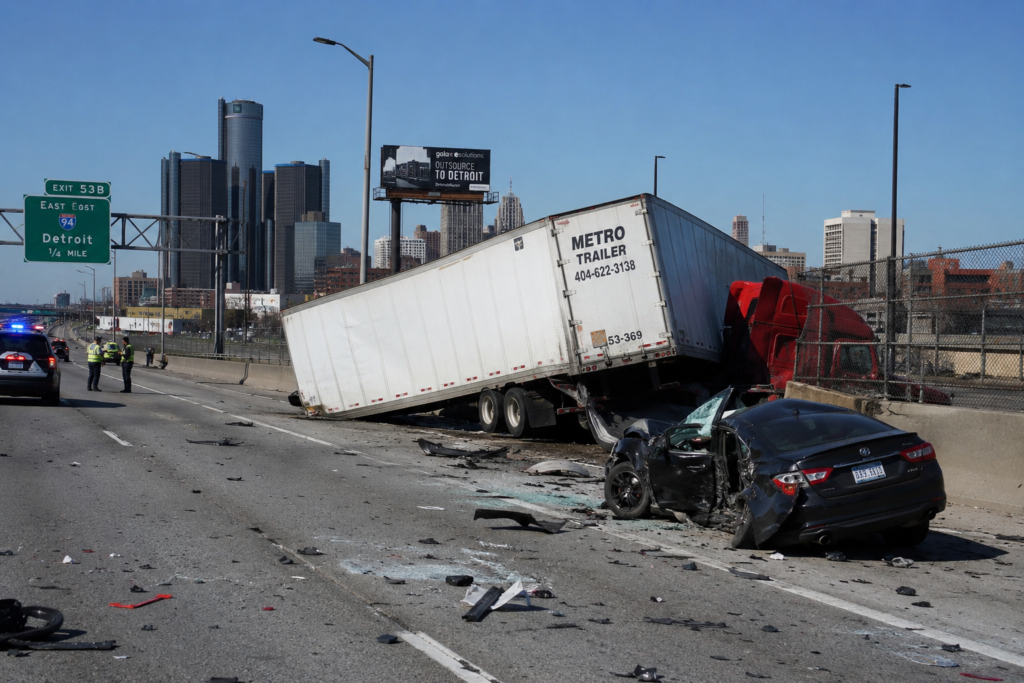
A serious semi-truck crash on a Detroit freeway illustrates the severe damage that can result when commercial trucks collide with passenger vehicles.