










A traumatic brain injury can affect memory, concentration, balance, communication, sleep, mood, employment, and a person’s ability to manage everyday responsibilities.
A Sterling Heights brain injury lawyer at Khamo Law can investigate how the injury occurred, identify potentially responsible parties, preserve accident evidence, document neurological and cognitive symptoms, evaluate insurance coverage, and pursue compensation supported by Michigan law and the facts. A Sterling Heights brain injury attorney can also help address traumatic brain injury and TBI claims involving long-term medical care, lost income, and future rehabilitation needs.
Khamo Law has an office in Sterling Heights at:
36250 Dequindre Road
Suite 110
Sterling Heights, MI 48310
Call 248-466-0606 for a free consultation.
For broader injury representation, visit Khamo Law’s Sterling Heights Personal Injury Lawyers page. For statewide information about traumatic brain injury claims, long-term effects, liability, and compensation under Michigan law, visit our Michigan Brain Injury resource.
How Can a Sterling Heights Brain Injury Lawyer Help?
Brain-injury claims can be difficult because symptoms may not be visible to other people and the effects can change over time.
Khamo Law can help by:
- Investigating the accident that caused the injury
- Preserving photographs, video, and physical evidence
- Obtaining police or incident reports
- Identifying witnesses
- Reviewing applicable insurance coverage
- Documenting medical treatment
- Organizing the timeline of neurological symptoms
- Evaluating lost income
- Investigating reduced future earning capacity
- Documenting rehabilitation and future-care needs
- Communicating with insurance companies
- Consulting appropriate professionals when necessary
- Filing a lawsuit when appropriate
The case should document both how the accident happened and how the brain injury changed the person’s life.
What Is a Traumatic Brain Injury?
A traumatic brain injury, or TBI, occurs when trauma disrupts normal brain function.
Brain injuries can range from concussions and mild traumatic brain injuries to severe injuries involving permanent cognitive, neurological, or physical impairment.
The Centers for Disease Control and Prevention provides medical information concerning traumatic brain injury and concussion.
For broader Michigan legal information, visit our Michigan Traumatic Brain Injury Lawyer page.
Brain Injuries After Accidents in Sterling Heights
Traumatic brain injuries can result from many kinds of accidents handled by Khamo Law, including:
- Car accidents
- Truck accidents
- Motorcycle crashes
- Pedestrian collisions
- Bicycle accidents
- Slip and fall accidents
- Dangerous property conditions
- Other serious traumatic incidents
The underlying accident determines which liability rules, insurance policies, and evidence may apply.
Brain Injuries From Sterling Heights Car Accidents
Motor-vehicle crashes can cause head and brain trauma through direct impact or rapid acceleration and deceleration.
Potential evidence may include:
- Police reports
- Vehicle damage
- Crash-scene photographs
- Surveillance footage
- Dashcam video
- Witness accounts
- Emergency medical records
- Electronic vehicle information when available
For collision-specific liability and insurance information, visit our Sterling Heights Car Accident Lawyer page.
Brain Injuries From Truck Accidents
Commercial truck collisions may cause severe brain injuries and can involve additional evidence controlled by trucking companies or motor carriers.
Potential evidence may include:
- Electronic logging information
- Commercial driver records
- Maintenance records
- Vehicle data
- Dispatch information
- Commercial insurance
For those cases, visit our Sterling Heights Truck Accident Lawyer page.
Motorcycle Brain Injuries
Motorcyclists may suffer head trauma when they:
- Strike another vehicle
- Contact the pavement
- Are thrown from the motorcycle
- Strike another object
Helmet use can reduce the risk of some head injuries, but it cannot eliminate every traumatic brain injury.
For motorcycle-specific issues, visit our Sterling Heights Motorcycle Accident Lawyer page.
Pedestrian and Bicycle Brain Injuries
Pedestrians and bicyclists have little protection when struck by motor vehicles.
A brain injury may result from:
- Direct vehicle impact
- Impact with the pavement
- Secondary collisions
- Rapid acceleration or rotational forces
Khamo Law maintains dedicated Sterling Heights Pedestrian Accident Lawyer and Sterling Heights Bicycle Accident Lawyer pages.
Brain Injuries From Falls
Falls can cause serious head injuries when a person strikes:
- Concrete
- Tile
- Stairs
- Pavement
- A wall
- A railing
- Another hard surface
If a dangerous property condition caused the fall, visit our Sterling Heights Premises Liability Attorney page.
For falls involving ice, snow, wet flooring, stairs, or other walking-surface hazards, see our Sterling Heights Slip and Fall Lawyer page.
Symptoms of a Traumatic Brain Injury
Potential TBI symptoms can include:
- Headaches
- Dizziness
- Balance problems
- Nausea
- Vision problems
- Sensitivity to light
- Sensitivity to noise
- Fatigue
- Memory problems
- Difficulty concentrating
- Feeling mentally slowed down
- Sleep changes
- Irritability
- Anxiety
- Mood changes
Some concussion and mild-TBI symptoms may appear immediately, while others may not become noticeable until hours or days later.
Anyone experiencing concerning symptoms after head trauma should obtain appropriate medical evaluation.
Concussions and Mild Traumatic Brain Injuries
A concussion is a form of traumatic brain injury.
The word “mild” refers to the initial clinical classification and does not necessarily mean the person’s symptoms feel insignificant.
A concussion may interfere with:
- Work
- Driving
- Reading
- Screen use
- Exercise
- Sleep
- Concentration
- Household responsibilities
Symptoms and restrictions should be discussed with appropriate medical professionals.
Moderate and Severe Brain Injuries
More serious brain injuries can result in substantial long-term impairment.
Potential consequences may involve:
- Loss of consciousness
- Memory loss
- Cognitive impairment
- Speech or communication problems
- Movement difficulties
- Behavioral changes
- Vision problems
- Loss of independence
- Need for rehabilitation
- Need for long-term assistance
The extent of recovery varies considerably between individuals.
Brain Injuries Are Often Invisible
A person with a brain injury may look physically healthy while experiencing substantial neurological, emotional, or cognitive difficulties.
This can make careful documentation particularly important.
Medical evidence may document:
- Headaches
- Memory problems
- Concentration difficulties
- Balance problems
- Sleep changes
- Mood changes
- Work restrictions
- Rehabilitation needs
Family members and coworkers may also notice changes in the person’s behavior or functioning after the accident.
Evidence That May Matter in a Brain Injury Claim
Potential evidence can include:
- Police or incident reports
- Crash photographs
- Property-condition photographs
- Surveillance footage
- Dashcam video
- Witness statements
- Medical records
- Emergency-room records
- Imaging
- Neurological evaluations
- Neuropsychological testing when appropriate
- Rehabilitation records
- Therapy records
- Employment records
- Wage documentation
- Insurance records
The exact evidence depends on how the injury occurred and how it affects the person.
Why the Injury Timeline Matters
Brain-injury symptoms can change over time.
An injured person may initially focus on obvious physical injuries and later recognize problems involving:
- Memory
- Concentration
- Balance
- Sleep
- Mood
- Vision
- Headaches
A consistent treatment and symptom timeline can help document when these problems began and how they progressed.
Medical treatment should be based on healthcare needs rather than solely on legal considerations.
Documenting Changes in Daily Life
Medical records alone may not show the entire effect of a brain injury.
Useful information may include difficulties with:
- Returning to work
- Completing normal job duties
- Driving
- Managing finances
- Household tasks
- Parenting or caregiving
- Social activities
- Exercise
- Memory
- Communication
A brain-injury claim may need to explain what the person could do before the accident compared with what they can do afterward.
Lost Income and Reduced Earning Capacity
Brain injuries may interfere with a person’s ability to work even when they do not cause obvious physical limitations.
Potential employment effects include:
- Missed work
- Reduced hours
- Memory problems
- Difficulty concentrating
- Slower processing
- Fatigue
- Need for workplace accommodations
- Inability to return to a previous occupation
Depending on the injury, a claim may involve both past wage loss and future earning limitations.
Rehabilitation and Future Care
Some people recover from brain injuries relatively quickly, while others require extended treatment and rehabilitation.
Potential care may involve:
- Neurology
- Physical therapy
- Occupational therapy
- Speech therapy
- Cognitive rehabilitation
- Psychological treatment
- Medication management
- Other supportive services
Michigan also maintains brain injury services and resources through the Michigan Department of Health and Human Services.
Future-care claims should be supported by medical evidence rather than speculation.
Michigan No-Fault Insurance and Brain Injuries
When a TBI results from a motor-vehicle accident, Michigan No-Fault insurance may become part of the claim.
Potential issues may involve:
- Medical expenses
- Wage-loss benefits
- Replacement services
- Attendant care
- Applicable PIP coverage
- Insurance disputes
Because those rules apply across Michigan rather than only in Sterling Heights, the deeper insurance discussion belongs on Khamo Law’s statewide No-Fault resources.
The Michigan Department of Insurance and Financial Services also provides official information about Michigan automobile insurance.
Who May Be Responsible?
Responsibility depends on what caused the brain injury.
Potentially responsible parties may include:
- A negligent driver
- A commercial driver
- A trucking company
- A property owner or possessor
- A business
- A contractor
- Another person or company whose conduct caused the accident
The severity of the brain injury does not itself establish liability.
The underlying accident still must be investigated.
What Compensation May Be Available?
Depending on the underlying claim, applicable law, and insurance, damages may include:
- Medical expenses
- Future medical care
- Rehabilitation
- Lost income
- Reduced earning capacity
- Pain and suffering when legally recoverable
- Disability
- Loss of normal activities
- Other legally recoverable losses
There is no standard settlement amount for a Sterling Heights brain-injury case.
Potential value depends on the severity and permanence of the injury, treatment, future care, employment effects, liability evidence, and insurance coverage.
What If Imaging Looks Normal?
Brain-injury claims should not be evaluated from one test result alone.
The significance of imaging, neurological symptoms, cognitive problems, and other medical findings should be evaluated by qualified healthcare professionals.
Insurance companies may still question a claim when a person appears physically healthy or imaging does not show an obvious structural injury.
The full medical record and functional effects of the injury matter.
What Should You Do After a Suspected Brain Injury?
Your medical needs come first.
After significant head trauma:
- Seek appropriate medical evaluation.
- Follow medical instructions.
- Report new or worsening symptoms.
- Keep medical records and bills.
- Preserve accident photographs and video.
- Obtain witness information when appropriate.
- Save insurance communications.
- Document missed work.
- Keep track of significant changes in daily functioning.
The CDC identifies certain symptoms following head trauma as emergency warning signs and advises seeking emergency care when appropriate.
Sterling Heights Accident Records
When a brain injury results from a collision or other incident investigated by Sterling Heights Police, local reports may become part of the evidence.
The City provides procedures for obtaining Sterling Heights police and accident reports.
Reports may help establish:
- When the incident occurred
- Where it happened
- People or vehicles involved
- Witness information
- Initial observations
A police report does not necessarily determine civil liability.
Sterling Heights Roadway Context
Many local brain-injury claims arise from vehicle, motorcycle, pedestrian, or bicycle collisions.
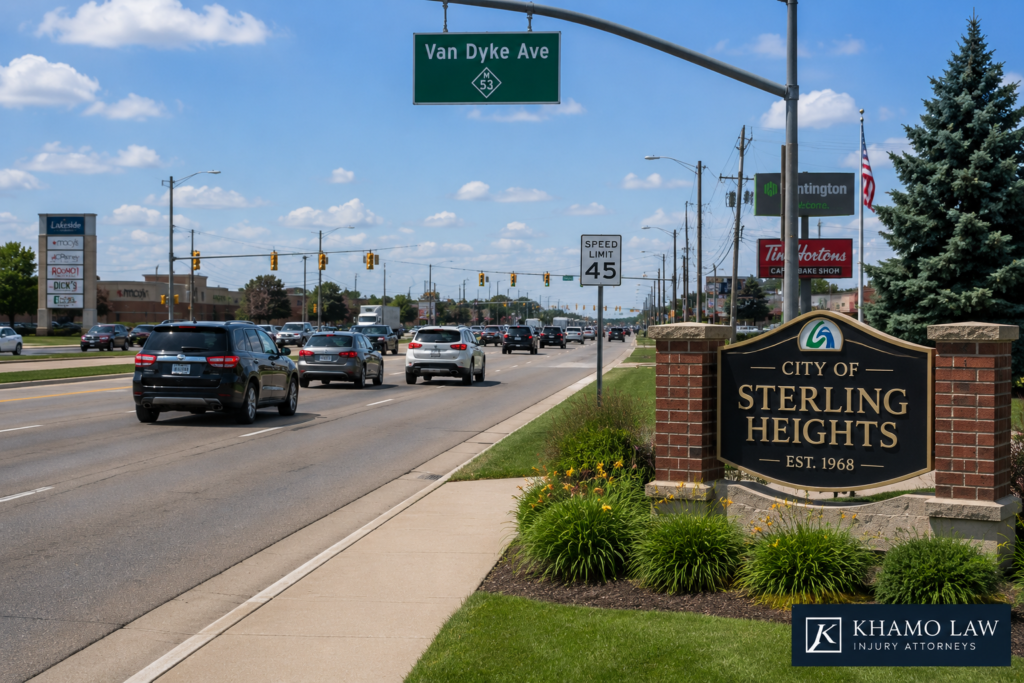
Sterling Heights includes major corridors such as:
- Van Dyke Avenue / M-53
- Hall Road / M-59
- Mound Road
- Dequindre Road
- Schoenherr Road
- Metropolitan Parkway
- Clinton River Road
The City continues to maintain and reconstruct important local transportation corridors, including projects involving Clinton River Road and Metropolitan Parkway.
Road location or construction does not establish fault. It can, however, help identify traffic controls, roadway configuration, nearby cameras, witnesses, and other evidence that may matter after a serious crash.
Brain Injury and Spinal Cord Injury
Some serious accidents cause both brain and spinal trauma.
When an accident also causes weakness, loss of sensation, mobility limitations, or spinal-cord damage, visit our Sterling Heights Spinal Cord Injury Attorney page.
Keeping these resources separate helps each page address its distinct medical and financial consequences.
Fatal Brain Injuries
Some traumatic brain injuries result in death.
When legally actionable conduct causes a fatal injury, Michigan wrongful-death law may apply.
Families can visit our Sterling Heights Wrongful Death Attorney page.
Why Choose Khamo Law for a Sterling Heights Brain Injury Case?
Brain-injury claims can involve complicated medical evidence, disputed symptoms, future treatment, lost earning capacity, insurance issues, and significant long-term consequences.
Khamo Law can investigate:
- How the accident happened
- Who may be responsible
- What evidence should be preserved
- What insurance may apply
- How the injury affects work
- How symptoms affect daily life
- What treatment and rehabilitation have been required
- What future losses should be documented
Khamo Law has an office in Sterling Heights at:
36250 Dequindre Road
Suite 110
Sterling Heights, MI 48310
By Appointment
Personal-injury matters are handled on a contingency-fee basis.
Call 248-466-0606 for a free consultation.
Sterling Heights Brain Injury Attorney FAQs
Can you have a brain injury without losing consciousness?
Yes. Loss of consciousness is not required for every concussion or traumatic brain injury.
What Is the Difference Between a Brain Injury Lawyer and a TBI Attorney?
These terms generally refer to the same type of legal representation. A Sterling Heights brain injury lawyer or TBI attorney may investigate how the injury occurred, preserve evidence, document neurological and cognitive symptoms, evaluate insurance coverage, calculate financial losses, and pursue compensation when supported by the facts and law.
Can concussion symptoms appear later?
Yes. Some symptoms may appear immediately while others can develop hours or days later.
What if my scan is normal?
Imaging is one part of medical evaluation. The significance of symptoms and testing should be evaluated by qualified healthcare professionals.
Can a car accident cause a brain injury?
Yes. Motor-vehicle collisions can cause traumatic brain injuries through direct impact or rapid acceleration and deceleration.
Can a fall cause a traumatic brain injury?
Yes. A serious fall can cause head trauma when the person’s head strikes the floor, stairs, pavement, or another surface.
What evidence can help a brain-injury case?
Potential evidence includes accident reports, photographs, video, witness statements, medical records, neurological testing, rehabilitation records, employment records, and insurance documents.
Can I recover lost income?
Potentially. Lost wages and reduced earning capacity may become part of a claim when supported by appropriate evidence.
How long do I have to file?
Michigan law imposes deadlines on injury claims. The applicable period depends on the claim and circumstances, so it should be evaluated specifically rather than assumed.
How much is my brain injury case worth?
There is no standard amount. Potential value depends on liability, injury severity, treatment, future needs, employment effects, insurance coverage, and other evidence.
How much does Khamo Law charge?
Khamo Law handles personal-injury cases on a contingency-fee basis. Attorney fees depend on obtaining a recovery rather than hourly billing throughout the case.
Speak With a Sterling Heights Brain Injury Attorney
If you or a loved one suffered a traumatic brain injury because of an accident in Sterling Heights, Khamo Law can investigate what happened, preserve important evidence, evaluate applicable insurance coverage, document the medical and financial consequences, and pursue compensation supported by the facts.
Call 248-466-0606 or contact Khamo Law online for a free consultation.