







A pedestrian has almost no physical protection when struck by a car, SUV, pickup truck, or commercial vehicle. Even a collision that causes relatively minor vehicle damage can leave the person on foot with fractures, traumatic brain injuries, spinal injuries, internal trauma, or permanent disability.
A Warren pedestrian accident lawyer at Khamo Law can investigate how the collision occurred, preserve available video and witness evidence, evaluate driver fault and insurance coverage, document your injuries and financial losses, and pursue compensation supported by Michigan law and the facts of your case.
Khamo Law represents injured pedestrians throughout Warren, Macomb County, and Metro Detroit. Warren is part of the firm’s service area; Khamo Law maintains physical offices in Troy and Sterling Heights.
Call 248-466-0606 or contact Khamo Law for a free consultation.
For other serious accidents and injuries in the city, visit our Warren personal injury lawyer page.
Legally reviewed by Attorney Koro E. Khamo
Founder & Managing Attorney at Khamo Law
Michigan Bar No. P80994
Why Warren Pedestrian Accident Cases Require a Different Investigation
Pedestrian collisions are different from ordinary two-car crashes.
There may be no second vehicle to preserve on behalf of the injured pedestrian. Instead, the investigation can depend heavily on:
- Traffic signals
- Crosswalk markings
- Driver and pedestrian visibility
- Turning movements
- Nearby surveillance footage
- Witness statements
- Vehicle damage
- Cellphone or dashcam video
- Lighting conditions
- Roadway configuration
- Police investigation
- The pedestrian’s location immediately before impact
Drivers and pedestrians may also disagree about whether the pedestrian was inside a crosswalk, which direction traffic was moving, what the signal displayed, or whether the driver had enough time to react.
Those disputes make early evidence preservation particularly important.
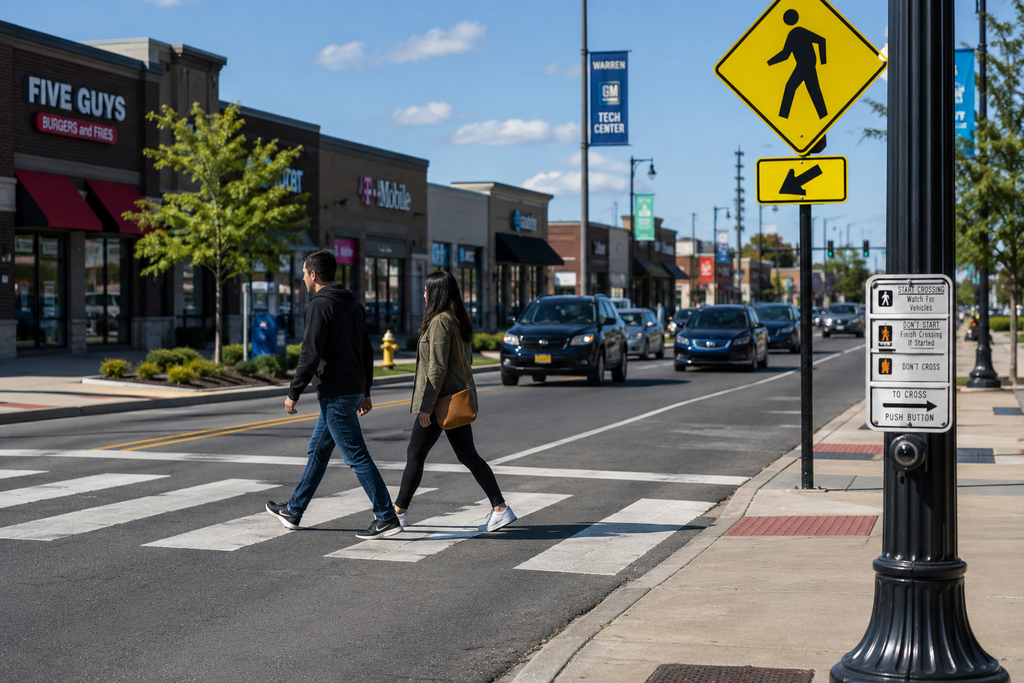
Pedestrians and motorists share Warren’s busy commercial corridors, where crosswalk visibility and turning movements can become important after a pedestrian collision.
Warren’s Transportation Planning Shows Why Pedestrian Conditions Deserve Local Attention
Warren is not simply a collection of residential streets.
The city contains wide arterial roads, commercial corridors, industrial areas, intersections, parking lots, bus stops, sidewalks, and freeway connections.
Warren has also been actively planning for pedestrian and non-motorized transportation.
The City of Warren Planning Department states that the Warren Active Mobility Plan was approved by City Council on January 27, 2026. The city has also adopted detailed planning documents for the Van Dyke corridor addressing pedestrian crossings, sidewalks, accessibility, lighting, and other mobility improvements.
These planning efforts do not prove that a particular roadway caused an accident.
They do provide genuine local context for how Warren is evaluating pedestrian movement and roadway design.
Pedestrian Conditions Along Van Dyke Avenue
Van Dyke Avenue is one of Warren’s major north-south corridors and presents a particularly useful example of why pedestrian accident investigations should consider roadway design.
The City of Warren Van Dyke Corridor Plan recommends improvements including formalized pedestrian crossings, pedestrian curb ramps, appropriate signage, pedestrian signal timing, enhanced lighting, and potential signalized mid-block crossings.
The city’s more recent Van Dyke Corridor Implementation Plan also identifies cracked and uneven sidewalk conditions and notes that the studied corridor lacks mid-block crossings in certain areas.
That does not mean every pedestrian collision on Van Dyke is caused by roadway design.
It means a crash investigation should consider the actual location, crosswalk availability, signals, visibility, lighting, turning movements, nearby businesses, and where the pedestrian was traveling immediately before impact.
IMAGE PLACEMENT — AFTER THIS SECTION
Recommended image: Photorealistic editorial image of pedestrians using a marked crossing along a Warren commercial corridor such as Van Dyke Avenue. Normal Southeast Michigan streetscape, realistic traffic, natural daylight. No staged collision, ambulance, attorney, courthouse, text overlay, or advertising graphics.
Alt text: Pedestrians crossing a commercial roadway in Warren, Michigan.
Caption: Warren’s transportation planning includes pedestrian crossings, sidewalks, accessibility, and mobility improvements along major corridors such as Van Dyke Avenue.
Pedestrian Accidents at Intersections
Intersections are common points of conflict between drivers and people on foot.
A pedestrian may be struck when a driver:
- Turns left through a crosswalk
- Turns right while watching approaching vehicle traffic
- Runs a red light
- Fails to stop
- Fails to yield
- Accelerates through an intersection
- Drives while distracted
- Misjudges the pedestrian’s position
Michigan law specifically addresses pedestrian traffic signals.
Under MCL 257.613, pedestrians facing a walk signal may proceed through the crosswalk, and drivers must yield the right of way to pedestrians proceeding under that signal.
That legal rule is statewide. The Warren-specific question is what the signal displayed and where the pedestrian and vehicle were positioned at the particular intersection.
Video, witnesses, traffic-signal information, photographs, and physical evidence can therefore become important.
Crosswalk Pedestrian Accidents
A marked crosswalk can become one of the most important pieces of evidence in a pedestrian claim.
Michigan administrative traffic rules require drivers to yield to pedestrians in crosswalks under specified circumstances when traffic-control signals are not operating or are not present.
But crosswalk cases can still involve factual disputes.
An insurer may argue that the pedestrian entered too suddenly, crossed against a signal, or was outside the crosswalk.
The pedestrian may contend that the driver failed to stop, turned through the crossing, was distracted, or never looked in the pedestrian’s direction.
Those issues should be evaluated through evidence rather than assumptions.
Turning Vehicles Can Be Particularly Dangerous to Pedestrians
A driver making a turn may be watching other vehicle traffic rather than the person crossing the street.
Right-turn and left-turn collisions can therefore raise questions involving:
- Driver line of sight
- Crosswalk location
- Pedestrian signal
- Vehicle signal
- Speed
- Turning radius
- Driver distraction
- A-pillars or other sight obstructions
- Nearby vehicles
- Lighting
- Witness testimony
A statement that the driver “never saw” the pedestrian does not automatically resolve fault.
The investigation should determine why the pedestrian was not seen and whether reasonable attention could have prevented the collision.
Pedestrian Accidents Near Warren Businesses and Parking Lots
Not every pedestrian accident happens in a roadway crosswalk.
People can be struck in:
- Shopping-center parking lots
- Store entrances
- Restaurant lots
- Apartment complexes
- Gas stations
- Office properties
- Commercial driveways
- Parking structures
- Private access roads
Vehicles backing from parking spaces or moving through busy lots can strike pedestrians who are walking toward stores, vehicles, sidewalks, or entrances.
These locations can also contain valuable evidence.
Commercial properties frequently use surveillance systems that may show the collision or the moments immediately before it.
If the collision occurred on private property and a dangerous property condition contributed to the injury, different legal issues may also arise. Our Warren premises liability attorney page addresses dangerous-property claims more broadly.
Surveillance Footage Can Be Critical
Video evidence can be especially valuable after a pedestrian collision.
A camera may show:
- Whether the pedestrian was in a crosswalk
- What the traffic signal displayed
- Whether a vehicle stopped
- A turning movement
- Driver speed
- Where the pedestrian entered the roadway
- The collision itself
- The driver’s actions afterward
Potential sources include:
- Nearby businesses
- Gas stations
- Restaurants
- Apartment buildings
- Homes
- Dashcams
- Public or private security systems
- Other vehicles
The problem is that many surveillance systems automatically overwrite older footage.
Identifying potential cameras quickly can therefore be important.
Hit-and-Run Pedestrian Accidents
Pedestrian hit-and-run collisions create an immediate identification and evidence problem.
When the driver leaves the scene, investigators may need to rely on:
- Witness descriptions
- Surveillance video
- Dashcam footage
- Vehicle fragments
- License-plate information
- Nearby business cameras
- Residential cameras
- Police investigation
- Cellphone video
Insurance coverage can also become more complicated when the responsible driver is unidentified or uninsured.
Khamo Law has discussed these evidence issues in a Warren hit-and-run case involving a serious spinal fracture. Read more about video preservation and insurance issues after a Warren hit-and-run.
What Should You Do After a Pedestrian Accident in Warren?
Your health comes first.
When reasonably possible:
- Call 911 and seek appropriate medical care.
- Report the collision to police.
- Photograph the vehicle, roadway, crosswalk, signals, signs, and visible injuries when safe.
- Obtain witness names and contact information.
- Identify nearby businesses or homes that may have cameras.
- Preserve cellphone photographs or video.
- Keep medical records, bills, insurance correspondence, wage-loss information, and accident-related receipts.
- Avoid detailed public social-media posts about the collision or your injuries.
- Consider speaking with an attorney when injuries are serious, fault is disputed, the driver fled, or insurance coverage is unclear.
The Warren Police Department provides information about obtaining accident reports and other police records.
Emergency medical treatment should never be delayed simply to gather evidence.
Obtaining a Warren Pedestrian Accident Report
When Warren Police investigate a motor-vehicle collision, the resulting report can provide useful information about:
- The driver
- Vehicle
- Collision location
- Witnesses
- Statements
- Observations made by officers
- Insurance information
- Diagram or crash circumstances
According to the Warren Police Department, vehicular accident reports are available through the department’s designated CLEMIS reporting system.
A police report can be important, but it does not necessarily determine civil liability.
Video, witness testimony, physical evidence, and additional investigation may establish facts that were not available to the responding officer.
Michigan No-Fault Benefits for Injured Pedestrians
A pedestrian struck by a motor vehicle may have rights under Michigan’s automobile No-Fault system even though the injured person was not occupying a vehicle.
The source of PIP benefits depends on Michigan’s statutory priority rules and available insurance.
The Michigan Department of Insurance and Financial Services explains that certain injured people who do not have applicable household No-Fault coverage—including pedestrians in some circumstances—may need to pursue PIP benefits through the Michigan Assigned Claims Plan.
PIP benefits can potentially address categories of losses such as accident-related medical care, wage loss, and replacement services, subject to applicable law and coverage.
Because these rules apply throughout Michigan rather than only in Warren, the deeper statewide discussion belongs on our Michigan pedestrian accident lawyer page.
Can an Injured Pedestrian Sue the Driver?
Potentially.
A pedestrian may have a liability claim against a negligent driver when the facts and Michigan law support one.
Potential examples include a driver who:
- Fails to yield
- Runs a traffic signal
- Turns through a crosswalk
- Drives while distracted
- Speeds
- Drives while impaired
- Backs into a pedestrian
- Leaves the scene
- Otherwise fails to use reasonable care
Automobile-related injury claims are also subject to Michigan’s rules governing recovery against an at-fault driver.
Our statewide Michigan pedestrian accident resource provides broader information about pedestrian claims throughout the state.
What If the Driver Blames the Pedestrian?
Drivers and insurers sometimes argue that the pedestrian crossed outside a crosswalk, ignored a traffic signal, entered the roadway suddenly, was distracted, or was difficult to see.
Those allegations should be investigated.
Michigan’s comparative-fault rules can affect damages when an injured person bears some responsibility for an accident.
But comparative fault should be based on evidence.
Relevant evidence can include:
- Signal timing
- Crosswalk markings
- Witnesses
- Video
- Driver statements
- Pedestrian location
- Vehicle speed
- Lighting
- Visibility
- Cellphone evidence
- Physical evidence
An insurance company’s initial percentage assignment does not necessarily determine the final outcome.
Distracted Driving and Pedestrian Collisions
Pedestrians can be particularly vulnerable to drivers who are looking at a cellphone, navigation screen, vehicle controls, passengers, or something outside the roadway.
At an intersection, even a short period of distraction can prevent a driver from noticing that a person has entered a crosswalk.
Where distraction is genuinely at issue, legally obtainable evidence may include:
- Cellphone records
- Witness statements
- Video
- Driver admissions
- Dashcam footage
- Vehicle information
- Police investigation
Cellphone records are not automatically relevant or obtainable in every case.
The investigation should be proportional to the facts.
Serious Injuries After Pedestrian Accidents
Pedestrian collisions can cause severe injuries because there is no vehicle structure around the injured person to absorb the impact.
Potential injuries include:
- Traumatic brain injuries
- Spinal cord injuries
- Fractures
- Pelvic injuries
- Leg and knee injuries
- Shoulder injuries
- Internal injuries
- Nerve damage
- Lacerations
- Scarring
- Permanent disability
Some victims require surgery, hospitalization, inpatient rehabilitation, therapy, assistive devices, or long-term medical treatment.
When a pedestrian collision causes neurological trauma, see our Warren brain injury lawyer page or Warren spinal cord injury lawyer page for more focused information.
Traumatic Brain Injuries After a Pedestrian Crash
A pedestrian may strike the vehicle, roadway, curb, or another object during a collision.
That can cause a traumatic brain injury even when there is no visible head wound.
Potential symptoms may include:
- Headaches
- Memory problems
- Difficulty concentrating
- Dizziness
- Balance problems
- Sleep disturbance
- Mood changes
- Sensitivity to light or noise
Neurological symptoms should be medically evaluated.
For deeper information about these claims, visit our Warren traumatic brain injury attorney page.
Spinal and Orthopedic Injuries
Pedestrian impacts can also cause spinal fractures, disc injuries, spinal cord trauma, pelvic fractures, leg fractures, shoulder injuries, and other serious orthopedic damage.
Some injuries can affect walking, lifting, driving, employment, and ordinary daily activities long after the initial collision.
When the accident causes catastrophic spinal trauma, our Warren spinal cord injury lawyer page provides injury-specific information.
Pedestrian Accidents Involving Commercial Trucks
A pedestrian struck by a tractor-trailer, delivery vehicle, box truck, or other commercial vehicle may face additional legal and evidence issues.
Commercial cases can involve:
- Driver qualification records
- Electronic logs
- GPS data
- Dispatch records
- Company policies
- Maintenance records
- Dashcam footage
- Commercial insurance
- Multiple potentially responsible companies
If a commercial vehicle was involved, visit our Warren truck accident lawyer page for more information about truck-specific evidence and liability.
Fatal Pedestrian Accidents
Some pedestrian collisions result in death.
When negligent conduct causes a fatal crash, Michigan’s wrongful-death law may provide a legal remedy through the deceased person’s estate.
A fatal pedestrian case may involve:
- Crash reconstruction
- Video preservation
- Witness investigation
- Insurance coverage
- Medical evidence
- Lost financial support
- Other damages recognized under Michigan law
Families dealing with a fatal Warren collision can learn more from our Warren wrongful death lawyer page.
What Compensation May Be Available?
The compensation available after a pedestrian accident depends on the injuries, insurance coverage, fault, applicable Michigan law, and the type of claim.
Potential losses may include:
- Medical and rehabilitation expenses
- Wage loss
- Reduced earning capacity
- Future medical treatment
- Assistive devices
- Home modifications
- Replacement services when applicable
- Pain and suffering when legally recoverable
- Scarring and disfigurement
- Other legally recoverable damages
No responsible attorney can determine case value merely from the fact that a pedestrian was struck.
The evidence matters.
How Long Do You Have After a Warren Pedestrian Accident?
Pedestrian cases can involve several different deadlines.
Michigan generally applies a three-year limitations period to many personal-injury actions, subject to exceptions and claim-specific rules.
No-Fault PIP claims can involve separate statutory notice and filing requirements.
Other special rules can apply depending on who is responsible and the type of claim.
The practical deadline for preserving evidence may arrive much sooner than the lawsuit deadline because surveillance footage can disappear, vehicles can be repaired, and witnesses can become difficult to locate.
How Khamo Law Helps After a Warren Pedestrian Accident
A serious pedestrian claim requires more than proving that a vehicle struck someone.
Khamo Law can:
- Investigate how the collision occurred
- Preserve surveillance and video evidence
- Identify witnesses
- Examine crosswalk and traffic-signal issues
- Review police reports
- Evaluate driver fault
- Identify applicable insurance
- Analyze Michigan No-Fault benefits
- Respond to comparative-fault allegations
- Document medical treatment
- Calculate wage and financial losses
- Evaluate future treatment and earning losses when appropriate
- Communicate with insurance companies
- Work with appropriate experts
- Prepare the case for litigation when necessary
The investigation should follow the evidence rather than assume that either the driver or pedestrian was automatically at fault.
Warren Pedestrian Accident Lawyer FAQs
What if I was hit while walking in a crosswalk?
Crosswalk location, signal status, vehicle movement, visibility, and witness or video evidence can all be important. Michigan law contains specific rules governing pedestrian signals and right of way.
What if the driver was turning when they hit me?
Turning-vehicle crashes often require analysis of the driver’s line of sight, crosswalk position, signal status, traffic conditions, and whether the driver was watching for pedestrians.
What if I crossed outside a marked crosswalk?
That does not automatically mean you have no claim. The pedestrian’s conduct, driver’s conduct, visibility, location, speed, and comparative-fault rules all need to be evaluated.
Can pedestrians receive Michigan No-Fault benefits?
Potentially. A pedestrian injured by a motor vehicle may qualify for PIP benefits depending on applicable household coverage and Michigan’s statutory priority rules.
What if the driver left the scene?
Hit-and-run cases require quick attention to video, witnesses, vehicle descriptions, debris, license-plate information, and available insurance coverage.
How do I get my Warren police accident report?
The Warren Police Department provides instructions for obtaining vehicular accident reports through its designated reporting system.
What if I suffered a brain injury?
Pedestrian crashes can cause serious neurological injuries. Visit our Warren brain injury lawyer page for more focused information.
What if I was hit by a delivery truck or semi?
Commercial-vehicle cases may involve trucking-company evidence and additional defendants. See our Warren truck accident lawyer page.
What if a loved one died in a pedestrian collision?
A wrongful-death claim may be available through the deceased person’s estate when negligent conduct caused the collision. See our Warren wrongful death lawyer page.
How much is my Warren pedestrian accident case worth?
There is no standard settlement amount. Value depends on fault, injuries, medical evidence, future treatment, income loss, insurance coverage, comparative fault, and other case-specific facts.
Speak With a Warren Pedestrian Accident Lawyer
If you or a loved one was struck by a vehicle while walking in Warren, Khamo Law can investigate what happened, preserve available video and witness evidence, evaluate Michigan No-Fault and liability insurance, document your injuries and financial losses, and explain the legal options that may be available.
Call 248-466-0606 or contact Khamo Law online for a free consultation.
For broader Warren injury representation, visit our Warren personal injury lawyer page. For statewide pedestrian insurance and injury information, visit our Michigan pedestrian accident lawyer resource.
Khamo Law represents injured pedestrians throughout Warren, Macomb County, Metro Detroit, and Michigan.