






Bike lanes and other bicycle facilities can help separate cyclists from some vehicle traffic, but they do not eliminate the risk of a collision.
A cyclist can be injured when a driver turns across the cyclist’s path, enters a bicycle travel area, passes too closely, opens a vehicle door, or fails to see the rider near an intersection or driveway.
This resource explains some of the evidence and crash scenarios that can matter after a bike lane accident in Troy.
If you were injured while riding a bicycle and need information about pursuing a claim, visit our Troy Bicycle Accident Lawyer page. For broader injury information in the city, see our Troy Personal Injury Lawyer resource.
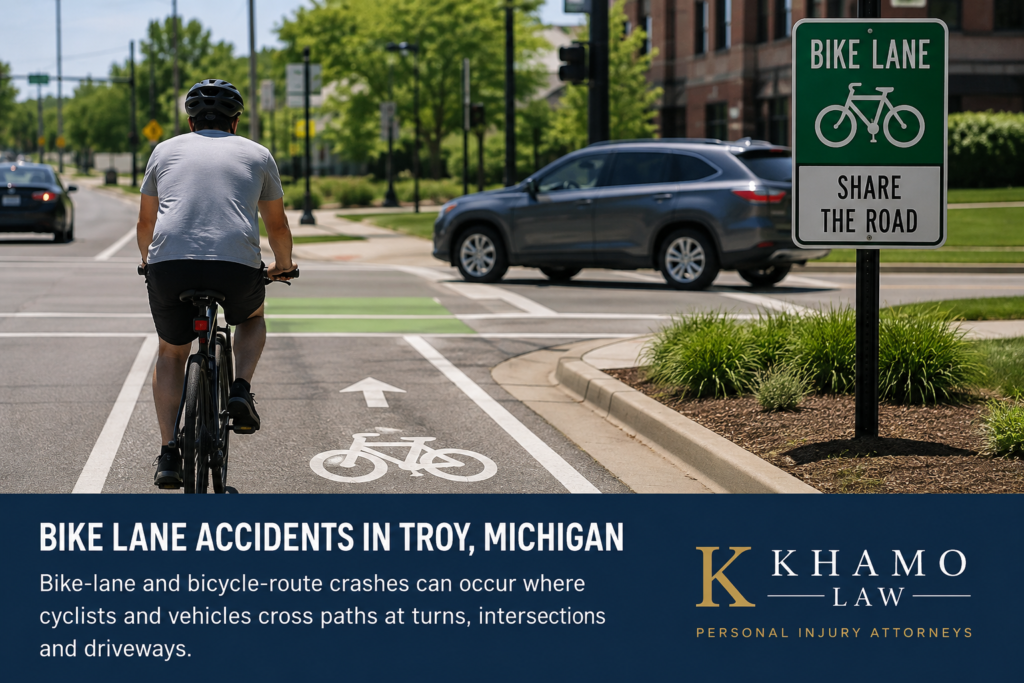
Bike-lane and bicycle-route crashes can occur where cyclists and vehicles cross paths at turns, intersections and driveways.
Bicycle Travel in Troy
Cyclists in Troy may encounter a mixture of major roads, neighborhood streets, commercial driveways, intersections, paths, and other nonmotorized facilities.
The City of Troy maintains its Troy Trails system for nonmotorized use and provides information about the city’s trail network.
That local network is important context because bicycle crashes do not occur in only one type of environment. A collision may occur where a cyclist transitions between a path, roadway, driveway, intersection, crossing, or shared traffic area.
How Bike Lane Accidents Can Happen
A bicycle lane does not prevent a motor vehicle from crossing a cyclist’s path.
Common scenarios can include:
- A driver turning right across a cyclist’s path
- A driver turning left in front of an approaching cyclist
- A vehicle entering or leaving a driveway
- A vehicle drifting into a bicycle travel area
- A driver passing too closely
- A parked vehicle door opening into a cyclist’s path
- A driver failing to check for a cyclist before changing position
- A cyclist and vehicle entering an intersection at the same time
The precise road design and traffic controls at the crash location matter. Evidence should therefore focus on the actual location instead of assuming all bike-lane collisions happen the same way.
Right-Turn Collisions
A cyclist traveling alongside vehicle traffic may be vulnerable when a driver turns right across the cyclist’s direction of travel.
An investigation may consider:
- Where the bicycle was located before the turn
- Whether the driver passed the cyclist immediately beforehand
- Whether a turn signal was used
- Traffic signals
- Road markings
- Sight lines
- Vehicle speed
- Witness accounts
- Video footage
A driver may claim that the cyclist suddenly appeared beside the vehicle. Surveillance, dashcam footage, witness statements, and the physical layout of the intersection may help establish what actually happened.
Left-Turn Bicycle Accidents
A driver making a left turn may cross directly in front of a cyclist traveling from the opposite direction.
Important questions can include:
- Which direction the cyclist was traveling
- Which signal was displayed
- Whether the cyclist was visible
- Whether the vehicle yielded
- Vehicle speed
- Lighting
- Sight obstructions
- The location of the impact
Photographs showing the cyclist’s approach and the driver’s field of view can be particularly useful.
Bike Lane Crashes Near Driveways and Businesses
Commercial areas can create repeated crossing points between cyclists and vehicles.
Drivers may:
- Pull out of a driveway into a cyclist’s path
- Turn into a business across bicycle traffic
- Stop while blocking part of a bicycle travel area
- Focus on vehicle traffic in one direction and fail to look for a cyclist approaching from another
After a collision near a business, nearby surveillance systems may become an important source of evidence.
Potential video may come from:
- Stores
- Restaurants
- Offices
- Gas stations
- Hotels
- Parking facilities
- Apartment buildings
- Dashcams
Video is not guaranteed to exist, and retention periods can vary. Potential camera locations should be identified as early as reasonably possible.
Dooring Accidents in Troy
A dooring crash can occur when someone in a parked vehicle opens a door into the path of an approaching cyclist.
The cyclist may:
- Strike the open door
- Be thrown from the bicycle
- Swerve into moving traffic
- Strike another vehicle or fixed object
Evidence may include:
- Position of the parked vehicle
- Damage to the door
- Bicycle damage
- Helmet-camera footage
- Nearby surveillance video
- Witness testimony
- Photographs of the roadway and parking layout
The location of the vehicle and bicycle can help reconstruct how the collision occurred.
Unsafe Passing Near a Bicycle
Michigan law addresses how motorists must pass bicyclists traveling in the same direction.
Under MCL 257.636, a motorist generally must pass a bicycle at a safe distance of at least three feet to the left. If three feet is impracticable, the statute requires a safe distance and safe speed.
The Michigan State Police bicyclist laws guide also provides statewide guidance for motorists and cyclists.
For the broader rules that apply to bicyclists and motorists throughout the state, see our Michigan Bicycle Accident Lawyer resource.
This Troy page does not need to duplicate the full statewide legal discussion.
What If There Was No Traditional Bike Lane?
Not every bicycle crash occurs inside a painted bicycle lane.
A cyclist may be riding:
- On a roadway
- Near the right side of a travel lane
- Through an intersection
- Across a driveway
- Along a trail or pathway
- Through another lawful bicycle travel area
Whether a painted bicycle lane existed does not by itself determine fault.
Michigan law and bicycle-specific rules may apply depending on the circumstances. The actual traffic rules, movements of the cyclist and driver, road design, and available evidence should be evaluated together.
Evidence After a Troy Bike Lane Accident
Bike-lane cases can depend heavily on evidence showing where each person was positioned immediately before impact.
Potential evidence includes:
- Photographs of bike-lane or roadway markings
- Traffic signals
- Signs
- Bicycle damage
- Vehicle damage
- Helmet damage
- Surveillance footage
- Helmet-camera video
- Dashcam footage
- Witness statements
- Police crash reports
- Roadway photographs
- Measurements
- Medical documentation
Photographs should show more than just the damaged bicycle.
When it can be done safely, wider views of the location may document:
- Lane configuration
- Intersection layout
- Driveways
- Parking areas
- Sight lines
- Signs
- Signals
- Surrounding businesses
Preserve the Bicycle and Helmet
A damaged bicycle can itself become evidence.
After a serious collision, avoid disposing of or substantially repairing the bicycle before its condition has been documented.
The same may apply to:
- Helmet
- Clothing
- Lights
- Bags
- Bicycle-mounted cameras
- Other damaged equipment
Damage patterns can sometimes help establish the point or direction of impact.
Look for Video Quickly
Video may be especially important in a bike-lane collision because it can show the positions and movements of the cyclist and vehicle before the impact.
Look for potential cameras at:
- Nearby businesses
- Parking areas
- Homes
- Apartment buildings
- Traffic-adjacent properties
- Other vehicles
A rider should not assume footage will remain available indefinitely.
Preserving information about where cameras were located can help even if the injured person cannot obtain the footage personally.
Photograph Road Markings and the Surrounding Area
Roadway markings can change because of maintenance, construction, resurfacing, weather, or other conditions.
Useful photographs may show:
- Bicycle symbols
- Lane lines
- Crosswalks
- Stop lines
- Turn lanes
- Driveways
- Parking spaces
- Signs
- Traffic signals
- Pavement condition
These photographs provide context that a close-up photograph of the bicycle alone cannot.
Witnesses Can Help Explain the Crash
Witnesses may have observed:
- The vehicle approaching the cyclist
- A turning movement
- Unsafe passing
- A door being opened
- A traffic signal
- The cyclist’s position
- The collision itself
When possible, obtain a witness’s name and contact information.
Police Reports and Troy Bicycle Crashes
A serious collision involving a bicyclist and motor vehicle should be reported to law enforcement.
If the crash is handled by the City of Troy, the Troy Police Department is the relevant local law-enforcement resource.
Police documentation can provide information about the drivers, vehicles, location, witnesses, reported injuries, and initial investigation.
A police report can be important, but it should not automatically be treated as the complete record of the collision.
Video, photographs, witness information, and physical evidence may provide additional information.
What If the Driver Blames the Cyclist?
Drivers and insurers sometimes argue that a cyclist:
- Was outside the bicycle lane
- Entered traffic unexpectedly
- Failed to obey a signal
- Was difficult to see
- Was riding too far into a travel lane
- Failed to use appropriate lighting
Those allegations should be evaluated against Michigan law and the actual evidence.
The fact that a cyclist was not centered inside a painted bicycle lane does not, standing alone, establish responsibility for a crash.
Injuries From Bike Lane Collisions
Bicyclists have little protection when struck by a motor vehicle or thrown onto the pavement.
Potential injuries include:
- Concussions
- Traumatic brain injuries
- Broken bones
- Shoulder injuries
- Wrist and arm injuries
- Knee and leg injuries
- Facial injuries
- Road rash
- Spinal injuries
- Internal injuries
For severe injuries, Khamo Law maintains separate resources regarding Troy brain injury claims and Troy spinal cord injury claims.
Michigan Insurance Issues After a Bicycle Crash
When a motor vehicle strikes a cyclist, Michigan insurance law may affect which benefits and claims are available.
Because those insurance rules apply statewide rather than only in Troy, the deeper explanation belongs on Khamo Law’s Michigan Bicycle Accident Lawyer and Michigan No-Fault Insurance Lawyer resources.
The important point for this page is that an injured cyclist should not assume the driver’s liability policy is necessarily the only insurance issue involved.
What to Do After a Bike Lane Accident in Troy
Medical needs and immediate safety should come first.
If circumstances allow:
- Call 911.
- Seek appropriate medical treatment.
- Obtain the driver’s identifying and insurance information.
- Photograph the bicycle and vehicle.
- Photograph the lane, intersection, signs, signals, and surrounding area.
- Identify witnesses.
- Note nearby surveillance cameras.
- Preserve the bicycle, helmet, clothing, and equipment.
- Keep medical and insurance documents.
- Avoid altering original photographs or videos.
Do not put yourself back in traffic or delay emergency treatment merely to collect evidence.
How This Page Fits Into Khamo Law’s Troy Bicycle Resources
Khamo Law’s bicycle content should answer different questions on different pages rather than repeating the same material.
The Michigan Bicycle Accident Lawyer page provides statewide information about Michigan bicycle law, insurance, injuries, and legal claims.
The Troy Personal Injury Lawyer page is the broader local injury hub.
The Troy Bicycle Accident Lawyer page is the primary commercial resource for someone seeking representation after a bicycle collision in Troy.
This Bike Lane Accidents in Troy page serves a narrower informational purpose: explaining bike-lane crash scenarios and the evidence that may matter when a motor vehicle and cyclist come into conflict.
Injured in a Bicycle Accident in Troy?
If you were injured when a vehicle struck you while you were riding in Troy, Khamo Law can review the circumstances of the collision and explain the legal options that may be available.
Visit our Troy Bicycle Accident Lawyer page for information about liability, insurance, compensation, and representation.
Khamo Law’s Troy office is located at:
1120 E. Long Lake Road
Suite 250
Troy, MI 48085
Call 248-466-0606 for a free consultation.