






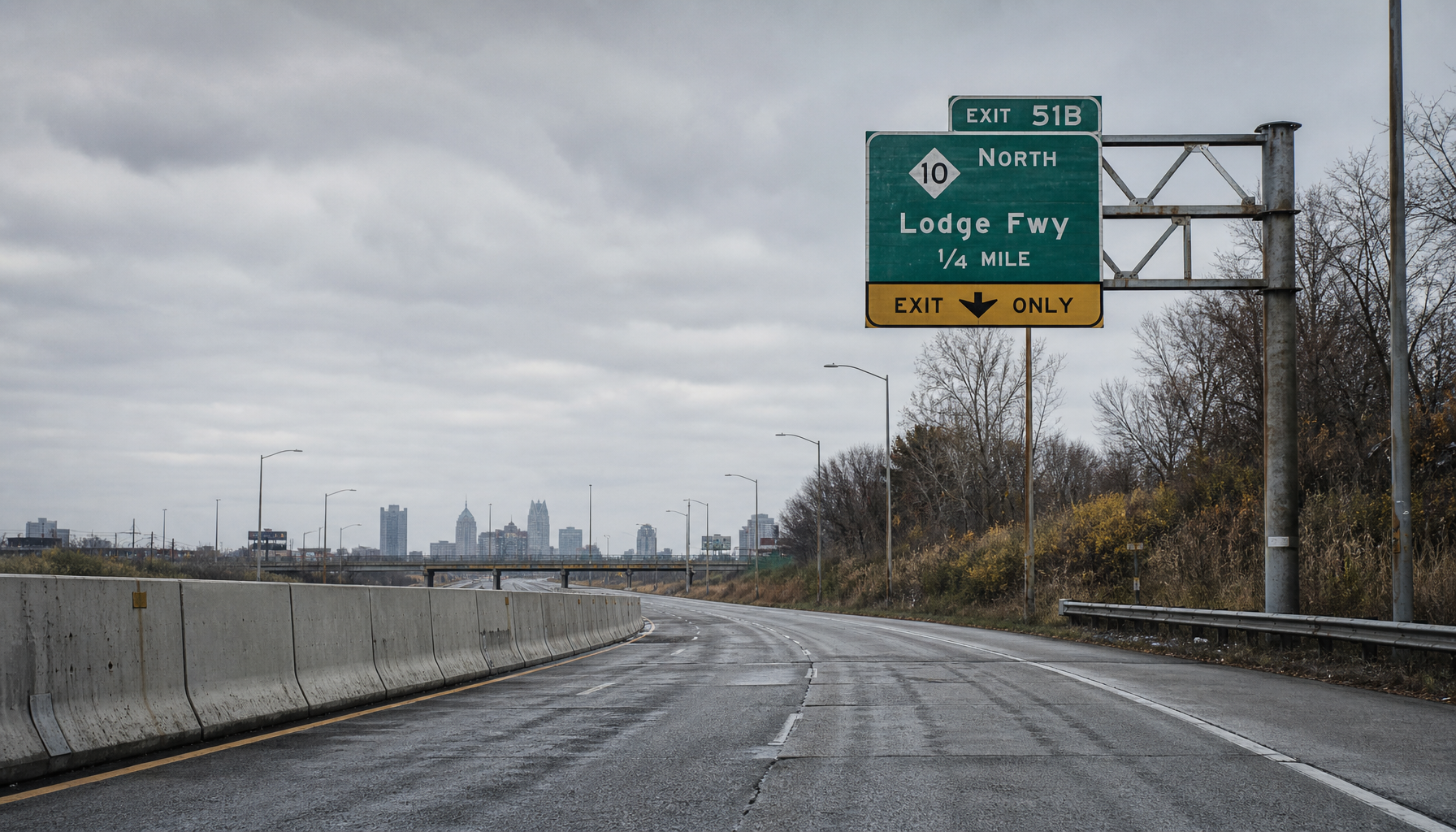
A motorcycle crash on the Lodge Freeway (M-10) near Livernois temporarily closed one of Detroit’s busiest corridors. If you ride the Lodge — or if you or someone you love was hurt in this crash — Michigan law gives you specific rights, and the steps you take in the first 24 to 72 hours matter more than most people realize.
As reported by FOX 2 Detroit, the crash forced a road closure on the Lodge near Livernois — a stretch of freeway that sees heavy commuter and truck traffic through northwest Detroit. Details about the rider’s condition were still developing at the time of publication.
Why the Lodge Freeway Is So Dangerous for Motorcyclists
The Lodge Freeway carries thousands of vehicles daily between downtown Detroit and the suburbs. For motorcyclists, that mix of merging drivers, lane changes, and distracted commuters creates real risk. According to NHTSA crash data, motorcyclists are about 24 times more likely to die in a crash per mile traveled than people in passenger cars. That number doesn’t change much whether you’re on a quiet side street or a major freeway — but freeway speeds make the consequences of any mistake far more severe.
The Livernois interchange specifically sits in a section of M-10 where ramps merge in quick succession. Drivers cutting across lanes to exit — often without checking mirrors — are a known hazard. If you’ve ridden the Lodge at rush hour, you already know this.
What Michigan Law Actually Covers After a Motorcycle Crash
Michigan’s no-fault system is more complicated for motorcyclists than for car drivers, and that confusion costs injured riders real money. Here’s the honest picture.
Personal Injury Protection (PIP) Benefits
Under MCL 500.3107, PIP benefits cover medical expenses, replacement services, and a portion of lost wages after a crash. The catch for motorcycle riders: motorcycles themselves are not required to carry no-fault insurance in Michigan. That means your PIP coverage typically comes from another source — your own auto policy if you own a car, a resident relative’s auto policy, or, in some cases, the Michigan Assigned Claims Plan.
If the other driver was in a car or truck, their no-fault policy may be the primary source of your PIP benefits. Getting this sorted out quickly matters, because the insurer you need to file with isn’t always obvious.
Pain and Suffering — the Tort Threshold
Beyond PIP, you may have a claim against the at-fault driver for pain and suffering. Michigan law under MCL 500.3135 requires that your injury meet a defined threshold — serious impairment of a body function, permanent serious disfigurement, or death. Road rash, broken bones, and traumatic brain injuries frequently qualify. A soft-tissue strain typically won’t.
For riders coming off a freeway crash at highway speeds, serious injury is far more common than not. The question is whether you have documented it properly.
The Statute of Limitations
You have three years from the date of the crash to file a personal injury lawsuit in Michigan — MCL 600.5805(2). That sounds like a long time. It isn’t, once you account for medical treatment, gathering evidence, and the time it takes an insurer to deny or lowball a claim.
Steps to Take After a Motorcycle Crash on the Lodge or Any Detroit Freeway
These aren’t generic tips. They’re specific to how Michigan no-fault claims actually work.
- Get medical attention the same day, even if you feel okay. Adrenaline masks pain. ER records dated the day of the crash are far stronger evidence than records from a week later.
- Call police and get a crash report number. Michigan State Police or Detroit Police will respond to Lodge Freeway incidents. Ask specifically for the report number before you leave the scene.
- Photograph everything you can — road surface, skid marks, the other vehicle’s position, your gear, your bike. If you can’t do this yourself, ask someone at the scene.
- Do not give a recorded statement to any insurance adjuster — yours or the other driver’s — before you talk to an attorney. Adjusters are trained to find inconsistencies that reduce your claim.
- Write down your account of what happened as soon as you’re able. Memory fades. Your own notes, dated and timestamped, can corroborate your later testimony.
- Identify any witnesses. Get a name and phone number if possible. On a freeway, bystanders often leave quickly.
- Contact an attorney before you sign anything. This includes any “medical authorization” forms from the insurance company — those can be broader than they appear.
What Happens If the Other Driver Was at Fault
If a car driver caused the crash — a sudden lane change, failing to yield at a ramp, distracted driving — you have a third-party negligence claim on top of your PIP claim. These are two separate tracks, and they run simultaneously.
The third-party claim is where your pain and suffering, excess medical costs, and future impairment are compensated. PIP only covers economic losses up to your chosen benefit level. Riders who handle only the PIP side and ignore the tort claim often leave the most significant money on the table.
For a closer look at how common crash types play out in the metro area, our post on types of motorcycle crashes in Sterling Heights breaks down the patterns that cause the most serious injuries — many of which apply equally to Detroit freeway crashes.
If the Crash Involved a Commercial Vehicle
Semi-trucks and commercial vehicles also use the Lodge Freeway corridor. If a commercial vehicle was involved in this crash, federal regulations under 49 CFR Part 395 govern driver hours of service, and Part 396 requires inspection and maintenance records. Those records are often destroyed after 90 days unless a legal hold is placed. An attorney can send a preservation letter quickly — on your own, you’d likely never know those records existed until they’re gone.
Our team has handled crashes involving commercial vehicles on Detroit-area freeways, including a semi-truck accident that shut down I-75 for eight hours — the evidence-gathering process in those cases looks very different from a standard two-car collision.
What Gear You Were Wearing Affects Your Recovery, Not Your Claim
Some riders worry that not wearing full gear will hurt their legal case. In Michigan, the comparative fault rules under tort law can theoretically assign some responsibility to a rider, but gear — or the absence of it — is rarely the determining factor in a freeway crash where another driver caused the collision. What matters most is the other driver’s negligence. That said, wearing a helmet and protective gear reduces your injuries, which reduces the complexity of your recovery. Michigan’s helmet law requires riders under 21 to wear a helmet; riders 21 and older may ride without one if they meet specific insurance and training requirements. You can review the current Michigan motorcycle laws for a full breakdown.
Riders in the Arab and Chaldean Community
The Lodge Freeway runs through neighborhoods where a significant number of Detroit’s Arab and Chaldean residents live and work. If you or a family member was injured and you’d feel more comfortable speaking with someone in Arabic or Chaldean, Khamo Law has attorneys who can do that. Attorney Samar S. Shadaia handles auto and motorcycle accident matters and speaks Arabic. Founder Koro Khamo is Chaldean-speaking. Language shouldn’t be a barrier to understanding your rights. Our post on finding an Arabic-speaking motorcycle attorney in Michigan explains what to look for.
Frequently Asked Questions
I was on my motorcycle and a car hit me on the Lodge. Whose insurance do I file with first?
For PIP benefits, you file with the auto insurer of the vehicle that would be primary under Michigan’s no-fault priority rules — typically the at-fault car driver’s insurer if you don’t own a registered car yourself, or your own auto policy if you do. The order of priority matters and gets complicated fast. An attorney can sort this out in a short consultation, usually at no cost to you.
What if I don’t have health insurance and can’t pay my medical bills right now?
PIP benefits are designed to cover medical expenses regardless of your health insurance status. Your PIP insurer — once identified — pays your medical providers directly or reimburses you. Don’t delay treatment because you’re worried about the bill. Treatment gaps hurt both your health and your claim.
The other driver’s insurance called me the day after the crash. Should I talk to them?
No. Decline politely and tell them your attorney will be in touch. An adjuster calling you within 24 hours of a serious crash is moving fast for a reason — and that reason isn’t to help you. Anything you say can be used to minimize your claim.
How long does a motorcycle accident claim in Michigan usually take to resolve?
It depends heavily on the severity of your injuries. A claim involving a broken leg and a few months of physical therapy might settle in six to twelve months. A claim involving spinal cord damage or a traumatic brain injury — where the full extent of impairment takes time to assess — can take longer. Settling too early, before you know the full picture of your recovery, often means accepting far less than your case is worth.
I was injured on the Lodge before, in a different crash. Does that affect this claim?
Pre-existing injuries complicate claims but don’t eliminate them. If this crash made an existing condition worse — aggravated a prior back injury, for example — you have a right to compensation for that aggravation. The insurer will use your medical history to argue the injury predates the crash. A good attorney anticipates that argument and prepares for it.
What if the rider who was injured dies from their injuries?
The family may have a wrongful death claim under Michigan law. Our Detroit wrongful death attorneys handle exactly these situations — and the statute of limitations in wrongful death cases has its own timeline, so time matters.
If you or someone you love was hurt in the Lodge Freeway crash near Livernois — or in any motorcycle accident in the Detroit area — talk to us before you sign anything or give a recorded statement. Khamo Law, PLLC offers a free consultation. Call 248-466-0606 or reach us through the contact form on our site. We serve Detroit, Sterling Heights, Warren, Southfield, and the surrounding metro area. Arabic and Chaldean speakers are welcome — نتحدث العربية والكلدانية.