






When someone you love is killed by a car, the questions come fast — and they don’t stop. Who is responsible? What does the law actually allow you to do? How long do you have? This post walks through what Michigan law says about fatal pedestrian accidents and wrongful death claims, using plain language, so a grieving family can understand their options.
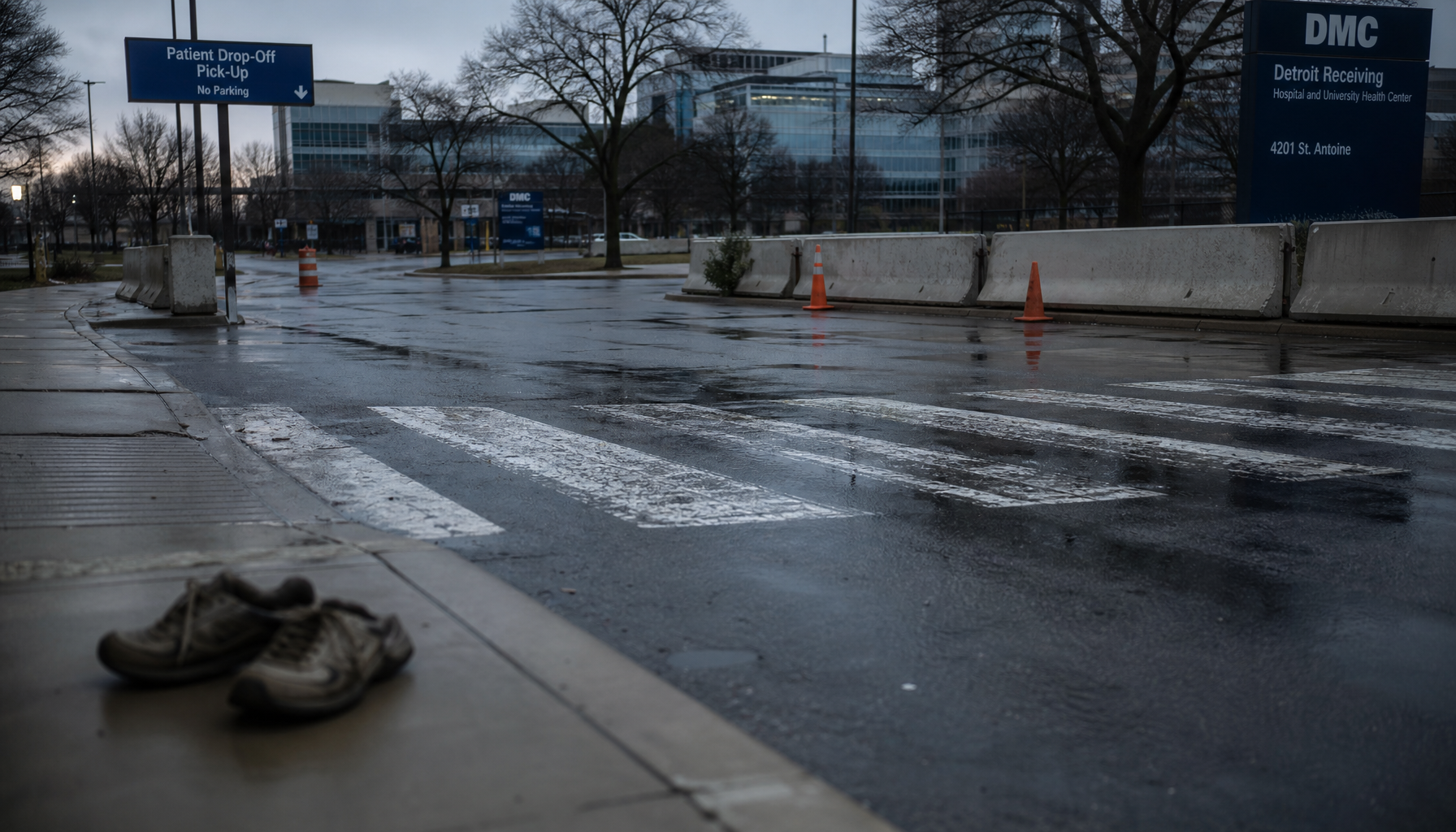
According to Patch, a beloved Detroit-area priest was struck and killed by a car outside a local hospital. The details are still emerging, but the loss is already being felt across his community. For the people who loved him — and for any family who has lost someone to a fatal pedestrian crash — understanding what the law allows is the first real step.
What Happens After a Fatal Pedestrian Accident in Michigan
Michigan sees a troubling number of fatal pedestrian crashes each year. The Michigan State Police Traffic Crash Reporting Unit recorded over 160 pedestrian fatalities statewide in a recent reporting year. Hospital driveways, parking lots, and crosswalks near medical facilities are not exempt — vehicles move through those areas constantly, often in low-light conditions, with distracted drivers.
When someone dies in a pedestrian crash, two separate legal processes may apply: a wrongful death claim in civil court, and — depending on the facts — a criminal investigation. These are separate tracks. A driver can be held civilly liable even if criminal charges are reduced or dropped.
What Is a Wrongful Death Claim?
Under the Michigan Wrongful Death Act, MCL 600.2922, when a person is killed by the negligent or wrongful act of another, certain family members have the right to file a civil lawsuit. This is not about revenge. It’s about holding the responsible party accountable and recovering compensation for real losses.
Who can bring a wrongful death claim in Michigan:
- The surviving spouse
- Children of the deceased
- Parents, grandparents, or grandchildren
- Siblings
- In some cases, the estate’s personal representative on behalf of dependents
The law allows recovery for:
- Loss of financial support the deceased would have provided
- Loss of companionship, society, and guidance
- Funeral and burial expenses
- Medical expenses incurred before death
- The deceased’s pain and suffering between the crash and death, if conscious
How Michigan’s No-Fault Law Applies to Pedestrian Deaths
Michigan’s no-fault system covers pedestrians — not just drivers. A pedestrian struck by a motor vehicle is generally entitled to Personal Injury Protection (PIP) benefits under MCL 500.3107, which covers medical expenses and a portion of lost wages. In a fatal case, PIP pays for reasonable medical and emergency care incurred before death.
But PIP is only the beginning. For the larger wrongful death claim — the one that addresses the family’s loss — the threshold under MCL 500.3135 must be met. Because death is the outcome, that threshold is met automatically. The family can pursue the at-fault driver (or their insurer) directly for non-economic damages like loss of companionship.
This is a meaningful distinction. Don’t let an insurance adjuster tell you PIP is the only available benefit. It isn’t.
Why Location Matters — Hospital Driveways and Parking Areas
A crash outside a hospital raises specific questions. Was there adequate lighting? Were pedestrian crosswalks clearly marked and maintained? Did the vehicle enter a restricted or pedestrian-priority zone? If the hospital owned or managed the property where the crash occurred, premises liability may be a separate avenue worth examining.
Similar questions came up after the accident at Canal and Delco in Sterling Heights, where property conditions contributed to how a pedestrian crash unfolded. The physical environment is always part of the picture.
In busy urban Detroit corridors — think Woodward Avenue, Michigan Avenue, or the area around Detroit Medical Center — pedestrian infrastructure is often inconsistent. Marked crosswalks end without warning. Curb cuts disappear. Lighting fails. When public infrastructure contributes to a death, a government entity may share liability, and different notice rules apply. An attorney needs to look at this early.
The Clock Starts the Day of the Crash
In Michigan, a wrongful death lawsuit must generally be filed within three years of the date of death. That deadline comes from MCL 600.5805(2). Three years can feel like a long time when you’re in grief. It isn’t — not when you account for the time needed to investigate the crash, gather evidence, identify all liable parties, and build a case.
For our full breakdown of filing deadlines, see how long you have to file a pedestrian accident lawsuit in Michigan.
If a government entity is involved — a city, county, or state agency — you may have as little as 60 days to file a notice of intent before the lawsuit deadline even begins. That’s not a typo. Some government claims require action within two months.
What Families Should Do Right Now
If you’ve lost someone in a pedestrian crash, the steps below won’t bring them back. But they protect your family’s legal rights during a time when those rights are most at risk.
- Do not give a recorded statement to any insurance company — not the driver’s insurer, not your own — without speaking to an attorney first.
- Request a copy of the police report as soon as it’s available. The case number is usually given at the scene or within 24–48 hours.
- Preserve any evidence you have access to — photos from the scene, video from nearby phones or businesses, clothing the victim was wearing.
- Write down what you know about the circumstances while it’s still fresh: time of day, weather, lighting, speed of the vehicle, whether the driver stopped.
- Contact an attorney before signing anything. Insurance companies move fast. Their goal is to minimize what they pay — not to make your family whole.
Understanding What Insurance Companies May Try
After a fatal crash, a driver’s insurance company may reach out quickly with a settlement offer. Sometimes this happens within days. That offer will almost never reflect the full value of a wrongful death claim. It’s designed to close the case before a lawyer gets involved.
For context on how insurers handle these situations, our post on dealing with insurance companies after a Detroit crash covers the tactics families commonly face.
Accepting a settlement releases all future claims. Once you sign, that’s it.
Who Bears Fault — and Can It Be Shared?
Michigan follows a modified comparative fault rule. A plaintiff can recover damages as long as they are not more than 50 percent at fault for the incident. In a pedestrian crash, fault is often disputed — drivers or their insurers may argue the pedestrian wasn’t in a crosswalk, was wearing dark clothing, or stepped into traffic without warning.
For a detailed breakdown of how fault is assigned in pedestrian crashes, see who’s at fault when a pedestrian is hit in a crosswalk.
In a hospital setting, fault analysis may extend beyond just the driver:
- The hospital or property manager if lighting or crosswalk markings were deficient
- A vehicle’s owner if different from the driver
- An employer if the driver was operating a work vehicle
- A government entity if road design or signage contributed
Every layer of liability matters because it determines how much insurance coverage is available and who can be held accountable.
A Note on Wrongful Death Claims Involving Community Figures
When the person killed is a public figure — a priest, a teacher, a community leader — the grief is collective. Dozens or hundreds of people feel the loss personally. That doesn’t change the legal framework, but it does affect the strength of a loss-of-companionship claim. Courts and juries consider the relationships the deceased had with those who survive them. A person deeply embedded in a community — present at funerals, weddings, baptisms, and moments of crisis — leaves a documented impact that matters in a wrongful death case.
For a broader look at how Michigan law handles fatal crashes and the families left behind, the Macomb County pedestrian killed by SUV guide and our post on wrongful death claims after a Dearborn train fatality walk through similar situations in detail.
Frequently Asked Questions
Does Michigan law allow a family to sue the driver who killed their loved one?
Yes. Under the Michigan Wrongful Death Act (MCL 600.2922), the personal representative of the deceased’s estate can file a civil lawsuit against the at-fault driver. A successful claim can recover compensation for loss of companionship, financial support, funeral expenses, and related damages. This is separate from any criminal case against the driver.
What if the crash happened in a hospital parking lot — not on a public road?
Private property crashes still trigger Michigan’s wrongful death and auto liability framework. The driver can still be held liable. If the property owner’s negligence — poor lighting, unmarked crosswalks, missing signage — contributed to the crash, the property owner may share liability as well. An attorney should examine the physical conditions at the site.
How long does a wrongful death case take in Michigan?
It varies. Cases that settle out of court — which many do — can resolve in several months to a couple of years. Cases that go to trial take longer, often two to four years from filing. The complexity depends on how many parties are involved, whether liability is disputed, and the extent of damages. Starting early gives your attorney more time to build the strongest possible case.
Can the family recover if the driver had no insurance or minimal coverage?
Possibly. Michigan requires uninsured and underinsured motorist coverage on most policies, and a pedestrian may be able to access coverage through a household policy or the Michigan Assigned Claims Plan. The availability of coverage depends on the specific policies in play. This is one of the first things an attorney will investigate.
Is there a difference between what the estate recovers and what family members personally recover?
Yes. Michigan’s wrongful death statute allows the personal representative to bring the claim on behalf of the estate and certain named beneficiaries. Some damages — like pre-death medical expenses and funeral costs — go to the estate. Others — like loss of companionship — are distributed to qualifying family members individually. A probate court oversees the distribution.
What if we’re not sure the driver was at fault?
You don’t need to be certain before consulting an attorney. Fault is determined through investigation — crash reconstruction, witness interviews, surveillance footage, police reports, and physical evidence from the scene. Many families come in without complete information, and an attorney’s job is to find the facts. The consultation is free.
If you’ve lost a family member in a pedestrian crash in the Detroit area, talk to us before you sign anything or speak to an insurance adjuster. Khamo Law, PLLC offers a free consultation — call 248-466-0606 or message us through the contact form. We serve Detroit, Macomb County, Oakland County, Wayne County, and surrounding communities. يتكلم فريقنا العربية، ونحن هنا لمساعدة العائلات الناطقة بالعربية والكلدانية والآشورية.