










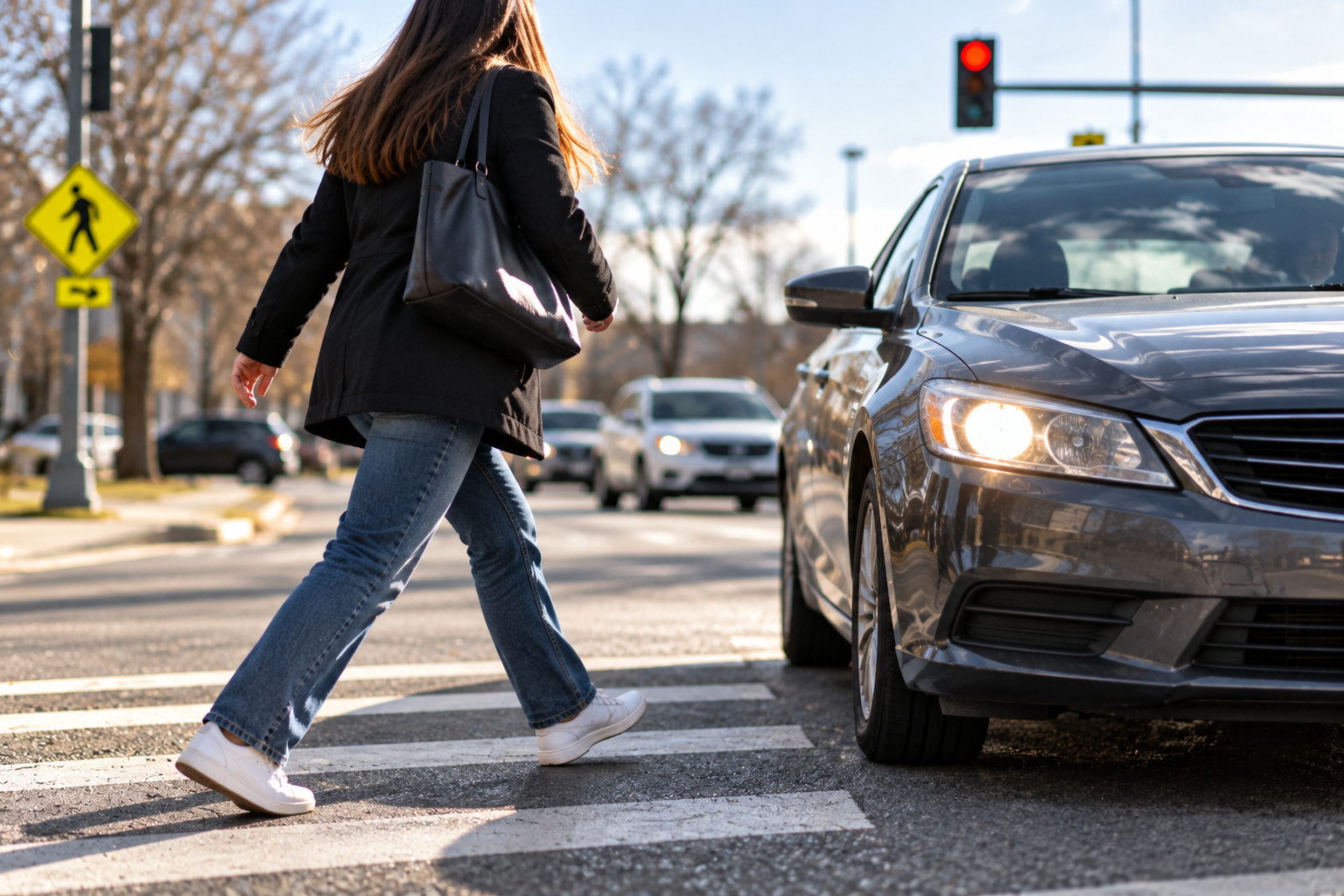
A pedestrian accident can change someone’s life in seconds. When a person walking through Madison Heights is struck by a car, SUV, delivery truck, or another motor vehicle, the consequences may include serious injuries, emergency medical treatment, lost income, and uncertainty about who will pay the bills.
A Madison Heights pedestrian accident lawyer at Khamo Law Accident & Injury Lawyers can investigate the collision, examine traffic and crosswalk evidence, determine available insurance coverage, and pursue compensation when Michigan law and the facts support a claim.
Our Michigan pedestrian accident lawyers help injured pedestrians throughout the state navigate No-Fault insurance, liability disputes, and injury claims. Our Madison Heights personal injury lawyers provide local guidance for people injured in Madison Heights and Oakland County.
Call Khamo Law at 248-466-0606 or contact us online for a free consultation.
How Can a Madison Heights Pedestrian Accident Lawyer Help?
Pedestrian accidents often involve conflicting descriptions of what occurred. A driver may claim the pedestrian crossed unexpectedly, while witnesses or surveillance footage may tell a different story.
An attorney can help by:
- Obtaining the police crash report and identifying the investigating agency.
- Reviewing photographs, dashcam recordings, and nearby surveillance footage.
- Investigating traffic signals, crosswalk markings, and intersection conditions.
- Identifying witnesses and documenting their observations.
- Evaluating driver distraction, speed, visibility, and failure-to-yield allegations.
- Determining which Michigan No-Fault insurer may be responsible for PIP benefits.
- Investigating whether the Michigan Assigned Claims Plan applies.
- Gathering medical records, lost-wage documentation, and evidence of permanent injuries.
- Evaluating claims against the driver or another legally responsible party.
- Negotiating with insurers and preparing litigation when necessary.
A careful investigation can help separate assumptions from facts. The severity of a pedestrian’s injuries does not establish fault by itself.
Pedestrian Accidents in Madison Heights and Oakland County
Madison Heights has residential neighborhoods, commercial shopping areas, parking lots, and busy roads where pedestrians and vehicles interact.
Pedestrian crashes may occur near:
- John R Road
- 12 Mile Road
- 13 Mile Road
- Dequindre Road
- Commercial driveways and shopping-center entrances
- Signalized intersections and marked crosswalks
- Residential streets and apartment complexes
- Parking lots and pedestrian walkways near the I-75 corridor
These locations are examples of local roads and settings, not a claim that any particular intersection has a verified high number of pedestrian crashes.
An investigation should focus on the exact location of the collision, available traffic controls, surrounding visibility, and evidence of how the driver and pedestrian moved before impact.
Example: Pedestrian Struck While Crossing at an Intersection
Imagine a pedestrian crossing an intersection in Madison Heights while a driver turns left across the crosswalk.
The driver may claim the pedestrian entered unexpectedly. The investigation could examine the pedestrian signal, traffic light sequence, turning lane, driver visibility, witness accounts, and any available surveillance footage.
Those details may help determine whether the driver failed to yield or whether other factors contributed to the collision.
This is a hypothetical example, not an actual Khamo Law case.
What Michigan Laws Protect Pedestrians?
Michigan’s Motor Vehicle Code contains rules governing traffic signals, pedestrian crossings, and the responsibilities of drivers.
Under MCL 257.612, drivers facing certain traffic-signal indications must yield to pedestrians who are lawfully within an adjacent crosswalk.
MCL 257.613 addresses pedestrian compliance with regular traffic-control signals and special pedestrian signals.
These laws can be important in establishing how a crossing was supposed to operate when a collision occurred.
Do Drivers Always Have to Yield to Pedestrians?
Drivers must comply with applicable traffic laws and exercise reasonable care, but legal right-of-way depends on the circumstances.
A pedestrian lawfully crossing with an appropriate signal may be in a different legal position from someone crossing against a traffic signal.
The exact roadway, signal indication, and movements of both parties matter.
Can a Driver Be Liable Even if the Pedestrian Was Outside a Crosswalk?
Potentially.
Being outside a marked crosswalk does not automatically establish that the driver was free from negligence.
An investigation may evaluate driver speed, visibility, attention, reaction time, and whether the driver could reasonably have avoided the collision. The pedestrian’s own conduct may also be relevant.
Who Is Responsible for a Pedestrian Accident?
A negligent driver may be legally responsible when a failure to exercise reasonable care causes a pedestrian’s injuries.
Examples of potentially negligent conduct include:
- Failing to yield to a pedestrian lawfully in a crosswalk.
- Turning without checking the pedestrian crossing area.
- Driving while distracted by a phone.
- Speeding or driving too fast for conditions.
- Running a red light or stop sign.
- Failing to observe a pedestrian while backing up.
- Driving while impaired.
- Failing to maintain an appropriate lookout.
In some cases, responsibility may extend beyond an individual driver.
For example, a collision involving a commercial vehicle could raise questions about employer responsibility or vehicle maintenance. Those claims require their own supporting facts and legal analysis.
Our Madison Heights car accident lawyers address related collisions involving negligent motorists.
What Causes Pedestrian Accidents in Madison Heights?
Pedestrians are vulnerable because they have little physical protection when struck by a moving vehicle.
Several recurring collision mechanisms deserve investigation.
Left-Turn Accidents
A driver focuses on finding a gap in oncoming traffic but fails to observe a pedestrian crossing the street.
Evidence may include the driver’s turning path, signal timing, visual obstructions, and witness testimony.
Right-Turn Accidents
A driver watches approaching vehicles but fails to check for a pedestrian using the crosswalk.
Whether the turning movement was legally permitted does not by itself resolve whether the driver exercised reasonable care.
Distracted Driving
Drivers using phones, navigation devices, or other distractions may fail to recognize a pedestrian until it is too late.
Relevant evidence may include witness accounts, camera footage, and records obtained through appropriate legal procedures.
Backing-Up Accidents
Pedestrians can be struck by vehicles reversing from parking spaces or driveways.
These incidents may involve blind spots, parking-lot camera footage, driver warnings, and the surrounding pedestrian traffic.
Low-Visibility Collisions
Darkness, rain, snow, headlights, street lighting, and parked vehicles may affect what a driver could reasonably see.
Visibility should be assessed from the evidence rather than assumed to excuse either party.
Who Pays Medical Bills After a Michigan Pedestrian Accident?
A pedestrian struck by a motor vehicle may qualify for Michigan Personal Injury Protection (PIP) benefits, depending on the applicable insurance coverage and statutory eligibility rules.
The important question is which insurance policy has priority.
Under MCL 500.3114(1), an applicable No-Fault policy can cover the named insured, a spouse, or a qualifying relative domiciled in the same household for injuries arising from a motor-vehicle accident.
When no applicable coverage exists under that rule, MCL 500.3115 generally directs qualifying people injured while not occupying a motor vehicle to the Michigan Assigned Claims Plan.
This means the driver who struck the pedestrian is not automatically the insurer responsible for the pedestrian’s PIP benefits.
What Can PIP Benefits Cover?
Depending on eligibility and coverage limits, Michigan No-Fault benefits may include:
- Qualifying medical treatment and rehabilitation.
- Accident-related wage-loss benefits.
- Certain replacement services.
- Qualifying attendant care.
- Other benefits permitted by Michigan law.
The scope of medical coverage depends on the applicable policy and statutory rules.
Read our Michigan No-Fault insurance guide for more information about coverage and benefit disputes.
Can a Pedestrian Get PIP Benefits Without Owning a Car?
Potentially.
A person who does not own or insure a vehicle may nevertheless have access to coverage through an applicable spouse or resident-relative policy.
If no higher-priority policy applies, the Michigan Assigned Claims Plan may become relevant, subject to its eligibility and procedural requirements.
The absence of a car registered to the pedestrian does not automatically mean there is no potential PIP coverage.
What Is the Michigan Assigned Claims Plan?
The Michigan Assigned Claims Plan (MACP) provides a statutory process for certain people who are entitled to No-Fault benefits but have no applicable policy at a higher priority.
A pedestrian injured by a motor vehicle may need to apply through this process when no applicable household No-Fault coverage exists.
The MACP does not simply pay every submitted bill. Eligibility, available benefits, the accident circumstances, and the required application process must be established.
What If No Insurance Company Accepts Responsibility?
Michigan law provides procedures for assigned claims and certain disputes over which insurer is responsible.
A dispute between insurers should be addressed promptly because medical expenses and lost income can continue while priority is being investigated.
How Long Do You Have to Apply?
Michigan’s assigned-claims rules include a one-year application deadline under MCL 500.3174.
Other No-Fault deadlines can also affect payment and litigation.
Someone who may need MACP benefits should seek case-specific guidance promptly rather than assume a pending investigation extends the filing period.
Can an Injured Pedestrian Sue the Driver?
Potentially, yes. A pedestrian may have a separate negligence claim against the driver whose conduct caused the collision.
This is distinct from the pedestrian’s potential claim for No-Fault benefits.
Under MCL 500.3135, tort liability for noneconomic loss arising from the ownership, maintenance, or use of a motor vehicle generally requires death, serious impairment of body function, or permanent serious disfigurement.
This legal standard is often called the Michigan serious-injury threshold.
What Is a Serious Impairment of Body Function?
Michigan law defines serious impairment of body function through requirements concerning an objectively manifested impairment of an important body function that affects a person’s general ability to lead their normal life.
The assessment depends on the injury and its real effects.
For example, a pedestrian whose injuries interfere with walking, employment, basic mobility, or daily activities may require a detailed threshold analysis.
The diagnosis alone does not necessarily resolve the legal question.
What if the Driver’s Insurance Company Offers a Settlement?
Before accepting an offer, it is important to understand which claims the proposed release would resolve.
A settlement may implicate damages, insurance coverage, future treatment needs, and other issues that should be reviewed before rights are waived.
What Compensation Can Pedestrian Accident Victims Recover?
Depending on the circumstances, injured pedestrians may have access to first-party No-Fault benefits and a separate claim for legally recoverable damages against a negligent motorist.
Potential losses include:
- Medical expenses and rehabilitation.
- Wage loss.
- Reduced future earning capacity.
- Pain and suffering where the legal threshold is met.
- Permanent disability or disfigurement.
- Ongoing treatment and assistance.
- Loss of normal activities and independence.
- Other legally recoverable damages.
Not all categories are available in every case, and some losses may be covered through No-Fault benefits rather than a liability lawsuit.
What Is the Average Pedestrian Accident Settlement?
There is no reliable average that can determine the value of an individual pedestrian accident claim.
A broken wrist that heals completely differs from a serious brain injury that causes permanent cognitive difficulties.
Relevant factors include liability evidence, comparative fault, insurance limits, medical prognosis, future restrictions, and the damages permitted by Michigan law.
An attorney should evaluate those factors before estimating the claim’s potential value.
Can a Pedestrian Be Partly Responsible for an Accident?
Yes.
An insurer may allege that a pedestrian crossed against a signal, entered the roadway unexpectedly, was distracted, or failed to observe traffic.
Michigan comparative-fault principles can affect the outcome of a liability claim.
However, an allegation of pedestrian fault is not proof. Investigators must consider the applicable traffic law and evidence about both the pedestrian’s conduct and the driver’s actions.
What If I Was Not in a Marked Crosswalk?
You may still have legal options.
Whether the driver was negligent and whether your own conduct contributed to the collision require separate evaluation.
The collision location, traffic controls, visibility, and the timing of each party’s movements may all matter.
What If the Driver Says I Ran Into Traffic?
Relevant evidence may include nearby business cameras, traffic-signal timing, vehicle damage, witness descriptions, and photographs of the roadway.
A fair determination should not rely solely on one driver’s account.
What Injuries Are Common in Pedestrian Accidents?
Pedestrian collisions can cause extensive injuries because the person may be struck by the vehicle and then fall onto the pavement.
Injuries may include:
- Broken legs, hips, ankles, arms, or wrists.
- Pelvic fractures.
- Traumatic brain injuries and concussions.
- Spinal injuries and nerve damage.
- Knee and shoulder injuries.
- Internal organ damage.
- Serious cuts, abrasions, and scarring.
- Long-term mobility limitations.
- Psychological symptoms after a traumatic collision.
Some injuries require extensive rehabilitation and may affect a person’s independence, work, and ability to perform daily tasks.
Traumatic Brain Injuries
A head injury may cause memory problems, dizziness, headaches, concentration difficulties, or more serious neurological complications.
The long-term consequences should be evaluated through appropriate medical records and specialist care.
Spinal Cord Injuries
A severe pedestrian collision may damage the spinal cord, potentially affecting movement, sensation, and everyday function.
Some people require ongoing assistance, medical equipment, or rehabilitation.
What If a Pedestrian Dies After Being Struck?
When a fatal collision is caused by legally actionable negligence, the deceased person’s estate may be able to bring a wrongful death claim.
Michigan’s wrongful-death procedures differ from an ordinary injury lawsuit.
Learn more from our Michigan wrongful death lawyers.
What Evidence Helps Prove a Pedestrian Accident Claim?
Pedestrian cases can involve disputes over who entered the intersection first, what traffic signal was displayed, how fast the vehicle was moving, and whether the driver was paying attention.
Relevant evidence may include:
- The police traffic crash report.
- Photographs of the crosswalk, intersection, or parking lot.
- Traffic signals and applicable pedestrian signal phases.
- Witness names and statements.
- Business surveillance and doorbell-camera footage.
- Dashcam recordings.
- Vehicle damage and physical collision evidence.
- Available electronic vehicle information.
- Medical records and treatment timelines.
- Insurance information and correspondence.
Why Is Surveillance Video Important?
Video may establish the position and movement of a pedestrian or vehicle before impact.
It may also help resolve disputes about an unsafe turn, failure to yield, or other alleged traffic violation.
Businesses often retain video for a limited time. Preservation requests should therefore be made promptly.
Why Should Clothing and Personal Belongings Be Preserved?
Shoes, torn clothing, damaged bags, and other items may help document the force or circumstances of a collision.
Do not discard potentially relevant property before determining whether it should be preserved.
How Long Do You Have to File a Pedestrian Accident Claim in Michigan?
Different parts of a pedestrian accident case can have different deadlines.
For many negligence-based personal injury lawsuits, Michigan law generally provides a three-year limitations period under MCL 600.5805.
However, No-Fault claims have separate time-sensitive requirements.
Under MCL 500.3145, an action for PIP benefits generally involves a one-year framework, subject to statutory provisions concerning timely notice, prior benefit payments, and recovery of older expenses.
Applications through the Michigan Assigned Claims Plan also involve their own deadline rules.
What Is Michigan’s One-Year-Back Rule?
Michigan law can limit how far back unpaid No-Fault benefits may be recovered, even when a claim or lawsuit is otherwise timely.
Different provisions and tolling rules may affect the outcome.
A person dealing with unpaid medical bills or wage-loss benefits should have the relevant dates reviewed carefully.
What If the Accident Involved a Government Vehicle?
Additional rules may apply when a potential defendant is a governmental entity.
Governmental immunity, statutory exceptions, and special notice requirements can make these claims different from ordinary motorist-negligence cases.
The proper deadline must be determined from the facts and applicable law.
What Should You Do After Being Hit by a Car in Madison Heights?
Your safety and medical needs should come first.
- Call 911. Report the collision and request emergency assistance when needed.
- Get medical care. Some injuries may not be immediately obvious.
- Obtain the driver’s information. If possible, record the driver’s name, vehicle information, and insurance details.
- Photograph the scene. Capture crosswalks, signals, vehicle positions, damage, and visible injuries.
- Identify witnesses. Keep their contact information.
- Document nearby cameras. Note businesses or homes that may have relevant footage.
- Preserve records. Keep medical bills, discharge instructions, work restrictions, and insurance correspondence.
- Review insurance coverage promptly. Determine whether an applicable policy or assigned-claims procedure may provide PIP benefits.
- Consider speaking with an attorney. A legal review can clarify the different claims and deadlines.
Avoid making conclusions about fault before reviewing the available evidence.
What If the Driver Flees the Scene?
A hit-and-run pedestrian accident can make identifying the responsible motorist and determining available coverage more challenging.
A pedestrian should report the incident to the police, preserve any description of the vehicle, identify witnesses, and locate potential camera footage as soon as reasonably possible.
Even when the driver cannot be identified, some No-Fault benefits may still be available through an applicable policy or, where eligibility requirements are satisfied, the Michigan Assigned Claims Plan.
A separate uninsured-motorist claim may also require reviewing applicable policy language and notice requirements.
Can You Receive Compensation if the Driver Is Never Found?
Potentially, but the available paths depend on the insurance policies, the nature of the accident, statutory eligibility, and available evidence.
A hit-and-run does not automatically establish coverage under every insurance policy.
Frequently Asked Questions About Pedestrian Accidents in Madison Heights
Can I sue a driver who hit me in a crosswalk?
Potentially. The investigation must assess the driver’s conduct, applicable crosswalk rules, causation, and the Michigan standards for recoverable damages.
Who pays medical bills if I am hit while walking?
An applicable auto No-Fault policy covering you, your spouse, or certain resident relatives may be the first source of PIP benefits. If no applicable policy exists, the Michigan Assigned Claims Plan may be relevant.
What if I do not own a car or have auto insurance?
You may still have potential No-Fault coverage through a qualifying household policy or the Assigned Claims Plan, subject to applicable rules.
Can I receive PIP benefits if the accident was partly my fault?
PIP benefits generally do not depend on proving that another driver was negligent, although coverage eligibility, statutory exclusions, and the nature of the accident still matter.
Can I sue if I crossed outside a crosswalk?
Possibly. The absence of a marked crosswalk does not automatically resolve driver negligence or the pedestrian’s share of fault.
What if the driver was uninsured?
Other relevant insurance sources or assigned-claims procedures may exist. The driver’s lack of insurance does not automatically eliminate every possible claim.
Does a pedestrian accident have to involve direct vehicle contact?
Not necessarily for every potential legal theory or No-Fault situation, but evidence that the injuries arose from a qualifying motor-vehicle accident is essential. The circumstances require careful review.
What if a vehicle hit me in a parking lot?
Pedestrian injuries involving a moving motor vehicle in a parking lot may raise liability and No-Fault issues. The exact facts and applicable coverage rules determine what claims are possible.
Can I recover compensation for a broken leg?
Potentially. The severity, treatment, functional limitations, applicable insurance benefits, negligence evidence, and serious-injury threshold all affect the available claims.
What if I was hit by a delivery truck?
Additional evidence and potentially responsible parties may be relevant, depending on the driver’s employment and conduct. Our Madison Heights truck accident lawyers address commercial-vehicle collision issues.
How long do I have to file a pedestrian accident lawsuit?
Many Michigan negligence claims have a general three-year limitations period, but PIP and other claims can have much shorter timing requirements. Have the deadlines reviewed promptly.
How much does a pedestrian accident attorney cost?
Khamo Law offers free consultations. Ask about the firm’s contingency-fee agreement and how litigation expenses are handled before retaining counsel.
Why Choose Khamo Law for a Madison Heights Pedestrian Accident?
Khamo Law Accident & Injury Lawyers represents people injured in serious accidents throughout Michigan.
Pedestrian claims can involve a combination of traffic-law violations, disputed fault, significant medical treatment, and complex insurance questions.
Our attorneys can examine the collision evidence, evaluate Michigan No-Fault benefits, document accident-related losses, and pursue legally supported claims.
We recognize the importance of understanding how a serious injury affects a person’s work, mobility, independence, and daily life.
Learn more about attorney Koro E. Khamo and our firm’s injury practice.
Speak With a Madison Heights Pedestrian Accident Lawyer
If you or a loved one was struck by a vehicle while walking in Madison Heights or elsewhere in Oakland County, Khamo Law can review the circumstances and explain your potential legal options.
Call 248-466-0606 or contact Khamo Law online to request a free consultation.
Our team can help you understand Michigan No-Fault insurance, potential liability claims, medical evidence, and important legal deadlines.