






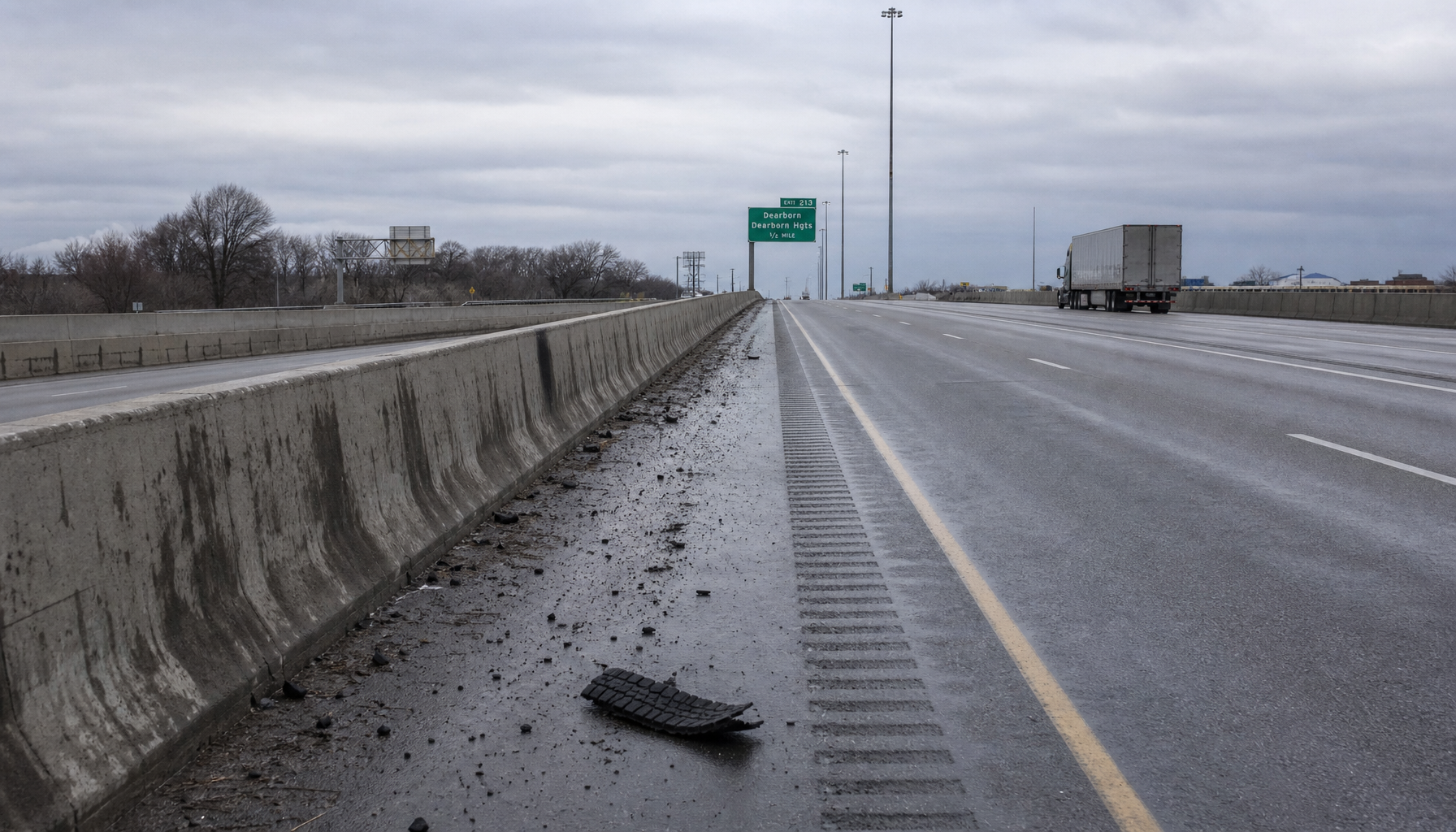
When a flat tire forces you out of your car on a Michigan highway, the danger doesn’t stop — it shifts. Two people learned that in the worst possible way on I-94, struck and killed by a semi-truck after they got out to check on their disabled vehicle. As reported by Audacy, Michigan State Police responded to the scene. I-94 runs the full width of the state — through Detroit, Ann Arbor, Battle Creek, and into western Michigan — and this corridor sees heavy semi-truck traffic around the clock. If you lost a family member in a crash like this, here’s what you need to understand about liability, Michigan law, and what happens next.
What Happened on I-94
Two people were outside their vehicle — likely trying to assess or change a flat tire — when a semi-truck struck them. Both died at the scene. Michigan State Police are investigating. The specific mile marker hasn’t been confirmed publicly, but the I-94 corridor is one of the busiest commercial trucking routes in the Midwest, carrying thousands of semi-trucks each day between Chicago, Detroit, and points east.
This kind of crash is more common than most people realize. According to NHTSA data, pedestrians struck on highways — including people outside disabled vehicles — account for a significant share of roadway fatalities. Being outside your car on an interstate, even briefly, puts you in the most dangerous position possible.
Why Flat Tire Stops on Freeways Are So Deadly
I-94 doesn’t slow down for a disabled vehicle. Trucks traveling 65–70 mph need close to 500 feet to stop under ideal conditions. At night, in rain, or near a curve, that stopping distance gets longer — and a person standing near the shoulder can be nearly invisible.
Several factors make these crashes especially fatal:
- No barrier between the person and traffic. A guardrail or median doesn’t protect someone standing on the shoulder or partially in a travel lane.
- Semi-trucks have wider blind zones. A commercial truck’s right-side blind spot can swallow a car — let alone a person standing beside one.
- Speed differentials are deadly. A stopped person hit by a vehicle moving 60 mph absorbs catastrophic force.
- Distracted or fatigued drivers. A trucker nearing the end of a shift may not react in time even when the hazard is visible.
If the truck driver was speeding, impaired, distracted, or fatigued, those facts are critical to any legal claim. Federal hours-of-service rules under 49 CFR Part 395 limit how long a commercial driver can operate without rest — and violations of those rules can be evidence of negligence.
Who Can Be Held Liable in This Type of Crash
In Michigan semi-truck accidents involving pedestrians or people outside a disabled vehicle, liability can fall on multiple parties — not just the driver who struck them.
The Truck Driver
The driver has a duty to maintain safe speeds, stay alert, and respond to visible hazards on the roadway. If dashcam footage, black box data, or eyewitness accounts show the driver failed to slow down or move over, that’s direct negligence.
The Trucking Company
Under federal motor-carrier law, the company that employs the driver is often liable too. If the driver was fatigued because the company pressured them to exceed legal drive-time limits, or if the truck’s lights or brakes were poorly maintained in violation of 49 CFR Part 396, the company shares responsibility. Our post on who is liable in a commercial truck accident in Michigan breaks this down in detail.
A Third Party
In some cases, the tire itself was defective. A tire blowout caused by a manufacturing defect — or a vehicle problem that a recent mechanic should have caught — could create a product liability or third-party negligence claim.
Michigan’s Move Over Law
Michigan law requires drivers to move over or slow down for vehicles with flashing lights on the roadside. But this protection wasn’t designed for a plain passenger car with a flat — which means the people who were struck may have had limited legal protection under the statute itself. That doesn’t eliminate the truck driver’s general duty of care, though.
What Michigan Law Applies to Wrongful Death Claims
When someone is killed in a crash like this, Michigan’s wrongful death statute allows surviving family members — spouses, children, parents — to bring a claim. The damages can include:
- Medical expenses incurred before death
- Funeral and burial costs
- Loss of financial support the deceased provided
- Loss of companionship, guidance, and society
The statute of limitations for a wrongful death claim tied to a personal injury is three years from the date of death under MCL 600.5805(2). Three years sounds like plenty of time. It isn’t — evidence disappears fast. The truck’s electronic logging device (ELD) data, dashcam footage, and the driver’s logs can all be overwritten or discarded within weeks if no one demands they be preserved.
If you’re a family member of one of the people killed on I-94, the most time-sensitive thing you can do is contact an attorney now — not in a few months — so that evidence is preserved immediately.
What to Do If You Witnessed This Crash or Were Injured
If you were in a nearby vehicle, saw the impact, or were involved in the secondary chaos that can follow a highway crash, here’s what matters:
- Contact Michigan State Police if you haven’t already. MSP is the lead investigator on highway crashes like this.
- Write down everything you remember — time, weather, the truck’s speed and lane, any brake lights or horn you did or didn’t hear. Memory fades within 24–48 hours.
- Preserve any dashcam footage from your own vehicle immediately. Most dashcams loop and overwrite within hours.
- Don’t speak to the trucking company’s insurance carrier without legal advice. They will contact you quickly and frame the conversation to limit their exposure.
- Talk to an attorney who handles semi-truck accidents in Michigan before you sign anything.
Michigan No-Fault and Semi-Truck Accidents
Michigan’s no-fault system is built around car accidents between insured drivers. When a pedestrian — or a person outside their car — is struck by a commercial truck, the rules shift.
Under MCL 500.3107, Personal Injury Protection (PIP) benefits cover medical expenses and lost wages. But in a fatal crash, the immediate focus is on wrongful death damages, which are pursued separately through a liability claim against the truck driver and their employer.
For non-economic damages — pain, suffering, and the human cost of what happened — Michigan requires meeting the tort threshold under MCL 500.3135. Death clearly clears that bar. The question becomes how to document and pursue the full measure of damages the family is owed.
For a fuller picture of how the claims process works, see our guide on how to file a truck accident claim in Michigan.
If You Have a Flat Tire on a Michigan Highway — What to Do
This crash is a reminder that getting out of your car on an interstate is a last resort, not a first step. If you get a flat on I-94 or any Michigan freeway:
- Don’t brake hard — steer smoothly to the right shoulder.
- Get as far off the road as possible. Even a few extra feet matters.
- Turn on your hazard lights immediately.
- Stay inside the vehicle if it’s safe to do so. A car, even a damaged one, offers more protection than standing on the shoulder.
- Call 911 and wait for assistance. Michigan State Police and MDOT can help manage traffic while you wait.
- If you must exit the vehicle, exit from the passenger side away from traffic and move as far from the roadway as possible — behind a guardrail if one is present.
The two people killed on I-94 may not have had good options. A flat tire at highway speed can force a stop in a dangerous location. But knowing these steps can make the difference in a survivable situation.
Frequently Asked Questions
Can a trucking company be sued when a semi strikes someone outside a disabled car?
Yes. The trucking company is typically liable alongside the driver when the driver was acting within the scope of employment. If the company also violated federal maintenance or hours-of-service rules, those violations are independent grounds for liability against the company directly.
How long do families have to file a wrongful death lawsuit in Michigan?
Three years from the date of death under MCL 600.5805(2). But don’t wait three years. Electronic data from the truck — the black box, GPS logs, and ELD records — can be lost or overwritten within weeks. A lawyer can send a preservation letter to the trucking company within days of the crash.
Does Michigan no-fault insurance cover someone who was outside their car when struck?
It depends on the circumstances. A person outside their vehicle may still qualify for PIP benefits if they were in close proximity to their own vehicle and the crash involved a motor vehicle. An attorney can assess which insurance sources apply based on the specific facts.
What if the person killed was partially at fault — standing in a travel lane, for example?
Michigan uses a modified comparative fault system. A family can still recover damages even if the person who died was partly responsible, as long as their share of fault doesn’t exceed 50 percent. The final damages award is reduced by their percentage of fault.
What evidence is most important in a crash like this?
The truck’s electronic logging device (ELD) data showing drive time and rest breaks, the truck’s event data recorder (black box) showing speed and braking at impact, dashcam footage from the truck or nearby vehicles, the driver’s drug and alcohol test results (required post-crash under federal rules), and any prior maintenance records for the truck’s lights and brakes.
What if the truck driver’s employer is based out of state?
It doesn’t matter where the company is headquartered. If the crash happened in Michigan, Michigan courts have jurisdiction over the claim. Federal motor-carrier regulations apply to all commercial trucks operating in interstate commerce, regardless of where the company is registered.
If you lost someone in the I-94 crash — or in any semi-truck accident on a Michigan highway — talk to us before you sign anything or speak to the trucking company’s insurer. Khamo Law, PLLC offers a free consultation. Call 248-466-0606 or reach us through the contact form. We serve Detroit, Warren, Sterling Heights, and communities across the metro area. نتحدث العربية ونقدم خدماتنا للمجتمعات العربية والكلدانية في ميشيغان.