






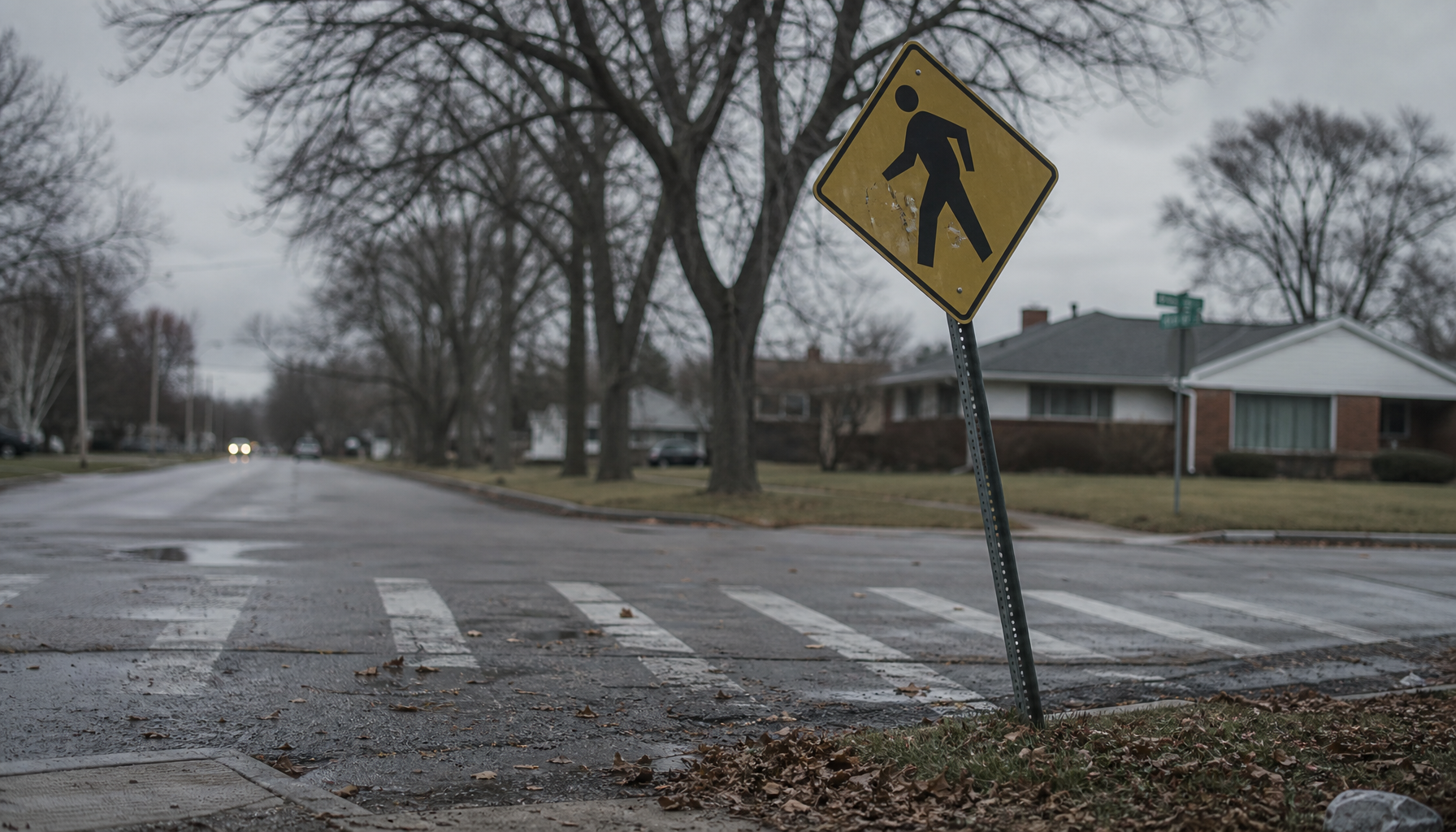
When a pedestrian is killed by a vehicle in Michigan, the family has three years to file a wrongful death lawsuit under MCL 600.5805, and the driver’s auto insurance — along with the victim’s own no-fault policy — may both be sources of compensation. Acting quickly preserves evidence and protects your rights. Here’s what Macomb County families need to know right now.
A 79-year-old man was struck and killed by an SUV in Macomb County this week, according to CBS News. Details are still emerging, but crashes like this one — an older adult on foot, hit by a larger vehicle — are not rare in this area. Macomb County roads like Hall Road, Van Dyke Avenue, and 15 Mile Road carry heavy traffic at speeds that leave very little room for error when a pedestrian steps into the path of an oncoming car.
If you lost someone in this crash, or in a similar one, this post is for you.
Why Pedestrian Deaths Involving Older Adults Happen So Often
Pedestrians 65 and older account for roughly 20% of all pedestrian traffic deaths in the United States, even though they make up a much smaller share of people walking near roadways, according to NHTSA pedestrian safety data. Older adults take longer to cross intersections, may have limited vision or hearing, and are physically more vulnerable when a vehicle does make contact.
SUVs make this worse. Because of their height and hood design, SUVs strike pedestrians higher on the body than a standard passenger car — often at the chest or head level rather than the legs. That difference in impact geometry is one reason SUV-involved pedestrian crashes are more likely to be fatal.
Macomb County has its own specific risk factors. Many of its busiest corridors lack adequate crosswalks, sidewalks end abruptly in residential stretches, and speed limits climb fast as roads transition from commercial to semi-rural. If you’ve driven Hall Road between Utica and Romeo, you already know what that looks like.
What Michigan Law Says About Pedestrian Deaths
Michigan is a no-fault state, which means the victim’s own auto insurance — through their Personal Injury Protection (PIP) coverage — pays certain benefits first, including medical expenses and a portion of lost wages. Under MCL 500.3107, PIP benefits can cover medical bills and some survivor loss benefits even when the insured person is the pedestrian, not the driver.
But PIP doesn’t cover everything. It doesn’t compensate a family for the grief of losing a parent, a grandparent, the person who held everything together. That kind of compensation — what the law calls non-economic damages — requires meeting the threshold under MCL 500.3135. A death clearly satisfies that threshold.
For the wrongful death claim itself, Michigan families can pursue the driver’s liability insurance for:
- Pain and suffering the victim experienced before death
- Loss of companionship and guidance the family has lost
- Funeral and burial expenses
- Survivor loss benefits for dependents
The statute that governs wrongful death claims in Michigan is the Wrongful Death Act, MCL 600.2922. It allows the personal representative of the estate to file on behalf of surviving family members.
The Three-Year Clock Starts at the Date of Death
Michigan’s statute of limitations for personal injury actions is three years under MCL 600.5805(2). In a wrongful death case, that window generally runs from the date of death — not the date the family retains an attorney or discovers evidence. Three years sounds like a long time. It isn’t, once you account for gathering police reports, crash reconstruction data, witness statements, and medical records.
Families who wait often find that dashcam footage has been overwritten, witnesses have moved, and the driver’s insurer has already built its defense. The families who act early have more to work with. If you want to understand what evidence matters and why timing affects your case, our post on what to do after a pedestrian accident in Michigan walks through the steps.
What the Investigation Will Look at
When a pedestrian is killed, law enforcement conducts a crash investigation. That’s separate from any civil claim your family might pursue. The two processes run in parallel, and the findings from the police report — while not binding in a civil case — matter a great deal.
Here’s what investigators typically examine:
- Vehicle speed — was the driver exceeding the posted limit, or driving too fast for conditions?
- Point of impact — where exactly was the pedestrian in the roadway? In a crosswalk? On the shoulder?
- Driver behavior — was the driver distracted, impaired, or inattentive?
- Roadway conditions — poor lighting, missing crosswalk markings, sight-line obstructions?
- Vehicle condition — were the SUV’s brakes and lights functioning properly?
- Witness accounts — what did people nearby see and hear before impact?
Your attorney’s job — before a lawsuit is ever filed — is to review the same evidence and identify where the driver, and sometimes a municipality, may bear legal responsibility. Dangerous road conditions can create liability that extends beyond just the driver.
When the Government Might Share Responsibility
Michigan municipalities and road agencies have a legal duty to maintain reasonably safe roads and pedestrian infrastructure. If a crosswalk was missing, a streetlight was out, or the road design funneled a pedestrian into a dangerous path with no alternative, a government entity may be a co-defendant.
Suing a government agency in Michigan involves different procedural rules and a much shorter notice deadline — in most cases, 60 days from the injury under the Michigan Court of Claims Act. Missing that window can eliminate that portion of your claim entirely. This is one of the reasons why getting an attorney involved in the first few weeks matters, not just the first few months.
What Families Should Do Right Now
Grief is not a checklist. We know that. But certain steps in the first days and weeks after a fatal pedestrian crash directly affect whether your family can recover compensation later. Here’s what matters most:
- Request the police report as soon as it’s available. In Michigan, crash reports are typically available through the Michigan State Police or the local department that responded.
- Preserve anything you have. If the victim had a cell phone, keep it. If you drove past the scene and took photos, keep those. Don’t post them publicly.
- Don’t talk to the driver’s insurance company. They will call quickly. Their job is to settle the claim as cheaply as possible. You are not required to give a recorded statement.
- Write down what you know while it’s fresh. Where was your family member going? What time? Who saw them last? These details are harder to recall three months from now.
- Find out who the personal representative of the estate is — or have one appointed. In Michigan, the wrongful death claim is filed by the estate’s personal representative, not directly by individual family members.
- Talk to an attorney before you sign anything the insurance company sends you.
For a broader look at how fault is determined when a pedestrian is hit, our post on who’s at fault when a pedestrian is hit in a crosswalk covers the legal framework in plain terms.
How Much Is a Wrongful Death Claim Worth in Michigan?
There’s no honest answer that comes with a dollar figure attached, and any attorney who gives you one in the first phone call is not being straight with you. What we can tell you is what factors courts and insurance companies look at:
- The victim’s age and life expectancy — a 79-year-old with a serious health condition and a 79-year-old who was healthy and active will be evaluated differently
- Economic contributions to the family — did the victim provide childcare, pay household bills, contribute financially to dependents?
- Pain and suffering before death — did the victim survive for any period after impact?
- Relationship to surviving family members — spouses, children, and grandchildren may all have recognized claims under Michigan’s wrongful death statute
- The driver’s insurance coverage limits — a case is only as recoverable as there are assets and coverage to pay it
Our post on how much a personal injury case is worth in Michigan explains the valuation process in more detail, including how non-economic damages are calculated.
Macomb County Families: You Have Local Options
Khamo Law, PLLC handles pedestrian accident and wrongful death cases throughout Macomb County, including Sterling Heights, Warren, Clinton Township, Utica, and the surrounding communities. Our attorneys know these roads, the local courts, and how insurers in this area approach claims.
For Sterling Heights families specifically, our Sterling Heights pedestrian accident lawyers page has additional information on local resources and how we approach cases in that community. For Warren, our Warren pedestrian accident attorneys page covers the same.
We also serve clients who speak Arabic, Chaldean, and Assyrian. If language has ever made you hesitant to call a law firm, it won’t be a barrier here.
Frequently Asked Questions
Can we file a lawsuit even if the driver wasn’t criminally charged?
Yes. Criminal charges and civil claims are entirely separate. A driver can be acquitted of criminal charges — or never charged at all — and still be found liable in a civil wrongful death case. The standard of proof in civil court is lower than in a criminal trial.
What if the pedestrian was crossing somewhere other than a crosswalk?
Michigan law does not bar recovery simply because a pedestrian was not in a marked crosswalk. Comparative fault applies — meaning if the victim was partially responsible for the crash, compensation may be reduced. But drivers have a duty to exercise reasonable care regardless of where a pedestrian is walking. The specific facts of the crash matter enormously here.
How long does a wrongful death case take in Michigan?
Most cases resolve in 12 to 24 months, though complex cases involving government defendants or disputed liability can take longer. Factors include how quickly evidence is gathered, whether the insurer negotiates in good faith, and whether the case goes to trial or settles. Your attorney should give you an honest timeline, not a rushed one.
What if the victim had Medicare or Medicaid?
If Medicare or Medicaid paid any of the victim’s medical bills, those agencies have a right to be reimbursed from any settlement — this is called a lien. Your attorney handles the lien resolution process. It’s a real issue in these cases and one reason you want counsel who’s handled it before.
What does it cost to hire Khamo Law for a wrongful death case?
Nothing upfront. We handle pedestrian accident and wrongful death cases on a contingency fee basis, which means we only get paid if we recover money for your family. The consultation is free.
Can family members in another state file a claim for a Michigan wrongful death?
Yes. The estate’s personal representative files the claim on behalf of all eligible family members, including those who live outside Michigan. You don’t need to be a Michigan resident to recover under the state’s wrongful death statute.
If your family lost someone in a pedestrian crash in Macomb County or anywhere else in metro Detroit, talk to us before you sign anything the insurance company sends. Khamo Law, PLLC offers a free consultation — call 248-466-0606 or reach us through the contact form on our site. We serve Macomb County, Wayne County, Oakland County, and the surrounding communities. نتحدث العربية والكلدانية ونحن هنا لمساعدتكم.