






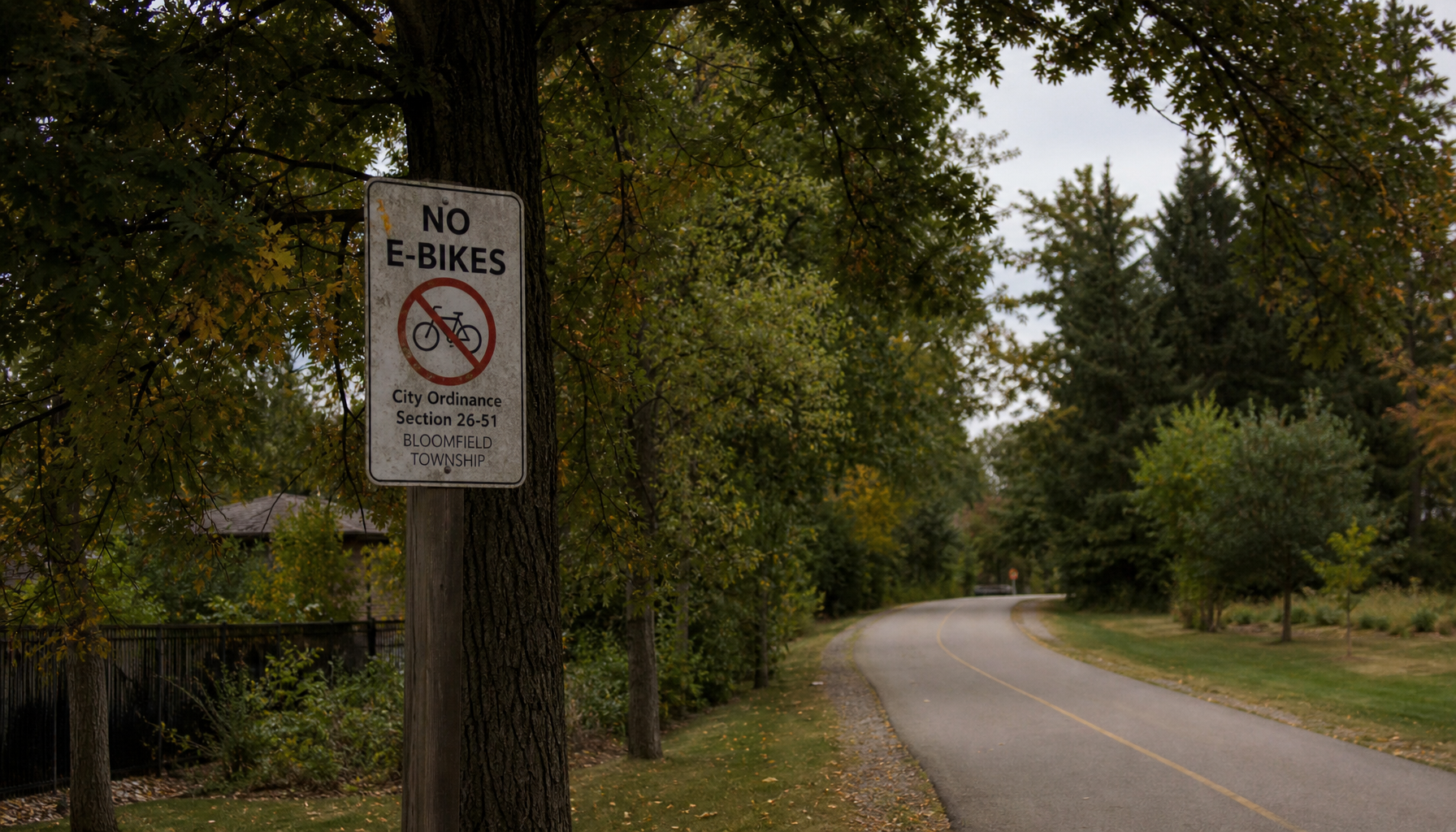
Bloomfield Township recently passed an ordinance banning e-bikes from its parks, trails, and non-motorized paths. If you ride in the area — or if you’ve already been hurt on one of those trails — this change matters more than you might think. Michigan law treats e-bikes differently depending on where they’re ridden and what class they are, and those details directly affect what happens if you’re in a crash.
As reported by FOX 2 Detroit, the township’s decision sparked real debate among residents and recreational cyclists who rely on those paths. The ban applies to all classes of e-bikes on township-owned non-motorized trails — not just the faster Class 3 models that can hit 28 mph.
What the Bloomfield Township E-Bike Ban Actually Says
The ordinance removes e-bikes from the same trails where traditional bicycles are still welcome. That distinction is important. A conventional bike and a Class 1 e-bike (pedal-assist only, max 20 mph) may feel nearly identical to ride, but Bloomfield Township has decided the motor — even a small one — changes the equation for shared trail safety.
Violations can result in a civil fine. The township has authority to enforce this under Michigan’s Home Rule City Act and general municipal police powers. If you’re caught riding an e-bike on a restricted trail, you could face a ticket — and if you cause a crash while doing so, the fact that you were breaking a local ordinance will almost certainly be used against you in any injury claim.
What Counts as an E-Bike Under Michigan Law
Michigan defines electric bicycles in three classes under MCL 257.13b:
- Class 1: Pedal-assist only, no throttle, motor cuts off at 20 mph
- Class 2: Throttle-assisted, motor cuts off at 20 mph
- Class 3: Pedal-assist only, no throttle, motor cuts off at 28 mph
All three are banned from Bloomfield Township’s non-motorized paths under the new ordinance. Statewide, Class 1 and Class 2 e-bikes are generally treated like regular bicycles on most trails — but local governments have the right to restrict them further, which is exactly what Bloomfield Township has done.
Why This Ban Has Real Legal Consequences
The ban isn’t just a safety policy. It creates legal exposure for riders who don’t follow it — and it changes the injury picture for anyone hurt on those trails.
If You’re Riding an E-Bike and Cause a Crash
Michigan follows a modified comparative fault system. If you were riding your e-bike somewhere it was legally prohibited, an insurance adjuster or opposing attorney will argue that your illegal presence on that trail contributed to the crash. Under MCL 600.2959, a plaintiff who is more than 50% at fault for their own injuries cannot recover non-economic damages at all. Even if you’re only found 30% at fault, your damages are reduced by that percentage.
That’s not a small detail. It’s the difference between a full recovery and a partial one.
If You’re Hit by an E-Bike on a Restricted Trail
If someone else was riding an e-bike illegally on a Bloomfield Township trail and struck you — as a pedestrian, a traditional cyclist, or even another e-bike rider — their violation of the local ordinance strengthens your claim. It’s evidence of negligence. It doesn’t guarantee you win, but it puts the rider who broke the rule in a much harder position to defend.
According to the National Highway Traffic Safety Administration (NHTSA), micromobility injuries — including e-bike crashes — have increased sharply in recent years. NHTSA reported over 2,000 micromobility fatalities between 2017 and 2021, with e-bike-involved incidents rising each year.
Michigan’s No-Fault System and E-Bikes
Here’s where things get complicated — and where a lot of riders get caught off guard.
Michigan’s no-fault auto insurance law (MCL 500.3101 et seq.) covers motor vehicles. Whether an e-bike qualifies as a motor vehicle under that statute depends on its class and how it’s being used. In most cases, e-bikes do not qualify as motor vehicles under Michigan no-fault, which means:
- Your auto insurance PIP coverage (MCL 500.3107) typically won’t pay your medical bills if you’re hurt solely in an e-bike crash with no car involved
- You may need to pursue the at-fault party directly through a negligence claim
- If a car hits you while you’re on an e-bike, the driver’s no-fault coverage almost certainly does apply — and that’s where most serious e-bike injury cases end up
If you’ve been injured on an e-bike in the Detroit metro area, the piece on what to do after an e-bike injury in Metro Detroit walks through the specific steps to take right after the crash.
The Statute of Limitations Clock Is Already Running
Most personal injury claims in Michigan have a three-year window under MCL 600.5805(2). That sounds like a lot of time. It isn’t. Evidence gets lost. Witnesses move. Trail camera footage gets overwritten. If you were hurt in an e-bike crash on a Bloomfield Township trail — before or after this ban — the time to act is now, not six months from now.
For injuries involving government-owned property or township negligence (say, a poorly maintained trail surface that contributed to your fall), Michigan’s notice requirements under the Government Tort Liability Act add another layer. You may have as little as 120 days to file a notice of intent before your right to sue is barred entirely.
What Riders Should Do Right Now
If you ride in Bloomfield Township — or in any Oakland County community that may follow with similar rules — here’s what makes sense:
- Know where the ban applies. Check the township’s website or call the parks department before you ride. Ignorance of a local ordinance isn’t a legal defense.
- Know your e-bike’s class. Check your owner’s manual or the sticker on the frame. Class matters for both legal compliance and insurance purposes.
- Carry identification and document your rides. If there’s ever an incident, you want a record of where you were and when.
- Check your homeowner’s or renter’s insurance. Some policies extend liability coverage to e-bike incidents. Others don’t. Find out now.
- Don’t give a recorded statement after a crash without talking to an attorney first. This applies whether you’re the injured party or whether someone is claiming you caused the crash.
For a broader look at where e-bike and bicycle crashes are happening across Michigan, the 2025 Sterling Heights bicycle safety report has useful local crash data worth reviewing.
What About Other Oakland County Communities?
Bloomfield Township’s ban may not stay isolated. Several neighboring communities — including Troy, Clawson, and Beverly Hills — have been watching how residents and riders respond. If local opposition is muted, other townships may pass similar restrictions.
Troy already has bike lanes along sections of Big Beaver and Rochester Roads, and its approach to e-bike regulation on those lanes is still evolving. If you ride in that area, check the bike lane accident resources for Troy for current information on how those roads are treated under Michigan law.
Parents riding with children, commuters, and seniors who use e-bikes for mobility should all pay close attention. The people most affected by a blanket ban often aren’t the fast Class 3 riders — they’re the 65-year-old using a Class 1 e-bike because it’s the only way they can still ride with their grandchildren.
Frequently Asked Questions
Can I still ride a regular bicycle on Bloomfield Township trails after the ban?
Yes. The ban applies specifically to electric bicycles — all three classes. Traditional pedal-only bikes remain permitted on township non-motorized paths. If there’s any doubt about whether a specific trail is covered, contact Bloomfield Township’s parks and recreation department directly before you ride.
What happens if I’m injured on a Bloomfield Township trail by someone riding an e-bike illegally?
The rider’s violation of the local ordinance is evidence of negligence. It doesn’t automatically decide your case, but it gives you a meaningful advantage. You can pursue a negligence claim against that rider for your medical costs, lost wages, and pain and suffering. Document everything at the scene — photos, witness contact information, and any trail signage showing e-bikes are prohibited.
Does Michigan no-fault insurance cover e-bike injuries?
Generally, no — not if no motor vehicle is involved. E-bikes typically fall outside the definition of a motor vehicle under Michigan’s no-fault act. If a car hits you while you’re on an e-bike, the car driver’s no-fault insurance does apply, and you may be entitled to PIP benefits and the right to sue for non-economic damages if your injuries meet the threshold under MCL 500.3135.
How long do I have to file a lawsuit after an e-bike crash in Michigan?
The general deadline is three years from the date of the crash under MCL 600.5805(2). But if the crash involved a government entity — like an injury caused by a poorly maintained township trail — you may need to file a notice of claim within 120 days. Missing that deadline can end your case entirely. Don’t wait.
If I was riding my e-bike illegally on a restricted trail and got hurt, do I still have a claim?
Possibly. Your illegal presence on the trail doesn’t automatically extinguish your right to recover — especially if another party was also negligent. Michigan’s comparative fault rules mean your damages may be reduced based on your percentage of fault, but you aren’t automatically barred from recovery unless you’re found more than 50% responsible. Talk to an attorney before assuming you have no case.
Is Bloomfield Township’s ban likely to spread to other Michigan communities?
It’s plausible. Local governments in Michigan have broad authority to regulate e-bikes on public property beyond what state law requires. As e-bike use increases across Oakland County and the broader metro area, more townships will face pressure to address trail conflicts between e-bike riders and pedestrians. Watching how Bloomfield Township enforces its new ordinance will likely shape what neighboring communities decide to do.
If you’ve been hurt in an e-bike crash — or ticketed under a local ordinance you didn’t know existed — talk to us before you sign anything or make a recorded statement. Khamo Law, PLLC offers a free consultation. Call 248-466-0606 or reach us through the contact form on our site. We serve Bloomfield Township, Oakland County, and the broader Metro Detroit area. Our team includes Arabic and Chaldean-speaking attorneys who can walk through your situation in the language that’s clearest for you.