










A Southfield bicycle accident attorney at Khamo Law can investigate how a crash occurred and preserve important evidence. Our team can also identify applicable insurance coverage, respond to disputed-fault allegations, document serious injuries and financial losses, and pursue compensation when Michigan law and the evidence support a claim.
Bicyclists have little physical protection when struck by cars, SUVs, commercial trucks, or other motor vehicles. A collision can result in traumatic brain injuries, spinal injuries, broken bones, facial injuries, road rash, permanent impairment, or fatal injuries.
Khamo Law represents injured bicyclists in Southfield, Oakland County, and throughout Metro Detroit.
For broader injury representation involving negligence in the city, visit our Southfield Personal Injury Attorney page. For statewide information about Michigan bicycle laws, insurance issues, and bicycle accident claims, visit our Michigan Bicycle Accident Lawyer resource.
Call 248-466-0606 or contact Khamo Law online for a free consultation.
Legally reviewed by Attorney Koro E. Khamo, Founder & Managing Attorney at Khamo Law.
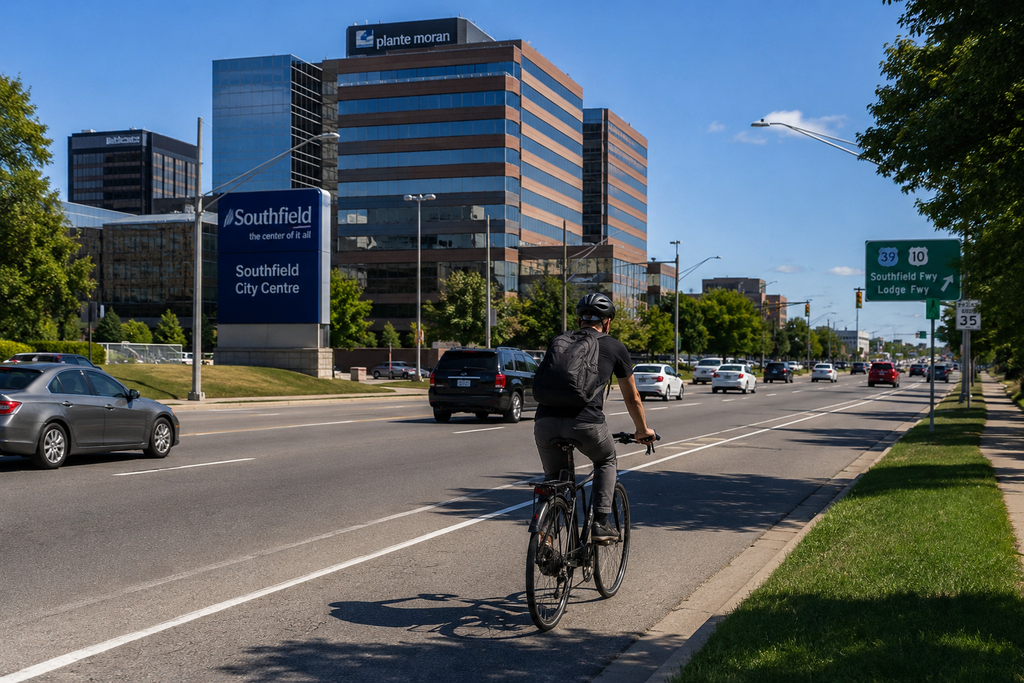
Bicycle Accidents in Southfield, Michigan
Southfield has a transportation network that combines major freeways, high-volume arterial roads, commercial districts, residential neighborhoods, office developments, sidewalks, trails, and non-motorized routes.
Major transportation corridors in and around Southfield include I-696, M-39/Southfield Freeway, US-10/Lodge Freeway, Telegraph Road/US-24, Eight Mile Road/M-102, Northwestern Highway, Evergreen Road, Greenfield Road, Lahser Road, Nine Mile Road, Ten Mile Road, Eleven Mile Road, and Twelve Mile Road.
The City of Southfield also maintains planning resources specifically devoted to non-motorized transportation and transit, including pathway maps, trail resources, the City Centre trail system, and ongoing non-motorized planning. Southfield’s City Centre district also offers a bike-share program.
That local transportation environment matters after a bicycle collision because the available evidence can differ depending on whether a crash happened at a signalized intersection, driveway, commercial entrance, neighborhood road, shared-use path, parking area, or major arterial.
A Southfield bicycle accident investigation may examine roadway configuration, traffic controls, bicycle infrastructure, vehicle speed, sight distance, surrounding businesses, nearby cameras, construction conditions, and the movements of both the cyclist and driver.
How Can a Southfield Bicycle Accident Lawyer Help?
Bicycle accident cases frequently involve disagreements about who had the right of way, whether a motorist saw the cyclist, whether the cyclist was visible, where the bicycle was positioned, and how much time each person had to react.
Khamo Law can investigate issues such as the accident location, police reports, photographs, video, witnesses, vehicle and bicycle damage, traffic-control information, insurance coverage, medical treatment, lost income, future care needs, and allegations that the cyclist contributed to the collision.
Depending on the circumstances, a bicycle accident lawyer may also seek surveillance footage, dashcam recordings, electronic vehicle data, cellphone-related evidence when legally obtainable, roadway records, or qualified accident-reconstruction analysis.
Bicycle and vehicle evidence can change or disappear. Damaged bicycles may be repaired or discarded, vehicles may be fixed, witnesses may become harder to locate, and businesses may overwrite surveillance footage. Prompt preservation can therefore become important.
Common Causes of Southfield Bicycle Accidents
Bicycle collisions may result from distracted driving, speeding, failure to yield, unsafe left turns, unsafe right turns, dangerous lane changes, failure to check blind spots, following too closely, impaired driving, opening a vehicle door into a cyclist’s path, backing from a driveway or parking space, failing to provide adequate passing distance, or other negligent driving.
The cause should be determined from the evidence rather than assumed simply because one person was driving a vehicle and the other was riding a bicycle.
Bicycle Accidents at Southfield Intersections
Intersections create several potential conflict points between bicyclists and motor vehicles.
A driver may turn left across the path of an approaching cyclist, turn right without checking for a bicycle traveling alongside the vehicle, fail to yield at an intersection, disregard a traffic signal, or enter an intersection without properly observing surrounding traffic.
Important evidence may include traffic signals, lane markings, photographs, surveillance footage, dashcams, witnesses, vehicle damage, bicycle damage, and electronic vehicle information.
Southfield’s combination of major commercial corridors and neighborhood streets makes the exact crash location particularly important when evaluating what happened.
Left-Turn Bicycle Accidents
A serious bicycle collision can occur when a driver turns left in front of an approaching cyclist.
These cases may involve questions about the cyclist’s speed, driver visibility, traffic signals, distance between the bicycle and vehicle, whether the driver adequately observed approaching traffic, and whether the driver had enough time to safely complete the turn.
A driver’s statement that they “didn’t see” the cyclist does not, by itself, determine who was legally responsible.
Video and physical evidence can be particularly useful when the cyclist and driver give different accounts.
Right-Turn Bicycle Accidents
A right-turn collision can occur when a driver passes or travels beside a bicyclist and then turns across the cyclist’s path.
An investigation may examine whether the driver checked mirrors and blind spots, properly signaled, overtook the cyclist immediately before turning, yielded when required, or misjudged the cyclist’s position or speed.
The roadway design can also matter, particularly where driveways, sidewalks, bicycle facilities, commercial entrances, or intersections bring cyclists and turning vehicles together.
Michigan’s Safe-Passing Rule for Bicyclists
Michigan law generally requires a motorist overtaking a bicyclist traveling in the same direction to pass at a safe distance of at least three feet when practicable. Michigan law also addresses circumstances in which a driver may safely pass a bicycle in a no-passing zone.
Whether a motorist passed safely should be evaluated using the circumstances surrounding the actual collision.
Potential factors include vehicle speed, traffic conditions, lane width, available passing space, approaching traffic, roadway configuration, and the distance between the vehicle and bicyclist.
For a deeper statewide explanation of Michigan bicycle law, visit our Michigan Bicycle Accident Lawyer page.
Can Bicyclists Ride on Michigan Roads?
Generally, bicyclists may legally use Michigan roadways other than limited-access freeways and are subject to many of the same traffic rules as motorists. Michigan law also contains bicycle-specific requirements concerning roadway position, signals, equipment, sidewalks, and interaction with pedestrians.
A cyclist is therefore not automatically at fault merely because the collision occurred in the roadway.
The correct analysis depends on where the bicyclist was riding, what the driver was doing, applicable traffic controls, and the circumstances immediately before the crash.
Bicycle Accidents on Sidewalks and Crossings
Michigan generally permits bicycle operation on sidewalks unless prohibited by an official traffic-control device, although cyclists using sidewalks have specific duties toward pedestrians.
A crash near a sidewalk, driveway, parking-lot entrance, trail crossing, or intersection may require determining exactly where the cyclist was traveling and what traffic controls applied.
Photographs of the area can be especially important because construction, vegetation, markings, signs, or other physical conditions may later change.
Southfield’s Non-Motorized Transportation Network
Southfield has spent years developing non-motorized transportation planning intended to improve bicycle and pedestrian connections between neighborhoods, business areas, public destinations, trails, and transit.
The City’s current non-motorized resources include pathway and trail maps, the City Centre trail network, the 9-Line Trail, and planning materials for pedestrian and bicycle connectivity. Southfield has also implemented a bike-share program within the City Centre district.
This is useful local context in a bicycle accident case because Southfield cyclists may interact with vehicles in several different environments—not only traditional road lanes.
The physical design at the actual location should be investigated rather than assuming every bicycle collision occurred under the same conditions.
Bicycle Accidents Involving Commercial Trucks
Commercial trucks create additional risks for bicyclists because of their size, turning requirements, stopping distance, and areas around the vehicle that may be difficult for a driver to observe.
A bicycle-truck collision may involve additional evidence, including driver qualification records, electronic logging information, maintenance records, commercial insurance, company records, vehicle data, and applicable federal safety regulations.
For truck-specific claims, visit our Southfield Truck Accident Lawyer page.
Hit-and-Run Bicycle Accidents
When a driver strikes a bicyclist and leaves the scene, identifying the vehicle can become an immediate priority.
Potential evidence may include surveillance footage, dashcam recordings, witnesses, vehicle debris, partial license-plate information, photographs, police investigation, or nearby business cameras.
Applicable insurance coverage should also be investigated if the driver cannot be identified.
For statewide information about these claims, visit our Michigan Hit-and-Run Accident Lawyer resource.
Dooring Bicycle Accidents
A “dooring” accident occurs when a vehicle occupant opens a door into the path of an approaching cyclist.
The cyclist may strike the open door, be thrown from the bicycle, swerve into moving traffic, or suffer a secondary impact with the roadway or another vehicle.
Potential evidence may include the location of the vehicle, bicycle damage, photographs, witnesses, video, and the position of the opened door.
Common Bicycle Accident Injuries
Because bicyclists do not have the protective structure of an enclosed passenger vehicle, bicycle crashes can cause severe injuries.
Potential injuries include concussions, traumatic brain injuries, spinal cord injuries, neck and back injuries, broken arms and legs, wrist fractures, shoulder injuries, knee injuries, facial and dental injuries, internal injuries, nerve damage, road rash, scarring, disfigurement, amputations, and permanent impairment.
For serious head injuries, visit our Southfield Brain Injury Attorney page.
For catastrophic spinal trauma, visit our Southfield Spinal Cord Injury Attorney page.
Michigan No-Fault Insurance After a Bicycle Accident
A bicyclist injured in a collision involving a motor vehicle may have rights under Michigan’s No-Fault insurance system.
Depending on the circumstances, applicable insurance and statutory priority rules, potential PIP benefits may involve qualifying medical expenses, rehabilitation, wage loss, replacement services, and other benefits allowed by Michigan law.
The correct insurer cannot always be determined simply by asking whether the cyclist personally had auto insurance.
For the statewide insurance framework, visit our Michigan No-Fault Insurance Lawyer resource.
Can an Injured Bicyclist Sue the Driver?
Potentially.
When negligent driving causes a bicycle collision, Michigan law may permit a liability claim against the responsible motorist or another legally responsible party.
For noneconomic damages arising from a motor-vehicle collision, Michigan law generally requires the applicable statutory automobile-injury threshold to be satisfied.
The analysis depends on the injuries, medical evidence, how the collision occurred, insurance issues, and other facts of the individual case.
What If the Driver Says the Bicyclist Was at Fault?
Drivers and insurance companies may allege that a cyclist was riding improperly, entered traffic unexpectedly, disregarded a signal, was difficult to see, failed to use required equipment, or otherwise contributed to the crash.
Those allegations should be tested against the evidence and applicable Michigan law.
Michigan’s comparative-fault rules can affect certain damages when an injured person shares responsibility for an accident, but fault should not be assigned merely because the injured person was riding a bicycle.
Evidence such as video, witnesses, traffic controls, roadway markings, vehicle speed, bicycle location, visibility, and physical damage may help determine what occurred.
Does Not Wearing a Helmet Mean the Cyclist Caused the Crash?
No.
Helmet use and responsibility for causing a collision are separate issues.
Whether a motorist failed to yield, turned into a cyclist, passed unsafely, opened a door into the cyclist’s path, or otherwise caused the collision should be evaluated independently from helmet use.
Depending on the injuries and circumstances, helmet-related arguments may arise during a damages analysis, but helmet use does not automatically determine who caused the accident.
What Evidence Can Help a Southfield Bicycle Accident Claim?
Important evidence can include police reports, photographs, bicycle damage, vehicle damage, surveillance footage, dashcam recordings, witness statements, traffic-control information, road markings, electronic vehicle data, cellphone evidence when relevant and legally obtainable, medical records, employment records, damaged riding equipment, and qualified accident-reconstruction evidence.
The bicycle itself can contain valuable evidence.
Before repairing, selling, or discarding a seriously damaged bicycle, consider whether it should first be preserved for inspection.
What Should I Do After a Bicycle Accident in Southfield?
Your immediate health and safety should come first.
When circumstances permit, report the crash, seek appropriate medical attention, photograph the scene, photograph the bicycle and involved vehicles, obtain witness information, identify nearby cameras, preserve the bicycle and damaged equipment, keep medical records and bills, document missed work, and save insurance correspondence.
Do not delay necessary medical treatment merely to gather evidence.
Before signing a settlement or release that you do not understand, consider obtaining advice about what rights may be affected.
Who May Be Responsible for a Bicycle Accident?
The responsible party depends on how the collision happened.
Potential defendants can include a negligent driver, vehicle owner in appropriate circumstances, commercial driver, trucking company, employer, or another person or company whose legally actionable conduct contributed to the crash.
Claims involving roadway conditions or governmental entities can involve different legal standards, governmental-immunity issues, or procedural requirements.
The investigation should identify responsible parties from the actual evidence rather than assuming liability based only on the type of accident.
What Compensation May Be Available?
Depending on Michigan law, insurance coverage, liability and the injuries involved, recoverable losses or insurance benefits may include medical expenses, rehabilitation, future treatment, lost income, reduced earning capacity, pain and suffering when legally recoverable, disability, scarring, disfigurement, loss of normal activities, damage to the bicycle and related property, and other legally recoverable losses.
No particular category or amount of recovery is guaranteed.
What Is a Southfield Bicycle Accident Case Worth?
There is no reliable “average” bicycle accident settlement.
Potential case value may depend on how the collision occurred, strength of liability evidence, severity of the injuries, medical treatment, surgery, permanent impairment, scarring, future medical needs, lost income, reduced earning capacity, comparative fault, and available insurance coverage.
A short-term injury and a catastrophic bicycle accident involving permanent neurological impairment are fundamentally different claims.
The case should be evaluated from its actual evidence rather than online settlement averages.
How Long Do I Have to File a Bicycle Accident Claim in Michigan?
Different legal and insurance claims arising from the same bicycle accident can have different deadlines.
Michigan generally applies a three-year limitations period to many personal-injury actions, subject to statutory exceptions. No-Fault benefits, governmental claims, insurance-policy requirements, and other claims can involve separate deadlines or procedures.
An injured cyclist should therefore not assume that every part of a claim can safely wait until the general personal-injury deadline approaches.
Fatal Bicycle Accidents in Southfield
Some bicycle collisions cause fatal injuries.
When legally actionable conduct causes a cyclist’s death, Michigan wrongful-death law may apply in addition to the underlying bicycle and motor-vehicle issues.
A fatal bicycle accident investigation may involve police reports, surveillance footage, witnesses, bicycle and vehicle evidence, electronic data, insurance coverage, medical records, and estate procedures.
Families can visit our Southfield Wrongful Death Attorney page for additional information.
Bicycle Accident vs. Pedestrian Accident Claims
Bicyclists and pedestrians are both vulnerable road users, but different traffic rules can apply depending on whether the injured person was riding a bicycle or walking.
If the injured person was a pedestrian rather than a cyclist, visit our Southfield Pedestrian Accident Attorney page.
Bicycle Accident vs. Car Accident Claims
A bicycle collision involving a motor vehicle can involve many of the same negligence and insurance issues as an automobile crash.
However, bicycle cases can raise additional questions concerning roadway position, passing distance, bicycle facilities, visibility and vulnerable-road-user injuries.
For broader automobile-claim information, visit our Southfield Car Accident Attorney page.
Southfield Bicycle Accident FAQs
Can I have a case if I was riding outside a bicycle lane?
Potentially. The existence or absence of a bicycle lane does not automatically determine fault. Michigan law contains specific rules governing bicycle operation, and the roadway and circumstances of the collision must be evaluated.
Can I have a claim if I was riding on a sidewalk?
Potentially. Michigan generally permits bicycle operation on sidewalks unless prohibited by an official traffic-control device, subject to bicycle-specific duties. The precise location and circumstances matter.
What if the driver says they did not see me?
A driver’s failure to see a bicyclist does not automatically determine liability. Driver attention, visibility, roadway configuration, speed, lighting, traffic controls, cyclist position and other evidence should be investigated.
How much space must a Michigan driver leave when passing a bicycle?
Michigan generally requires motorists overtaking a bicyclist to provide a safe passing distance of at least three feet when practicable.
Can I receive Michigan No-Fault benefits if I was riding a bicycle?
Potentially. A bicyclist injured in a collision involving a motor vehicle may have rights to PIP benefits depending on the facts, available insurance and Michigan priority rules.
What if the driver fled?
Report the collision promptly. Surveillance video, dashcams, witnesses, vehicle debris, plate information and applicable insurance can become especially important.
What if a commercial truck hit me?
Visit our Southfield Truck Accident Lawyer page for truck-specific liability and evidence issues.
What if I suffered a traumatic brain injury?
Visit our Southfield Brain Injury Attorney page.
What if I suffered a spinal cord injury?
Visit our Southfield Spinal Cord Injury Attorney page.
What if my family member was killed?
Visit our Southfield Wrongful Death Attorney page.
How much does Khamo Law charge for a consultation?
Khamo Law offers free consultations for potential bicycle-accident cases.
Why Choose Khamo Law After a Southfield Bicycle Accident?
A bicycle accident claim can involve several questions at once.
How did the collision happen?
The driver’s conduct, cyclist’s movement, traffic controls, roadway design, visibility and available evidence should be investigated.
What evidence exists?
Surveillance footage, witnesses, bicycle damage, vehicle damage, police reports and electronic information may matter.
What insurance applies?
Michigan No-Fault benefits, liability insurance and other applicable coverage may need to be evaluated.
Is the cyclist being blamed?
Comparative-fault allegations should be tested against Michigan bicycle law and the actual evidence.
How serious are the injuries?
Medical treatment, rehabilitation, missed work, permanent impairment and future care should be documented.
Khamo Law can investigate the collision, preserve available evidence, evaluate insurance coverage, document medical and financial losses, communicate with insurers, and pursue litigation when appropriate.
Services are available in English, Arabic, and Chaldean.
Call 248-466-0606 for a free consultation.
Speak With a Southfield Bicycle Accident Attorney
If you or a family member was injured while riding a bicycle in Southfield, Khamo Law can investigate how the collision happened, preserve important evidence, evaluate insurance coverage, address disputed-fault allegations, document serious injuries and financial losses, and explain the legal options supported by Michigan law and the facts.
For broader injury representation in Southfield, visit our Southfield Personal Injury Attorney page.
For statewide bicycle law and insurance information, visit our Michigan Bicycle Accident Lawyer resource.
Call 248-466-0606 or contact Khamo Law online for a free consultation.